| Author |
 Replies: 54 / Views: 7,133 Replies: 54 / Views: 7,133 |
|
Pillar Of The Community
Israel
4904 Posts |
|
|
Charles Darwin (1809–1882) was a British naturalist whose work transformed the biological sciences by introducing a coherent explanation for the diversity of life. His most influential contribution was the theory of evolution by natural selection, first presented comprehensively in On the Origin of Species (1859). Drawing on evidence from his voyage aboard HMS Beagle (1831–1836) as well as subsequent decades of research, Darwin proposed that populations of organisms vary naturally, and that individuals with heritable traits conferring advantages in survival and reproduction are more likely to leave offspring. Over many generations, this differential reproductive success alters the composition of populations, leading to adaptation and, ultimately, the emergence of new species. Darwin's theory provided a unifying framework that explained both the unity and diversity of living organisms, challenged prevailing static views of nature, and laid the foundation for modern fields such as genetics, ecology, and evolutionary developmental biology. Despite initial controversy, Darwin's ideas—refined and expanded with advances in genetics and molecular biology—remain central to our understanding of life's complexity and interconnectedness. Please share your stamps and items about Charles Darwin, his life, research and his theory of evolution.  |
|
Send note to Staff
|
|
|
|
|
Pillar Of The Community
Israel
4904 Posts |
|
|
A very nice and attractive design of Charles Darwin on engraved stamp, designed by Stanislaw Czeslaw Chludzinski, engraved by Eugeniusz Tirdiszek and issued by Poland on December 10, 1959. 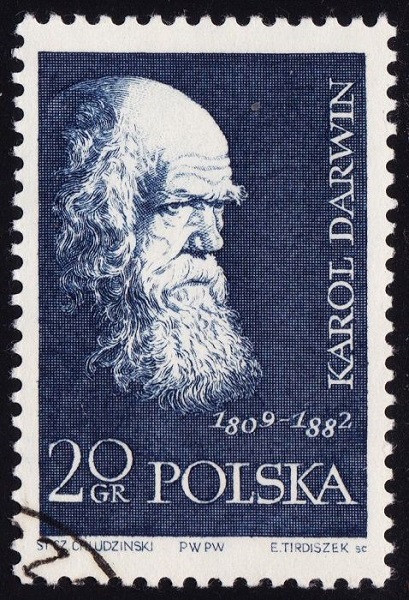 |
Send note to Staff 
|
|
|
Pillar Of The Community
Israel
4904 Posts |
|
|
From 1831 to 1836, Charles Darwin sailed around the world aboard HMS Beagle as a naturalist. His observations of geology, fossils, and especially the unique animals of the Galapagos Islands led him to question the fixity of species and laid the groundwork for his theory of evolution by natural selection. This stamp, issued by India in 1983, features Darwin and a map showing the voyage of HMS Beagle (1831–1836) and a Galapagos iguana symbolizing the observations that inspired his ideas on natural selection. 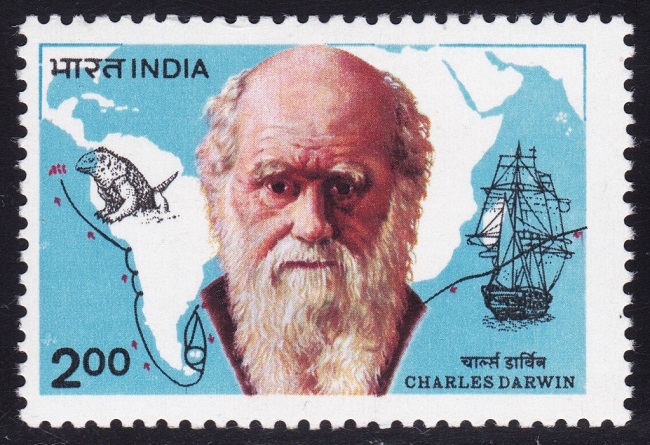 |
|
Send note to Staff
|
|
|
Pillar Of The Community
Israel
4904 Posts |
|
|
A set commemorates the centenary of Darwin's death was issued by GB in 1982. The stamps highlight the key observations that shaped Darwin theory of evolution by natural selection. During his voyage on HMS Beagle, Darwin studied the giant tortoises, iguanas, and finches of the Galapagos Islands, each demonstrating how species adapt to their unique environments. His later work extended these ideas to humanity itself, proposing that humans share a common ancestry with other primates. Galapagos Tortoises Darwin's observations of the giant tortoises of the Galapagos Islands revealed striking differences between populations on different islands. These variations helped him develop the idea that species are not fixed but adapt to their environments over time, a central pillar of his theory of evolution by natural selection. 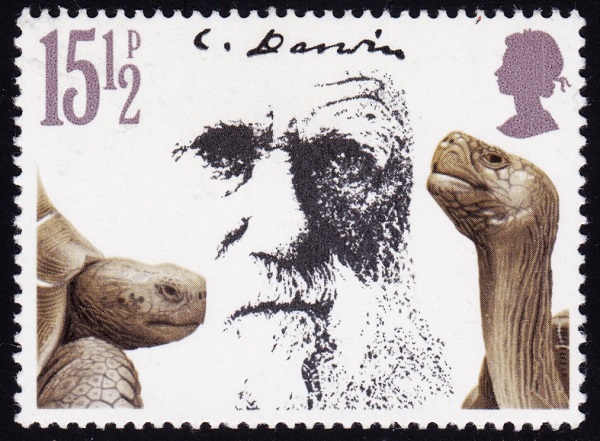 Galapagos Iguanas During his voyage on HMS Beagle (1831–1836), Darwin studied the unique iguanas of the Galápagos Islands, the land iguana and the marine iguana, the only lizard adapted to life in the sea. Their distinctive adaptations provided important evidence for Darwin's concept of species changing to fit their environments. 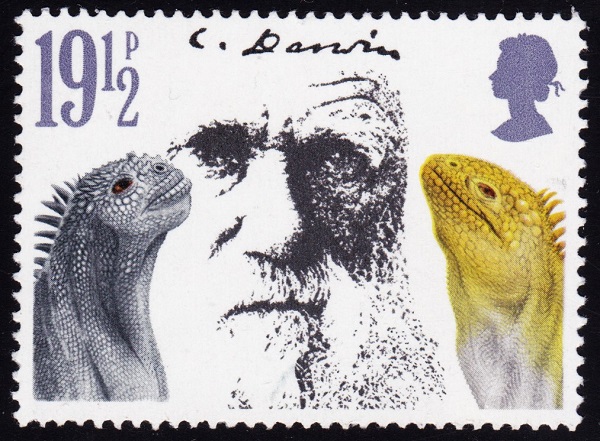 Darwin's Finches The Galapagos finches, with their diverse beak shapes adapted to different diets, became one of the most iconic examples of adaptive radiation. These birds offered Darwin compelling evidence that species diversify through natural selection, adapting to ecological niches over time. 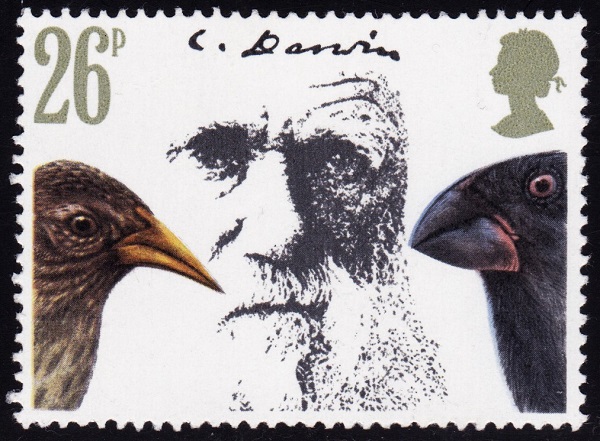 Human Skulls This design symbolizes Darwin's revolutionary insights into human origins. In The Descent of Man (1871), he argued that humans share a common ancestry with other primates, a claim that challenged Victorian beliefs but became a foundation of modern anthropology and evolutionary biology. 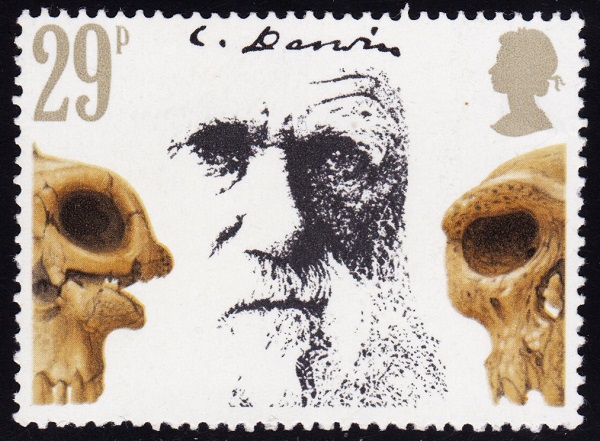 |
|
Send note to Staff
|
|
|
Pillar Of The Community
France
2942 Posts |
|
|
A Soviet stamp from 1959 150th birth anniversary of Charles Darwin (Michel # 2195) 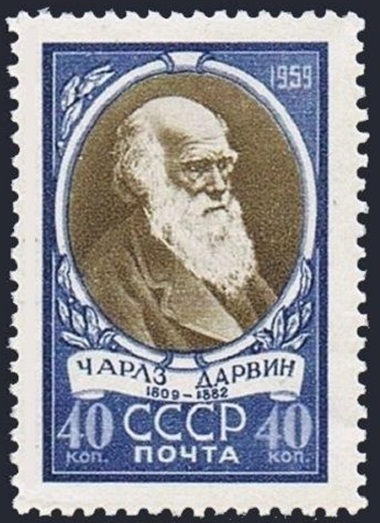 |
|
Send note to Staff
|
|
|
Pillar Of The Community
France
2942 Posts |
|
|
Pillar Of The Community
Israel
4904 Posts |
|
|
Nice, Vyolene, especially the last engraved stamp from Czech Republic  Postal stationary issued by DDR. The scheme is Darwin's evolutionary "Tree of Life" sketch, drawn in 1837. the scheme, Darwin diagrammed how species might branch from common ancestors, diverging over time. This sketch represents the first visual expression of Darwin's idea that all living organisms are related through descent with modification. The concept of a branching evolutionary tree became central to Darwin's theory of evolution by natural selection. 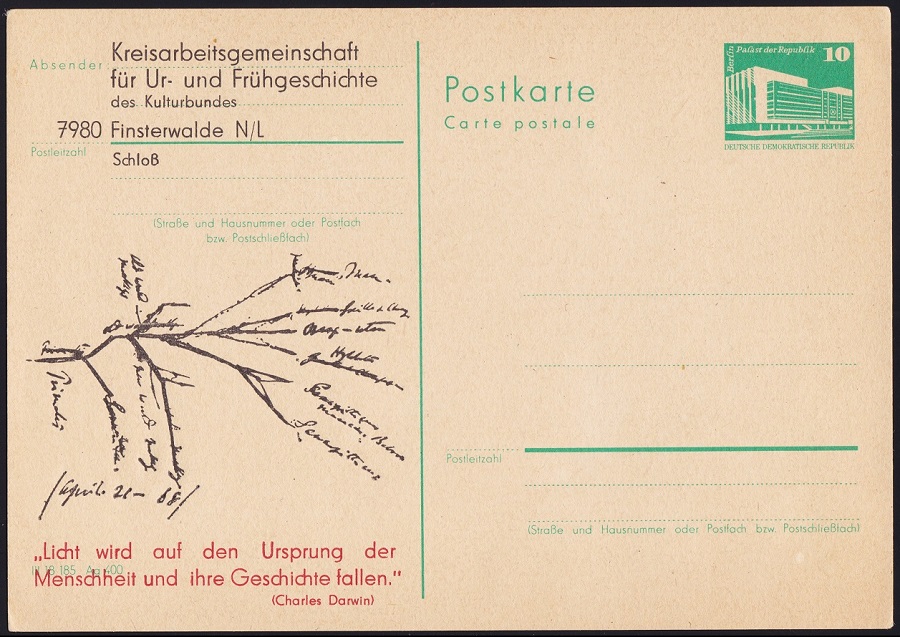 On the left bottom Darwin's phrase reads: "Licht wird auf den Ursprung der Menschheit und ihre Geschichte fallen" means: "Light will be thrown on the origin of man and his history." This is a famous phrase from the "On the Origin of Species (1859)", where Darwin hinted at applying evolutionary theory to humans. Same "Tree of Life" scheme on 2009 stamp from Cuba issued to commemorate the 200th anniversary of Darwin's birth and the 150th anniversary of the publication of "On the Origin of Species". 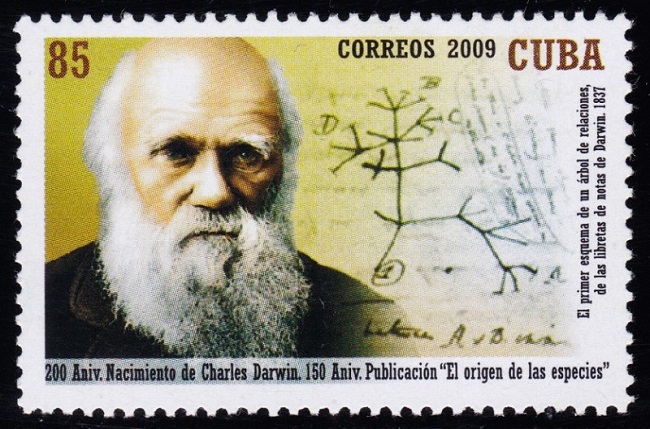 |
|
Send note to Staff
|
|
|
Valued Member
United States
305 Posts |
|
|
A few misconceptions I should try and clear up: Darwin's aha moment was the variation among mockingbirds, not finches nor tortoises. The warden of the penal colony (Galapagos was Ecuador's Siberia) mentioned the tortoises. The finches were noted by Gould, an ornithologist, as possible supporting evidence, but only became famously associated with Darwin a century later.
The aha moment was recognition of the limits of Humboldt's theory about the distribution of species around the world (full disclosure: I am working on a topical collection on Humboldt, and also an article about Darwin).
|
|
Send note to Staff
|
|
|
Pillar Of The Community
Israel
4904 Posts |
|
|
Quote:
A few misconceptions I should try and clear up: Darwin's aha moment was the variation among mockingbirds, not finches nor tortoises. The warden of the penal colony (Galapagos was Ecuador's Siberia) mentioned the tortoises. The finches were noted by Gould, an ornithologist, as possible supporting evidence, but only became famously associated with Darwin a century later.
The aha moment was recognition of the limits of Humboldt's theory about the distribution of species around the world (full disclosure: I am working on a topical collection on Humboldt, and also an article about Darwin). Greaden, Thank you very much for your information. I didn't know that Darwin studied mockingbirds before finches, and that his observations of mockingbirds actually preceded and inspired his famous finch studies, sparking his evolutionary thinking. I just checked my album and found that I don't have a single stamp showing Darwin with a mockingbird. When searching in Google Images, I only came across one stamp from Mozambique while most of the stamps depict Darwin and finches. Regarding Humboldt's theory, I intended to write about it in the future and also show several stamps I keep in my collection. Don't expect any surprises! |
|
Send note to Staff
|
|
|
Valued Member
Australia
178 Posts |
|
|
Thanks Greaden for the information about the mockingbirds and Darwin. I wasn't aware of it and I have taught biology at secondary school level for many years. It looks like the UK did acknowledge Darwin and a Floreana mockingbird in a stamp on a minisheet from 2009. (Bottom Right Corner) 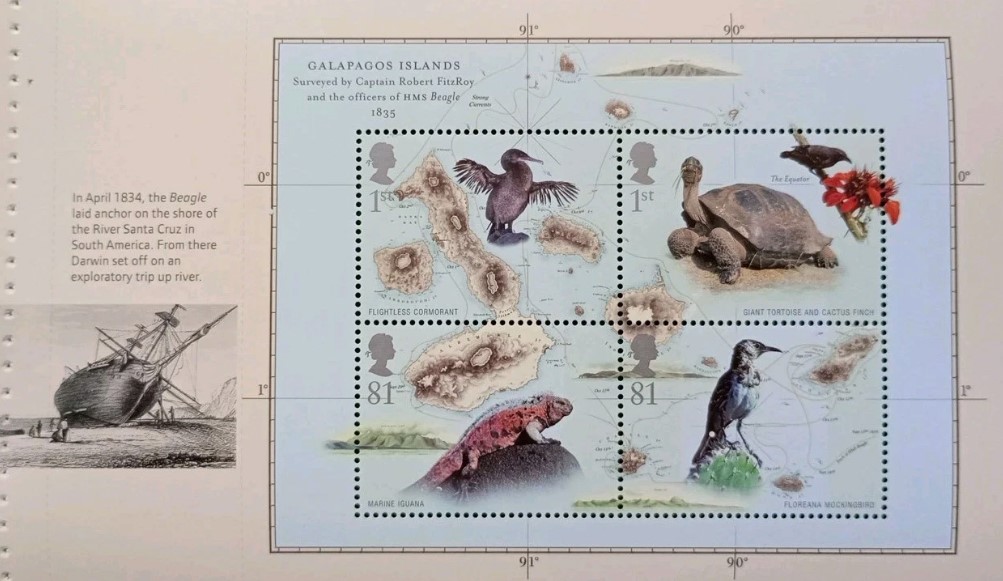 |
|
Send note to Staff
|
| Edited by StevieG - 09/06/2025 08:22 am |
|
|
Pillar Of The Community
Israel
4904 Posts |
|
|
Pillar Of The Community
France
2942 Posts |
|
|
Birth bicentenary of Charles Darwin (year 2009) Stamps from North Macedonia and from Bosnia & Herzegovina 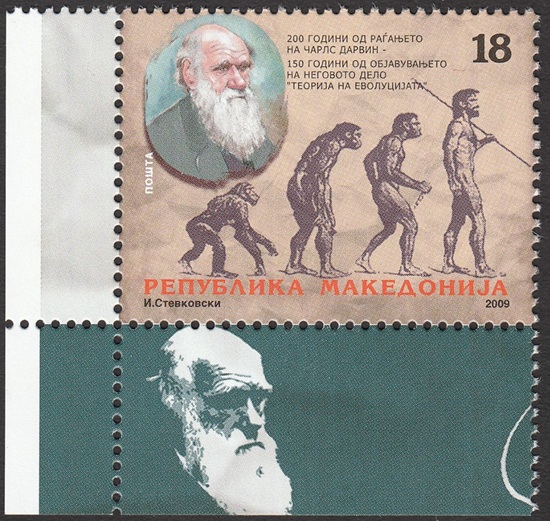 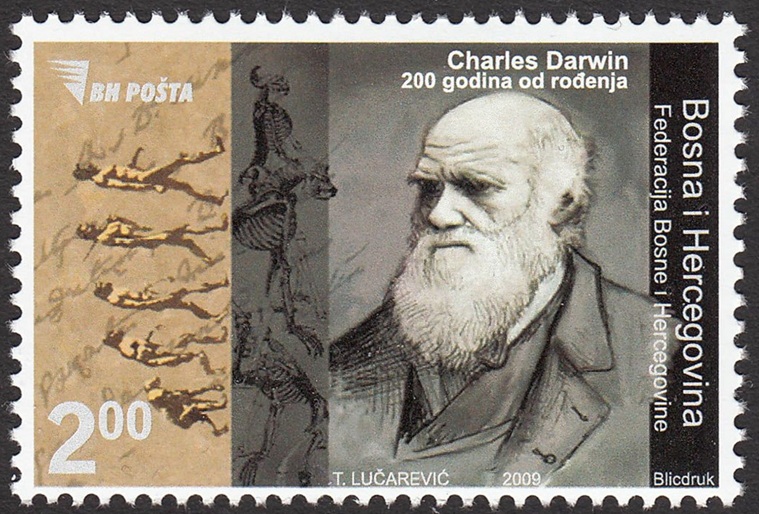 |
|
Send note to Staff
|
|
|
Pillar Of The Community
Israel
4904 Posts |
|
|
Darwin was fascinated by pigeon breeding as a vivid example of artificial selection, showing how great variety could arise from a single ancestral species. By choosing traits such as feather color, beak shape, and size, breeders produced an astonishing range of pigeon forms. In On the Origin of Species, Darwin drew on these observations to argue that if humans could create such diversity through selective breeding, nature could achieve the same through natural selection. Darwin pigeon dovecote, a sheet issued by North Korea in 1999 to commemorate the 190th anniversary of the birth of Charles Darwin. 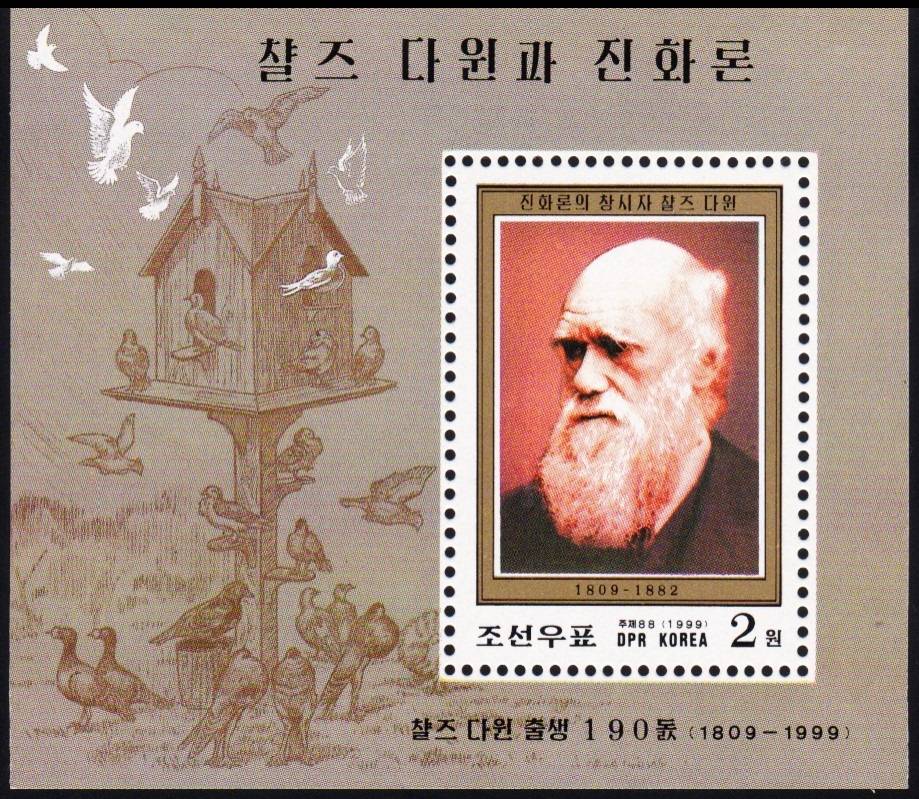 |
|
Send note to Staff
|
|
|
Pillar Of The Community
Israel
4904 Posts |
|
|
Pillar Of The Community
Israel
4904 Posts |
|
|
Pillar Of The Community
France
2942 Posts |
|
|
From Bosnia & Herzegovina (Serbian administration) 150th anniversary of the theory of Evolution. 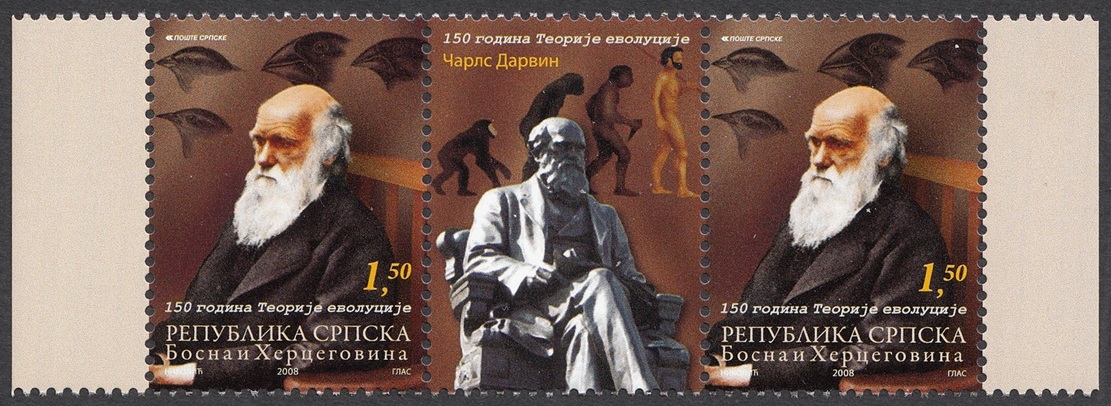 |
|
Send note to Staff
|
|
|
Replies: 54 / Views: 7,133 |
|




 Posted 09/04/2025 4:44 pm