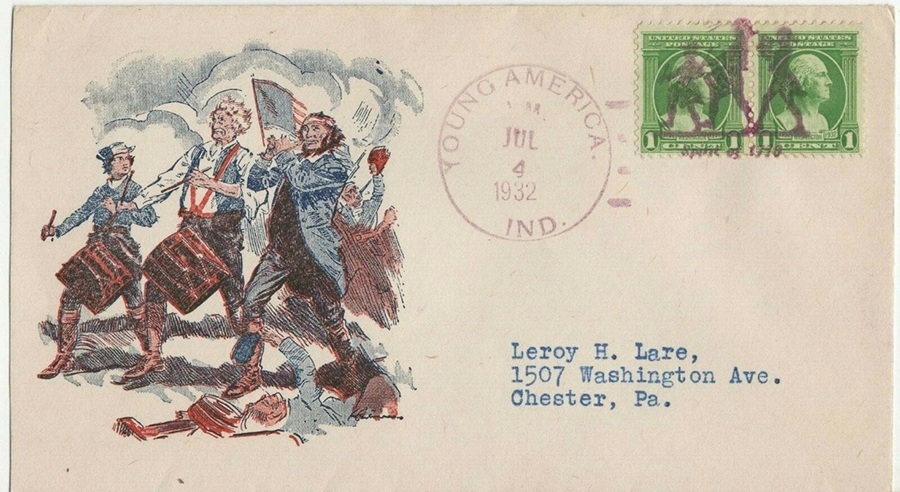
It does appear that it was mostly done by small towns, possibly because a small town postmaster had more free time on their hands to devote to creating and servicing these special cancellations.
Fancy Cancels were abundant in the 1850s-1890s but virtually disappeared after 1904 because of POD Order Number 497 that prohibited the use of postmarking devices or ink not furnished by the Post Office Department.
The "loophole" that appeared in the 1920s and 1930s was because of a change in the postal regulations for Registered mail that required the postmark with the city name and date to be used only on the
back of the envelope rather than the front, but the Post Office Department did not provide every post office with any alternative postmarking device for the front of the envelope, so the postmaster had to improvise.
From an article in the Western Postal History Museum Heliograph, written by A.W. Bork, a post office clerk from Prescott Arizona, an avid stamp collector and one of those fancy cancel creators, "in 1922 the Post Office Department ordered all postmasters to stop the use of any kind of cancelling device which would show the name of the mailing office on the face of a registered letter (or other article). It was felt that greater security would be provided if all mail handlers were forced to check the number on the face of the letter and the mailing office's backstamp on the back flaps sealing it. Seemingly there had been much tampering with such mail en route."
The 1920s-1930s fancy cancels were supposed to be used only on registered letters, but it seems that rule was not always adhered to.
References:
https://postalhistoryfoundation.org...graph3-3.pdf article by A.W. Bork starts on page 13.
https://www.linns.com/news/us-stamp...els-reportedhttps://postalmuseum.si.edu/object/...1987.0905.28https://www.purr-n-fur.org.uk/phila...tmarks4.html





 Posted 09/18/2025 3:22 pm