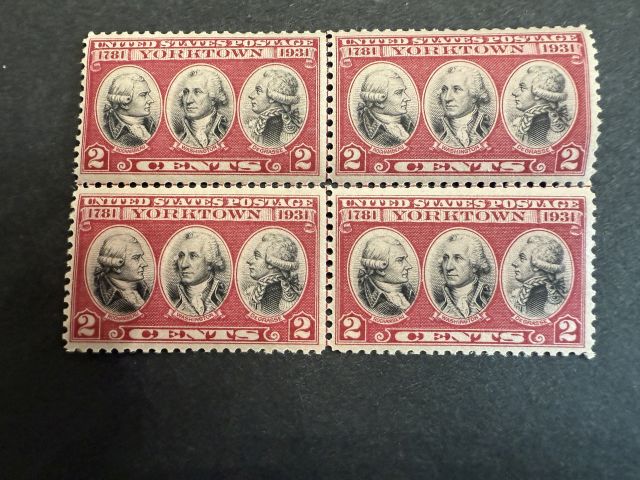
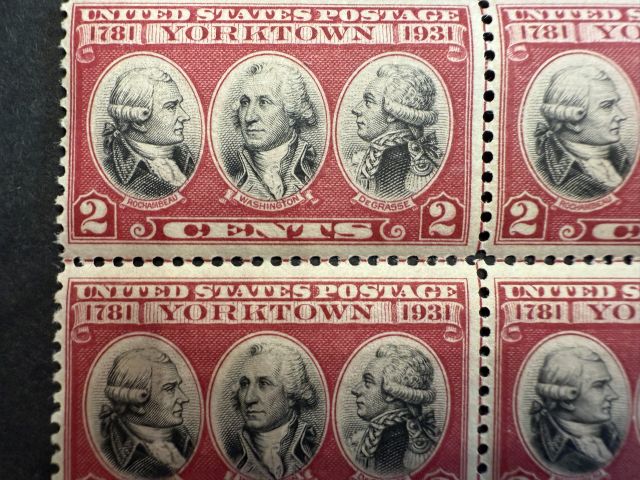
Joint lines can be found on rotary press coil stamps, and guide lines can be found on flat plate coils and flat plate sheet stamps. While the terms are often used interchangeably, there is a difference between joint lines and guide lines.
On rotary press coils, joint lines are an artifact produced by the ink that gathers in the separation gap where the edges of plates meet on the printing cylinder. Joint lines are sometimes smudgy and can be thick or thin and can sometimes look like a double line with weak color in-between.
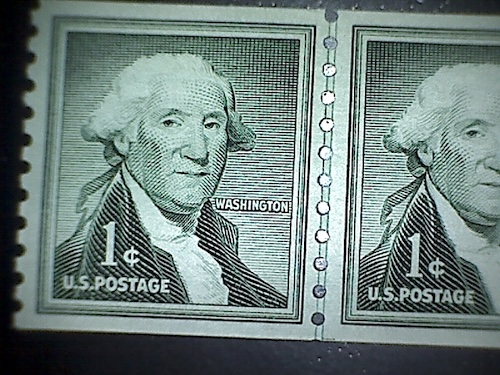
(This picture is from another SCF thread about guide lines and joint lines
https://goscf.com/t/54838 )
Joint lines can sometimes be seen at the edges or margins of rotary press sheet stamps, but these are often cut off during production. I am not aware of any examples where you would find joint line pairs on Rotary Press sheet stamps. An arguable exception could be the 6-cent Christmas stamp #1384 or the Scott #1622/1625 but those were from the Huck press and for some reason never recognized in the catalogs as joint line pairs, only mentioned in a footnote after #1625.

While joint lines are an unintentional side effect of the printing process, guide lines are deliberately printed to guide the perforation process, the cutting process, and/or assist the postal clerk with counting. Guide lines can appear on flat plate coils or flat plate sheet stamps.
The Yorktown issue #703 is a fascinating issue for specialists because there were two printings, with different types of guidelines for each printing.
The first printing was printed in sheets of 100 stamps, 10 stamps wide and 10 stamps tall, with guide lines printed between the 5th and 6th stamps horizontally and vertically. The sheets of 100 stamps were cut along the vertical guideline to produce two panes of 50 stamps to deliver to the post offices for sale. The horizontal guide line was used to guide the perforating machine along that center line.
Here is an example of the right pane from the first printing, note the vertical guide line (and straight-edge) at the left that separated the two panes, and the horizontal guide line between rows 5 and 6.
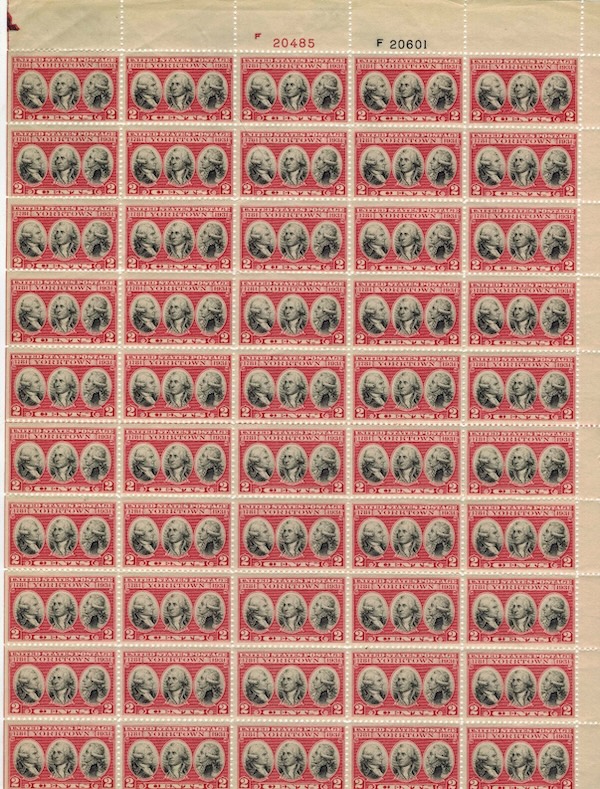
The second printing was perforated on all 4 sides with a 1-inch gutter between the two panes of 50 (no straight edge on the stamps at the edges of the panes) and there is now a vertical guide line between columns 2 and 3 of each pane, again to assist with correctly aligning the perforations along the guideline.
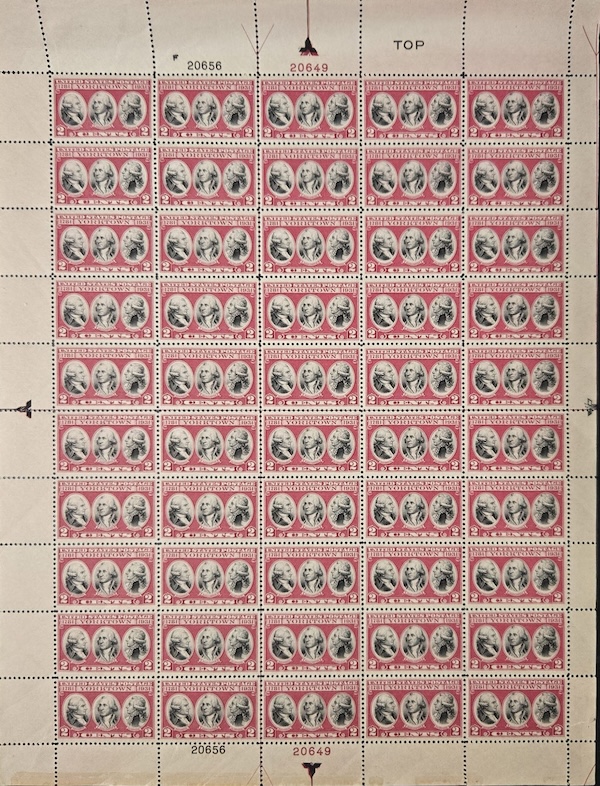
Another interesting "feature" of the second printing is that the red (frame) plates still contained 100 subjects, but the black (vignette) plates now contain just 50 subjects. Typically the top plate blocks from right-side panes will show the letter "F" while plate blocks from the left panes will not. The example above is from the left pane, the red (frame) plate number correctly without the "F", but the black (vignette) with the "F" plate number typically seen only on right-side panes.





 Posted 09/25/2025 8:57 pm