Stamp Community Family of Web Sites
Thousands of stamps, consistently graded, competitively priced and hundreds of in-depth blog posts to read


Stamp Community Forum
 
Username:
Password:
Save Password
Forgot your Password?

This page may contain links that result in small commissions to keep this free site up and running.

Welcome Guest! Registering and/or logging in will remove the anchor (bottom) ads. It's Free!

US Stamps With Taggant That Has A Long Duration Afterglow

 
To participate in the forum you must log in or register.
Author Previous TopicReplies: 9 / Views: 1,333Next Topic  
Valued Member
Learn More...
United States
257 Posts
Posted 10/03/2025   10:54 am  Show Profile Bookmark this topic Add mstocky2 to your friends list Get a Link to this Message
I have been looking into US stamps that have a taggant with a long duration afterglow. As you may or may not know, the taggant on US stamps when exposed to SW UV light glows and the glow appears to immediately disappear when the light is removed. Normally the afterglow of the phosphor taggant used on US stamps is in milliseconds which is to short to be visible to human eyes. A small number of US stamps though can be found where the afterglow from exposure to SW UV light can persist for three plus seconds which is easily visible to the human eye. My journey down this rabbit hole is as flows.

A couple of years ago someone on another stamp forum asked a questions about Scott 3112 in which that person indicated seeing an afterglow on some of these stamps. This was this first I had heard of a US stamp having a "long duration" afterglow. This lead me to hunt for all the various plate numbers for this booklet stamp. To date I have acquired at least one booklet for all the plate numbers except one (missing 5544-1) in an attempt to determine which booklets had which taggant. This stamp also has luminescent and non-luminescent yellow ink varieties as well. In the table below I have summarized my findings for 3112a (booklet) to date.

Plate#__Printer____Tag. Afterglow___Special Features
1111-1__BEP______short duration___non-lum yellow ink; hi-brite paper label side
1211-1__BEP______short duration___lum yellow ink; hi-brite paper label side
2212-1__BEP______short duration___non-lum yellow ink; hi-brite paper label side
2222-1__BEP______short duration___non-lum yellow ink; hi-brite paper label side
2323-1__BEP______short duration___non-lum yellow ink; hi-brite paper label side
2323-1__BEP______long duration____non-lum yellow ink; low fluorescent/gray paper label side
3323-1__BEP______long duration____non-lum yellow ink; hi-brite paper label side
3333-1__BEP______long duration____non-lum yellow ink; hi-brite paper label side
3334-1__BEP______long duration____lum yellow ink; hi-brite paper label side
4444-1__BEP______long duration____lum yellow ink; hi-brite paper label side
5544-1__BEP______long duration____not known
5555-1__BEP______long duration____lum yellow ink; dull fluorescent/gray paper label side
5556-2__BEP______long duration____lum yellow ink; hi-brite paper label side
5656-2__BEP______short duration___lum yellow ink; hi-brite paper label side
6656-2__BEP______short duration___lum yellow ink; hi-brite paper label side
6666-1__BEP______long duration____lum yellow ink; hi-brite paper label side
6666-2__BEP______long duration____lum yellow ink; hi-brite paper label side
6766-1__BEP______short duration___lum yellow ink & non-fluorescent paper stamp side; duller hi-brite paper label side
6766-1__BEP______long duration____lum yellow ink & low fluorescent paper stamp side; hi-brite paper label side
7887-1__BEP______short duration___lum yellow ink; hi-brite paper label side
7887-2__BEP______short duration___lum yellow ink; hi-brite paper label side
7988-2__BEP______short duration___lum yellow ink; hi-brite paper label side
6766-1__BEP______long duration____lum yellow ink; no die-cuts; hi-brite paper label side

In the table above two plate numbers for 3112a also contain additional varieties in terms of paper utilized, either label side or stamp side. There may be more varieties for other plate numbers. As you can see above the afterglow duration doesn't switch over from one type to another at some point in the series like the yellow ink does. The paper used on the stamp side is a dull fluorescent paper unless noted.

Earlier this year I found a second stamp with long duration ink. This stamp was Scott 3013 another booklet stamp. At that point I didn't pursue it any further due to lack of time. That changed when the recent issue (Oct 2025) of US Stamp News arrived in my email. In Rudy de Mordaigle's column he showed what would be a third stamp by my count with a long duration afterglow, Scott 3123. This prompted me to go through my accumulation of mint and used stamps to hunt for more. In doing so I found numerous additional stamps with this unique feature. All are from the 1996-97 time frame.

I did a scan of stamps from 1995 - 2000 to find these. I didn't go further in either direction when I stopped seeing any long duration samples. Some of the samples from the time period I scanned are limited so there may be more. A couple I found with long duration taggant only which may be due to my limited copies or maybe they were only printed with long duration taggant. I found it interesting that four different printers were involved in printing these stamps. Does that indicate they got the long duration taggant from the same supplier??? Below is a summary of these varieties with plate numbers. If there is no description in the "Tag. Afterglow" column it means I don't have that plate number yet.

Scott#_____Plate#____Printer____Tag. Afterglow___Comments
Booklet Stamps
3013a_____V1111_____AVR______long duration
3013a_____V1111_____AVR______short duration___does this exist?

3116a_____B1111_____BCA______long duration____block of four different scenes
3116a_____B2222_____BCA
3116a_____B3333_____BCA

3117a_____V1111_____AVR______long duration
3117a_____V2111_____AVR

3123a_____B1111_____BCA
3123a_____B2222_____BCA______short duration
3123a_____B3333_____BCA
3123a_____B4444_____BCA
3123a_____B5555_____BCA
3123a_____B6666_____BCA
3123a_____B7777_____BCA

3176a_____1111______BEP______short duration
3176a_____2222______BEP
3176a_____3333______BEP

3177a_____B1111_____BCA
3177a_____B2222_____BCA______short duration
3177a_____B3333_____BCA

Sheet Stamps
3066______1111-1____BEP______long duration
3066______2111-1____BEP
3066______2212-1____BEP
3066______2222-1____BEP______long duration
3066______2232-1____BEP
3066______3232-1____BEP______short duration
3066______4242-1____BEP
3066______4244-1____BEP______long duration
3066______5245-1____BEP
3066______5345-1____BEP______long duration
3066______5353-1____BEP
3066______6353-1____BEP______long duration
3066______6363-1____BEP
3066______7777-1____BEP______long duration

3104______1111______BEP______long duration
3104______1111______BEP______short duration_____does this exist?

Hopefully some of you will find this an interesting area to pursue. These stamps make great examples for demonstrating to people the afterglow effect of the taggant.

If anyone has Booklets or Plate blocks for the ones I am missing and wants to part with them please contact me. Thanks

Send note to Staff

Valued Member
276 Posts
Posted 10/03/2025   5:33 pm  Show Profile Bookmark this reply Add Perf10 to your friends list  Get a Link to this Reply
Nice work! Interesting findings, thanks for posting them.
Send note to Staff  Go to Top of Page
Valued Member
Switzerland
493 Posts
Posted 10/03/2025   11:12 pm  Show Profile Bookmark this reply Add drkohler to your friends list  Get a Link to this Reply
To date I have acquired at least one booklet for all the plate numbers except one (missing 5544-1)
Add plates 5556-1 and 7888-2 to your "things to find" list.

This is a complex issue (as are many others during this period in time). In the back of my head, I have the 3112a booklet in my head as a possible future article for the US Specialist but I haven't done anything (yet).

So let's start with the Hibright paper side in your list. What you see is fluorescence, not phosphorescence. While the BEP was careful not to accept stamp paper that shows fluoresccence (which could possibly irritate automatic mail sorters), it wasn't concerned with fluorescent backing paper.
Looking at the backing with a short wave uv light or long wave uv light gives you the same answers. The substance in the backing will be triggered by both light waves on this issue.
(I use the strong self made uv lamps that give "pure" sw and uv light each. Many commercial lamps, particularly the cheap handhelds, do not filter out visible light or the short uv also has a long wave component not fully blocked).

In general, there are backings that are dead (do not react to uv light), backings that show some low to medium glow and backings that are strongly glowing.
From my collection, here are the results for the backings:
Strong glow:
1111-1, 2212-1, 3323-1, 3333-1, 5555-1, 5556-1, 5556-2
No glow:
7887-2
Low glow:
2222-1, 5656-2, 6656-2, 6666-1, 6766-1, 7888-2, 7988-2
The other numbers are medium glow (the range of medium glow is somewhat wide from "more than low" to "less than high").

For the stamp side paper, there are a few plate papers that somewhat glow under long wave uv:
Low:
3323-1, 5656-2, 6656-2, 7887-1
Medium:
2212-1, 2222-1

The following plates do NOT have luminescent yellow ink:
1211-1, 2212-1, 2222-1, 2323-1, 3323-1, 3333-1
Basically the first few plates, with the exception of 1111-1, have nonluminescent yellow ink.

Plates that show afterglow for several seconds (after exposure to strong sw uv):
3323-1, 3333-1, 4444-1, 5544-1, 5556-1, 5556--2, 5656-2, 6666-1,6666-2, 6766-1
Plates that do not show afterglow
1111-1, 1211-1, 2212-1, 2222-1, 2323-1, 3334-1 (minimal afterglow), 6656-2, 7887-1, 7887-2, 7888-2, 7988-2

My list is roughly showing the same results as yours.
Send note to Staff  Go to Top of Page
Edited by drkohler - 10/04/2025 12:41 am
Pillar Of The Community
United States
4135 Posts
Posted 10/04/2025   1:05 pm  Show Profile Check eyeonwall's eBay Listings Bookmark this reply Add eyeonwall to your friends list  Get a Link to this Reply
It has been many years since I studied this, but

There are only 2 ways to get a longer visible glow after shutting off the SWUV light.

1) More of the taggant is present so that the decayed glow is still bright enough to see.

2) Use a different tagging compound. Each compound will have a different decay rate. However, each compound will also have its own different fixed color (like we had orange red for the early tagged airmails instead of yellow green).

Someday I will check my 2112a Madonnas, but I don't have the time now.
Send note to Staff  Go to Top of Page
Valued Member
Switzerland
493 Posts
Posted 10/04/2025   6:47 pm  Show Profile Bookmark this reply Add drkohler to your friends list  Get a Link to this Reply
There are only 2 ways..
As Einstein famously once said "Everything should be made simple, but not too simple".

There are several additional reasons why times can be different.
For the 3112a case, it is mostly a physiological reason. When we want to observe phosphorescence decay here, we sit in darkness. As we start up our sw uv lamp, the pane starts to glow and the eyes, adapted to pitch darkness, will quickly saturate so all panes will glow with the same brightness. That does not mean they actually do, however. All panes saturate our eyes after a few seconds at most, but in reality, panes may glow with different strengths when measured with a "luminosity meter" as they contain more taggant than needed to saturate our eyes.
So different amounts of taggant in panes will lead to different time scales as the pane with more stuff in it will have more molecules to decay. (though the rates of decay are identical in all panes).

Another additional reason for different afterglow times has to do with quantum physics and is difficult to explain in easy terms. Basically it depends on the environment the taggant is solved in. The taggant molecules have to undergo multiple quantum steps that depend on the ability of the excited molecules to "get rid of some energy first". All the stuff in a suspension with taggant in it can help or hinder the "getting rid bit".

A good example is when I compare a 3112a pane with a 3013a pane (this booklet pane glows because it has phosphor added to the lacquer layer on top of the pane). It is really interesting to see the different speeds of light decay - though the 3112a pane also has phosphor as active substance (at least I think it has, it is the cheapest of all substances).
Send note to Staff  Go to Top of Page
Pillar Of The Community
United States
4135 Posts
Posted 10/04/2025   7:20 pm  Show Profile Check eyeonwall's eBay Listings Bookmark this reply Add eyeonwall to your friends list  Get a Link to this Reply
Not quits sure how your first example is different than my first example, but I do follow what you are saying in your second example, I just don't know enough to know whether it would be enough to cause the transition (or any of the earlier transitions that take place before the visible one) to go from nearly instantaneous to on the order of a second.
Send note to Staff  Go to Top of Page
Valued Member
Learn More...
United States
257 Posts
Posted 10/04/2025   9:32 pm  Show Profile Bookmark this reply Add mstocky2 to your friends list  Get a Link to this Reply
drkohler:
Thanks for pointing out the missing numbers. I think it was a cut and paste issue from my spreadsheet where I went astray.

I had 1111-1 and 1211-1 swapped so I agree with your list for the yellow ink. That yellow ink in the plate number is hard to read.

For 2323-1 I have one with the short duration afterglow and the other with long afterglow.

The paper I list as hi-brite has various levels of variation in brightness. I can compare mine against the terms you use for the levels.
Send note to Staff  Go to Top of Page
Valued Member
Switzerland
493 Posts
Posted 10/04/2025   10:57 pm  Show Profile Bookmark this reply Add drkohler to your friends list  Get a Link to this Reply
As eyeonwall, I'm not too happy about your use of "long" versus "short" within the same issue. I'd rather prefer "strong" for "long" and "weak" for "short".

Place a "long" 3112a pane and a "long" 3013a pane next to each other and observe the difference in duration. The 3013 should actually glow "shorter" than the 3112a as it is a different "taggant environment" so we might get away with the "wrong" terms in this comparison. Very likely there is no "short" 3013a version as this was one print run of V1111 panes.
Send note to Staff  Go to Top of Page
Valued Member
Learn More...
United States
257 Posts
Posted 10/05/2025   10:02 pm  Show Profile Bookmark this reply Add mstocky2 to your friends list  Get a Link to this Reply
drkohler, I went through my samples to compare the label side paper against yours. For the most part it matched. I did find two differences which may be additional varieties. My 2222-1 is strong/high fluorescent and my 7887-2 is a low/medium fluorescence versus your no glow.

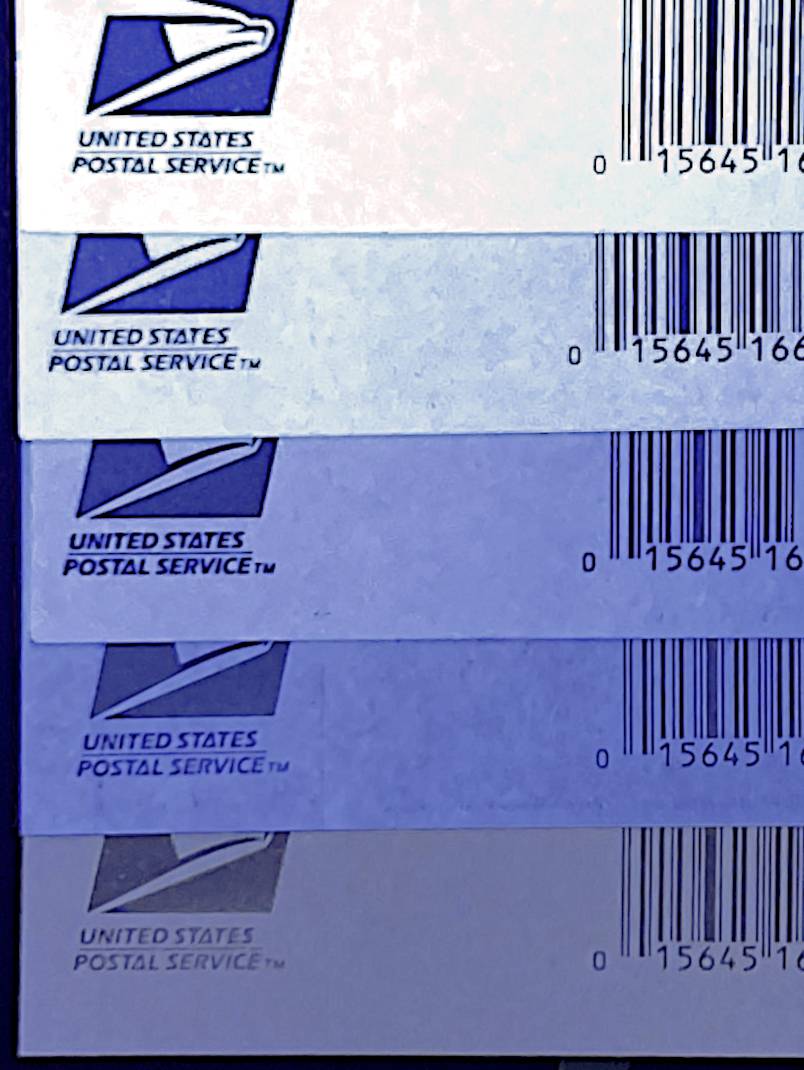
For those not familiar with paper varieties under LW UV, below is an image that illustrates the label side paper fluorescence. I show 5 levels as there is wide variation between low and medium fluorescence depending on how you bin them.


Things went really off the rails today when David Norris, who originally posted on the 3112a, contacted me about 1845 having a long duration afterglow. Checking my stock it turns out there are probably well over a hundred tagged stamps from 5c ones through the 1990's timeframe I mentioned that exhibit a long duration afterglow of the taggant. Pursing these new ones for varieties is a task for another timeframe.
Send note to Staff  Go to Top of Page
Pillar Of The Community
United States
677 Posts
Posted 10/17/2025   08:33 am  Show Profile Bookmark this reply Add oldtriguy1960 to your friends list  Get a Link to this Reply
Add 1862 20c Harry Truman to the list. I have a couple with no afterglow and several with the afterglow. All on the small tag variety.
Send note to Staff  Go to Top of Page
  Previous TopicReplies: 9 / Views: 1,333Next Topic  
 
To participate in the forum you must log in or register.

Go to Top of Page

Disclaimer: While a tremendous amount of effort goes into ensuring the accuracy of the information contained in this site, Stamp Community assumes no liability for errors. Copyright 2005 - 2026 Stamp Community Family - All rights reserved worldwide. Use of any images or content on this website without prior written permission of Stamp Community or the original lender is strictly prohibited.
Privacy Policy / Terms of Use    Advertise Here
Stamp Community Forum © 2007 - 2026 Stamp Community Forums
It took 0.21 seconds to lick this stamp. Powered By: Snitz Forums 2000 Version 3.4.05