There is some controversy over which stamp issue represents the first "Modern First Day Cover." Some argue that new post office policies place that event in 1922 while others argue that George Linn's use of cachets on the Harding Memorial issue in 1923 represents the event. What do you think? Let's look at some facts.
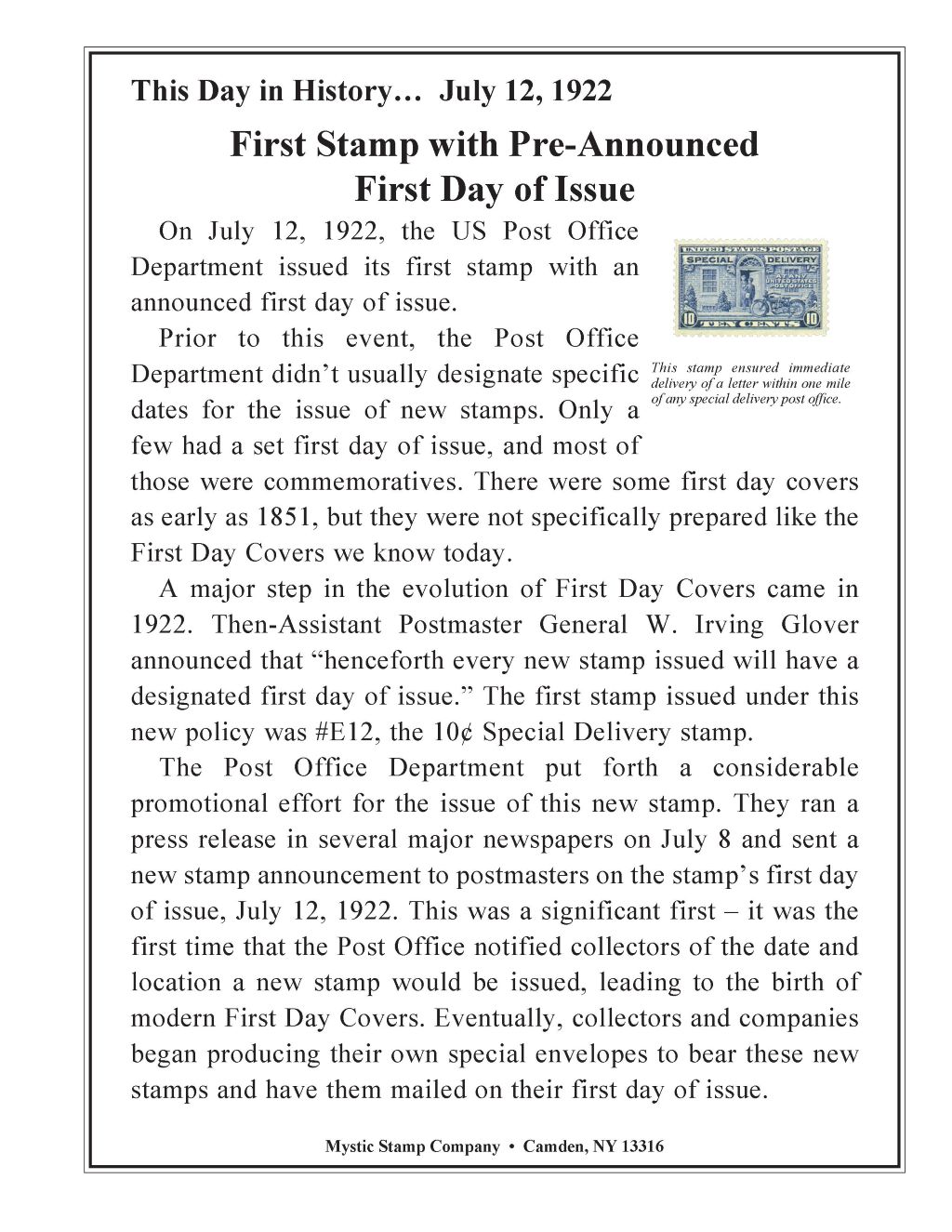
Although First Day Covers (FDCs) of some 19th and early 20th century stamps do exist, FDC collecting as we know it really dates from July 12, 1922. On that date the United States Post Office implemented its new policy of designating when and where a new issue would be sold. This would be true for not only commemoratives but ordinary and special issues as well.
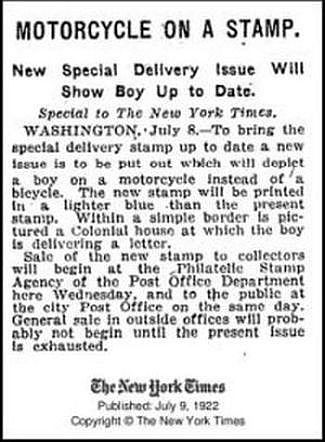
The stamp issued on that date was the ten-cent motorcycle special delivery (Sc. E12). The listed city of issue was Washington, DC. Except for the brief Post Office announcement dated July 8, 1922, there was little fanfare.
Because FDC collecting was still in its infancy and the fact that special delivery stamps were not popular, only a few FDCs of the new stamp would be processed on its First Day. We know of only eight servicers. They were collectors or dealers who were local area residents or who had a relationship of some sorts with the Post Office Department. It appears that none of the known covers were mail-in requests from collectors who read the First Day announcement.
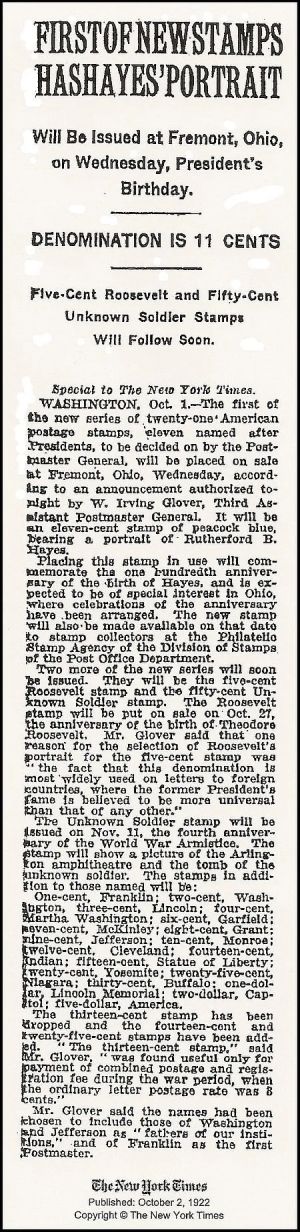
The Post Office added a few new twists in its announcement for the next new stamp, the 11-cent Rutherford B. Hayes (Sc.563), to be issued on October 4, 1922. In addition to Washington, DC., Hayes' hometown of Fremont, Ohio was also listed as a First Day city. Thus, for the first time, a city other than Washington with a link to the subject of the stamp was designated to sell a stamp on the First Day. In addition, a First Day ceremony, the first of its kind in this country, was held at Fremont. Programs for the event were prepared and distributed at the ceremony. 24 FDCs servicers, from far away as New York and Massachusetts, are known to have received 78 FDCs from Fremont.
The Hayes stamp was the first of a new series of ordinary stamps, now called the Fourth Bureau Issue, that was replacing the Washington-Franklin series of ordinary stamps. It's Post Office announcement also mentioned that other stamps of the series would soon be released.
President Warren G. Harding died suddenly on August 2, 1923. He was beloved across the country at the time and three million mourners gathered to watch his funeral train pass by. As was customary, the Post Office Department immediately began work on a memorial stamp to be issued on September 1, 1923. Demand for the stamp would be greater than that for any previous special issue. George Linn, who would later found Linn's Stamp News, greatly admired Harding and wanted to do something special to mark the stamp's issue. He chose to print a black five-line cachet with a black border on a variety of envelopes for his FDCs.
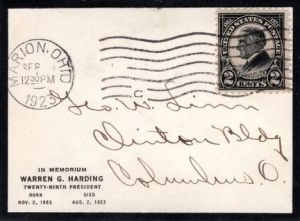
Since then and particularly since the Presidential series off 1938, many FDCs have been decorated with a cachet printed, stamped, pasted or drawn on the envelope which relates in some way to the subject depicted on the stamp. These designs vary from the crudely drawn to virtual works of art in their own right. Linn's entrepreneurial step opened the door to a new phase of FDC collecting. Stamp publishers, artists and individual collectors today continue to produce imaginative cachets for FDCs.
So what do you think? What is the first modern first day cover? If it is the Linn cachet cover, how should the 1922 competitors be identified?





 Posted 12/10/2025 01:11 am