| Author |
 Replies: 10 / Views: 1,416 Replies: 10 / Views: 1,416 |
|
|
Valued Member
United States
7 Posts |
|
|
There was a post some time ago about the color variations in the Special Delivery Stamps E15, E15a, and E15b. I have scanned in a page from my album which I believe to be the correct interpretation of the color variations. Could someone confirm if they think this is correct? Thank You! This is my first post, so please excuse me if I did something wrong. Larry 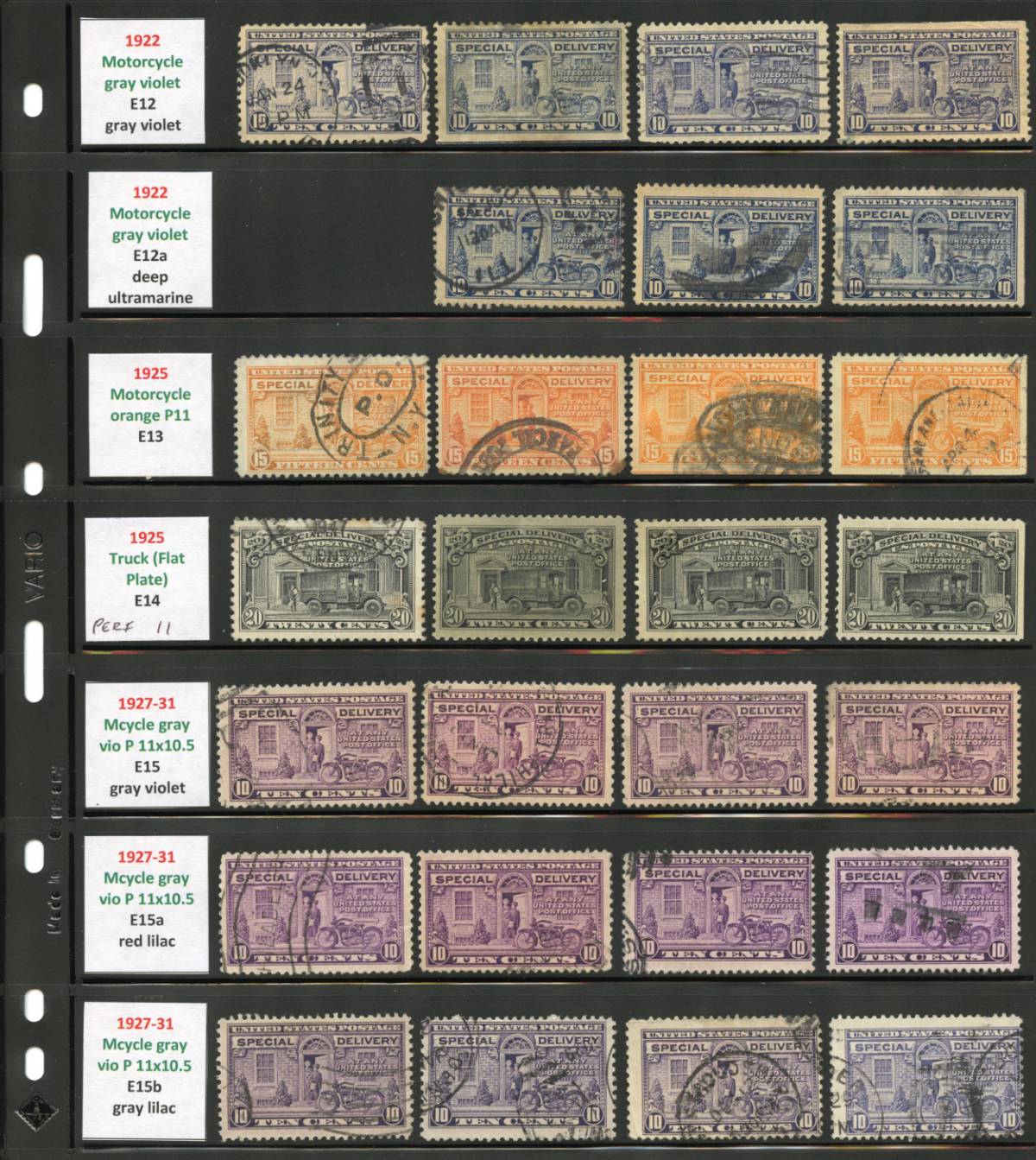 |
|
Send note to Staff
|
|
|
|
|
Pillar Of The Community
United States
796 Posts |
|
|
Colors cannot be reliability identified on a computer. Most variations are due to ink changes, poor plate wiping, plate wear and environmental conditions especially with used examples. If you have access to mint examples it will aid you in sorting things out. Good luck. |
Send note to Staff 
|
|
|
Valued Member
United States
232 Posts |
|
|
My opinion is that color difference are a dice roll. Stamps vary anyway, and these almost a hundred years old. It might have been easy in 1929, but today? |
|
Send note to Staff
|
| Edited by Tiger Dude - 12/16/2025 1:09 pm |
|
|
Valued Member
United States
7 Posts |
|
|
I agree with your comments, but if I understand correctly, the only difference between these three Scott's numbers is the variation in color. How are we supposed to identify them? Do you just group them all together in your collections? |
|
Send note to Staff
|
|
|
Bedrock Of The Community
United States
10869 Posts |
|
|
You seem to have them grouped well. And I don't think it was a roll of the dice, I think it was probably deliberate. The book "The Speedy" mentions the shades but does not go into details about timings or possibly being deliberate. But the variety of colors is so different that I find it difficult to believe that it was not intentional. |
|
Send note to Staff
|
|
|
Bedrock Of The Community
United States
10869 Posts |
|
|
The other possibility is that the inks came from different manufacturers over the years, and this was the result. Doing a serious study of the dates used by shade could prove interesting to some collector. |
|
Send note to Staff
|
| Edited by revcollector - 12/18/2025 07:26 am |
|
|
Pillar Of The Community
6366 Posts |
|
|
Several comments and observations:
1. The "1927-1931" listing in the Scott catalog is misleading. Some might interpret this as the use range of this stamp, but it is the release range of the "set" with E15 issued in 1927 and E16 issued in 1931. The base special delivery rate was 10 cents until 1944 and E15 was still available through the philatelic sales division as late as 1953 or 1954 and could have been in post office stocks throughout the country for many years later. I don't know when the last printings were done.
2. With this active range of 1927-1944, it falls neatly into the range when other definitive stamps are KNOWN to have undergone ink formulation changes - this includes the Prexies and J80-J84 postage dues. WWII necessitated some of the formulation changes to reduce the metal content of the pigments.
3. Like revcollector, I too looked in Gobie's "The Speedy" hoping he would address the shade in more detail. Nor were the shades mentioned in "Sloane's Column" which mentions shade changes with other long-term issues.
4. If I were approaching a shade study, I would thoroughly search "The Specialist" with emphasis on plate creation, use, and destruction dates and then accumulate data on plate block shades from actual examples. Additionally I would assemble a collection of several dozen (or more) covers to have examples from each year. I suspect when arranged chronologically, they will naturally group by shade. I would also look through old Scott catalogs to see when the various shades were added to the listings (They may not be listed in order of printing.).
5. While your groupings seem to match, the red component of many inks is more succeptible to fading, bleaching, etc., so it is better to build your knowledge base on mint or on-cover stamps which have not been through the soaking process one or more times. |
|
Send note to Staff
|
|
|
Pillar Of The Community
United States
3234 Posts |
|
|
I've always wondered how serious collectors know that what they have is a variation in ink color vs. color change from environment or paper it was stuck on. I never got that deep into the hobby, and don't think I could ever find the patience to! ;-) |
|
Send note to Staff
|
|
|
Bedrock Of The Community
United States
10869 Posts |
|
|
Usually it's the old fashioned way; by looking at lots and lots and lots and lots of stamps. Over years and years and years. |
|
Send note to Staff
|
|
|
Pillar Of The Community
United States
3234 Posts |
|
|
Pillar Of The Community
United States
811 Posts |
|
|
It is not difficult to identify shades - in theory. You just need references. In practice, it can be a challenge. Get certified copies. Get lots of examples to examine yourself. Get the in-person opinions of knowledgeable collectors. Cross-reference everything. |
|
Send note to Staff
|
|
| |
Replies: 10 / Views: 1,416 |
|




 Posted 12/15/2025 11:17 pm


