| Author |
 Replies: 3,980 / Views: 1,935,040 Replies: 3,980 / Views: 1,935,040 |
|
|
|
Valued Member
Australia
437 Posts |
|
|
So why would anyone drive 75km to go to a stamp club and then sit around looking at stamps till nearly midnight when they have to get up at 4.30am? Well, apart from the four examples above, I came home with about 60 engraved stamps from the exchange sheets, most of which cost 5 - 10 cents each. To me they are treasures but the low price shows that not everyone shares my passion - thank goodness! Here are a few acquired last night. These are by Lars Sjobloom     More to come.... |
Send note to Staff 
|
|
|
Valued Member
Australia
437 Posts |
|
|
More from the club haul. There were many from French engravers. Here are five of them. Postage Due from the Islamic Republic of Mauritania, 1981. The vulture seems somewhat appropriate for a postage due. This was designed by R. Serres and engraved by G. Betemps, both of whom engraved many stamps for France  This one caught my eye, engraved by Monvoisin.  This classic was engraved by Mignon and issued in 1930. A bargain, I thought even if heavily cancelled.  This one by Gandon from 1946 was shown before somewhere back in this thread. It's worth showing again and shows Apollo in his sky chariot.  Finally one from Decaris then I really must get some other work done.  Edited to fix Betemps initial. Thanks Adrian. |
|
Send note to Staff
|
| Edited by jjarmstrong47 - 06/04/2014 07:07 am |
|
|
Valued Member
United Kingdom
257 Posts |
|
|
That's some beautiful items you managed to get hold of! I love the cinderellas (very banknoty if you see what I mean) and those Sjooblom animal stamps. Gorgeous! By the way, it's G Bétemps, for Georges. I've just got my first GB Royal Mail stamp reproduction pack, of the 2013 Seahorses. 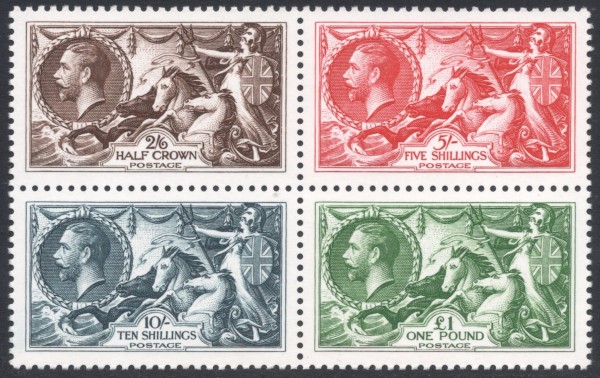 I had hoped the pack info would include whether these were made with the original dies or whether they're re-(computer?)engraved. But no information is given whatsoever. I presume they were made with the original dies but I'd like to be sure. Does anyone know? Here are close up details of the real thing and the reproduced thing. 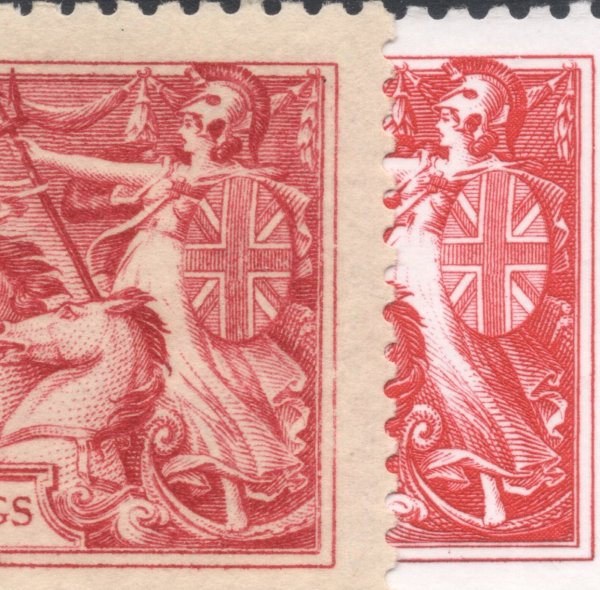 |
|
Send note to Staff
|
|
|
Valued Member
Australia
437 Posts |
|
|
Hi Adrian. looks like we have this thread to ourselves for a while. My bet is that they have scanned them and done a computer engraving. Look at the lines on the large fold of cloth. The edges of the lines are slightly rough which you would expect from a hand engraving. The lines on the new stamps seem to have smooth edges to me which suggests a computer engraving. Here is what I mean. This is a small part blown up of the Canadian whale stamp which was computer engraved. See how smooth the edges of the lines are.  Here for comparison is another recent Canadian stamp so printed on similar aged equipment. This is the polar bear engraved by Martin Morck. If you look at the edges of the lines they are rough as nobody can hold a burin in their hand with the same steadiness as an engraving robot.  For anyone who is not familiar with these two, here they are.   Another interesting feature on the whale stamp that is not obvious is the water and the flow lines within it. Here is what they look like.  |
|
Send note to Staff
|
|
|
Valued Member
Australia
437 Posts |
|
|
Also Adrian, the lines behind the head on your two examples are quite different so even if they were hand engraved, I don't think they are the same die. |
|
Send note to Staff
|
|
|
Valued Member
United Kingdom
257 Posts |
|
|
That's very convincing, John! The diagonal lines do not appear on the original stamps and neither are they on the stage 6a die proof of 1913. If they had been re-engraved by hand I'm quite sure the engraver would have been given a credit, so it looks very much like I've just wasted my money!
Oh well, at least the pack includes a pic of Harrison and his burin so that's something... |
|
Send note to Staff
|
|
|
Valued Member
Australia
437 Posts |
|
|
It's never wasted money when you learn something new. I drive a lot of different cars at work and I'm always annoyed when I go for petrol because I don't know what side the petrol cap is located. This week, I found out that the needle on the fuel guage points towards the side with the filler cap. I think I would have happily paid to learn something as useful as that. Besides, you could now write a new blog about the differences and that has to be worth the price of the sheet.  |
|
Send note to Staff
|
|
|
Valued Member
Australia
437 Posts |
|
|
Here are a few more from Tuesday's visit to the stamp club. Firstly, from the famous Austrians series of 1947-9, this portrait stamp of Franz Grillparzer was designed and engraved by Ferdinand Lorber.  Another beauty from Austria, this time from the winning team of Pilch and Toth who have been celebrated many times in this thread. This is from the 1962 Austrian Forests set.  From Italy to celebrate the 200th death anniversary of architect, Luigi Vanvitelli and showing the grand staircase in the royal palace at Caserta, this one was designed and engraved by R. di Giuseppe.  I have no details on this but by the initials I'm guessing it is from Sverre Morken. I would have bought this even if it was not engraved as having made my living for many years by playing the fiddle, in my arthritic old age I now have a small topical collection of fiddle stamps. I've played a five string but never a six string violin and wonder what the tuning would have been. If it followed the normal pattern, the stresses would have been enormous. Looking closely again at the blow-up, it looks as if two of the strings are lower so they are sympathetic as in those on a sitar. They sit beneath the fingerboard and pass through the lower part of the bridge.
 |
|
Send note to Staff
|
|
|
Valued Member
Australia
437 Posts |
|
|
Looking at the catalogue price on this Canadian stamp, I'd say that the 10c I paid for it was pretty good, even with the missing top corner. It shows Jacques Cartier and celebrates the fourth centenary of the discovery of Canada (though some would argue with that description). It was issued in 1934. I'd appreciate it if someone can tell me the engraver.  This is rather a nice stamp from Martin Cinovsky with the black engraved and the colours added. This is one engraved stamp where I don't think the colour addition takes anything away from the engraving. The stamp is from 1992 and is one of a set of two celebrating technology. This one shows Andreja Kvasza with his aeroplane. Like Australia, Slovakia seems to issue more stamps than they really need to but when the quality is this good, it is hard to argue against.  This 1898 stamp from Portuguese India celebrates the 400th anniversary of Vasco da Gama doing something or other, discovering the way around Africa to India, I believe. Normally I would point this stamp out to a mate of mine who has a pretty serious collection of elephants on stamps and I would give him first whack at it. Unfortunately, he had already gone home so I was forced to buy it myself.  This was printed by Waterlow & Sons but I don't have any engraver details.  Well, thats enough from the club purchases. I'll finish today with another from the South American collection. This was the stamp that got me interested in engraved issues back in 1984 and is firmly entrenched as my favourite stamp. It is from Costa Rica and was the first stamp I looked at under a microscope. The detail is so good, you can even see the walking stick in the man's hand. Quite astounding!  I've looked at this stamp so often that I have almost been there. I've decided that the image portrays the theatre in the early morning in wintertime, judging by the shadows as the theatre faces west and Costa Rica is in the Northern hemisphere and the light coming from east-south-east. Now I will wait for alternative ideas. See how much fun you can have with stamps! |
|
Send note to Staff
|
| Edited by jjarmstrong47 - 06/05/2014 12:10 am |
|
|
Valued Member
United Kingdom
257 Posts |
|
|
The plot thickens! Sorrry, but I'm still running around with those Seahorses in my mind. I had a look at some Seahorses on ebay yesterday and suddenly realised that the reproductions are based on the re-engraved Seahorses, not the original ones. The diagonal lines mentioned in the above post do also clearly feature on the re-engraved set. So there goes our 'proof'. However, the re-engraved set never included a £1 value, so it's still highly likely that the stamps are not based on the original engravings. Yet more to ponder! |
|
Send note to Staff
|
|
|
Valued Member
Australia
437 Posts |
|
|
Thickens indeed! Going back to the Marianne de Dulac issue, the De la Rue printing was only ever intended as a provisional issue until the Paris l'Atelier des Timbres-Poste was back in business. Perhaps they took over printing these and made a new die. For De la Rue to produce two dies for an issue that only lasted a year seems unusual, unless something happened to the original, but I would have thought there was only one DLR printing anyway. |
|
Send note to Staff
|
| Edited by jjarmstrong47 - 06/08/2014 04:23 am |
|
|
Valued Member
Australia
437 Posts |
|
|
Valued Member
Australia
437 Posts |
|
|
This one is much larger which should have allowed the engraver to produce a masterpiece but in my opinion it is fairly poor compared with the previous stamps. These come from a different US printer and I admit, I know nothing about this printer. These are the only stamps in my collection that I can recall that shows their name. Does anyone know much about them?  |
|
Send note to Staff
|
|
|
Valued Member
United Kingdom
257 Posts |
|
|
I still visit this topic, John, so you've got at least one fan!  But I can't help you with the printer query, I'm afraid. The Americas are still an unchartered territory for me, as I'm still firmly stuck in Europe. And I'm still working on my Karl Bickel collection. Here is one of his early Pro Juventute portraits, from 1932. 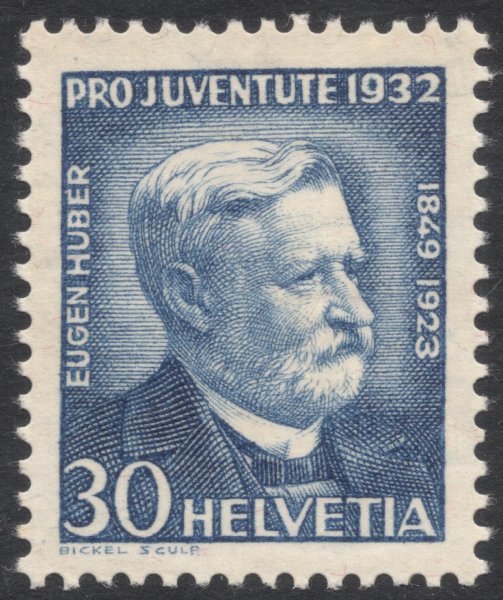 |
|
Send note to Staff
|
|
|
Moderator

United States
4788 Posts |
|
|
Replies: 3,980 / Views: 1,935,040 |
|



 Posted 06/04/2014 01:51 am


