| Author |
 Replies: 3,985 / Views: 1,945,941 Replies: 3,985 / Views: 1,945,941 |
|
|
|
Valued Member
Australia
437 Posts |
|
|
I've been loading stamps from Columbia into the database today and as usual, mostly I can only find the printer as they were all done by the usual suspects. Despite that frustration I spent some time looking at the air stamps printed by the American Bank Note Company from 1941 until the 1950s. The low values are smaller than a Machin yet get an astounding amount of detail into the four designs. They were reissued over a long period in different colours so I will show whichever is my best example of each.  1941 Pre-Columbian Monument. SG572 Scott C125  1948 Old Spanish Fort, Cartagena SG 693 Scott C153 (The ship is 4mm high)  1941 El Dorado Monument SG 569 Scott C122  1948 Street scene in Old Bogota. SG 698 Scott C158 |
Send note to Staff 
|
|
|
|
Valued Member
United States
17 Posts |
|
|
Thank you these stamps are works of art. I particularly enjoyed
1948 Old Spanish Fort, Cartagena |
|
Send note to Staff
|
|
|
New Member
1 Posts |
|
|
Florian, a very Interesting post about explorer Alberto Frei. I was a close associate of Frank Herbst Jakubicek 'til the end, who was a "legend in mapping the world." Tho' he lived in the Amazon among indigenous tribes for over two decades, he never mentioned any interest in seeds, and we miss him still. I do not have any of his stamps from N Dakota but his other memorabilia, and would be very interested in the letters and stamps to which you referred. |
|
Send note to Staff
|
|
|
Pillar Of The Community
Czech Republic
623 Posts |
|
|
JScott - How surprising! Please e-mail me direct to establish contact. I myself am unable to do so because on opening your Contact Information, I find "This Member does not wish to receive e-mail." Referring to my post on https://goscf.com/t/9106&whichpage=119#283097 here is an image of the stamp honouring explorer Alberto Vojtìch Friè as shown on http://www.wnsstamps.post/stamps/20...CZ029.12.jpg This is what Czech Post Past Issues, Year of issue 2012, page 3 says about him on https://www.ceskaposta.cz/en/sluzby...ehled-znamek : Alberto Vojtìch Friè (8 September 1882, Prague - 4 December 1944, Prague) was a Czech ethnographer, traveller, botanist, and author. South American Indians named him Karai Pukú (or "Long Hunter" in English), in Europe he became known as the "Cactus Hunter." Friè was born into the family of lawyer and Prague´s deputy mayor Vojtìch Friè. From his childhood he exhibited an exceptional talent for natural science, in disciplines that attracted him. Aged 15, Friè was already considered as one of the top experts in cactuses in Central Europe, receiving letters from leading European experts asking him for consultation and help identifying cactuses and inviting him to attend scientific conferences. He collected not only knowledge about cactuses but also real cactuses, but in 1899 his whole collection froze and died. He then decided to collect new plants and create a new collection. Over the period of 1901-29 he made 7 trips to South America and one to North America, not only to collect cactuses but also to discover new areas and gather ethnographic materials on wild Indian tribes. Friè made botanical and ethnographic photographs during his travels and is considered to be the pioneer of Czech landscape and travel photography. |
|
Send note to Staff
|
| Edited by florian - 07/18/2017 06:11 am |
|
|
Valued Member
United States
255 Posts |
|
|
This is going to sound like a somewhat newbie-ish question, but ... how does one go about identifying the various artists/engravers for each country, stamp issue, etc.? I am learning new things about this hobby every day. Thanks for posting such beautifully engraved stamps. |
|
Send note to Staff
|
|
|
Valued Member
United States
17 Posts |
|
|
Valued Member
United States
255 Posts |
|
|
Valued Member
United Kingdom
257 Posts |
|
|
I'm glad to say I've managed to track down another engraver's name for the beautiful US newspaper stamps of the late 19th century. I found this die proof, signed by James Kennedy. 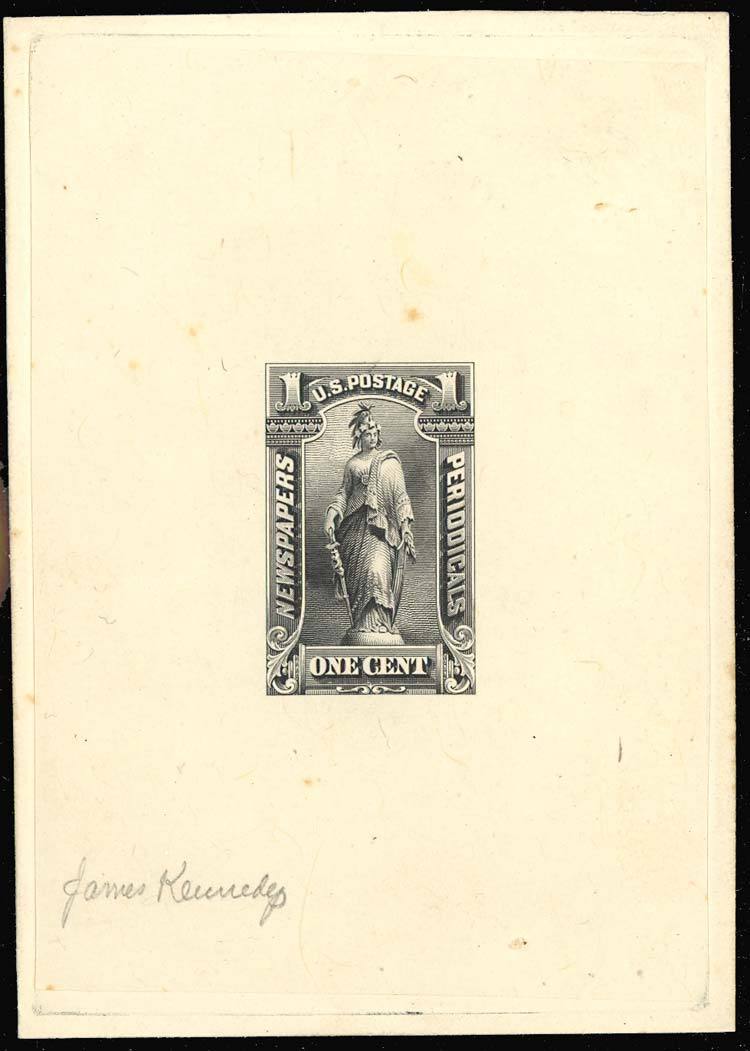 Now Kennedy was a letter engraver, so he will not have done the central vignette. Pity the proof isn't signed by both engravers, such as the one I showed on page 116, by Ellis and Smillie, but hey, at least there's another item added to the database! |
|
Send note to Staff
|
|
|
|
Valued Member
United Kingdom
257 Posts |
|
|
Sorry, me again. I have just been wondering about the $2 die proof I showed on page 116, and will show here again. 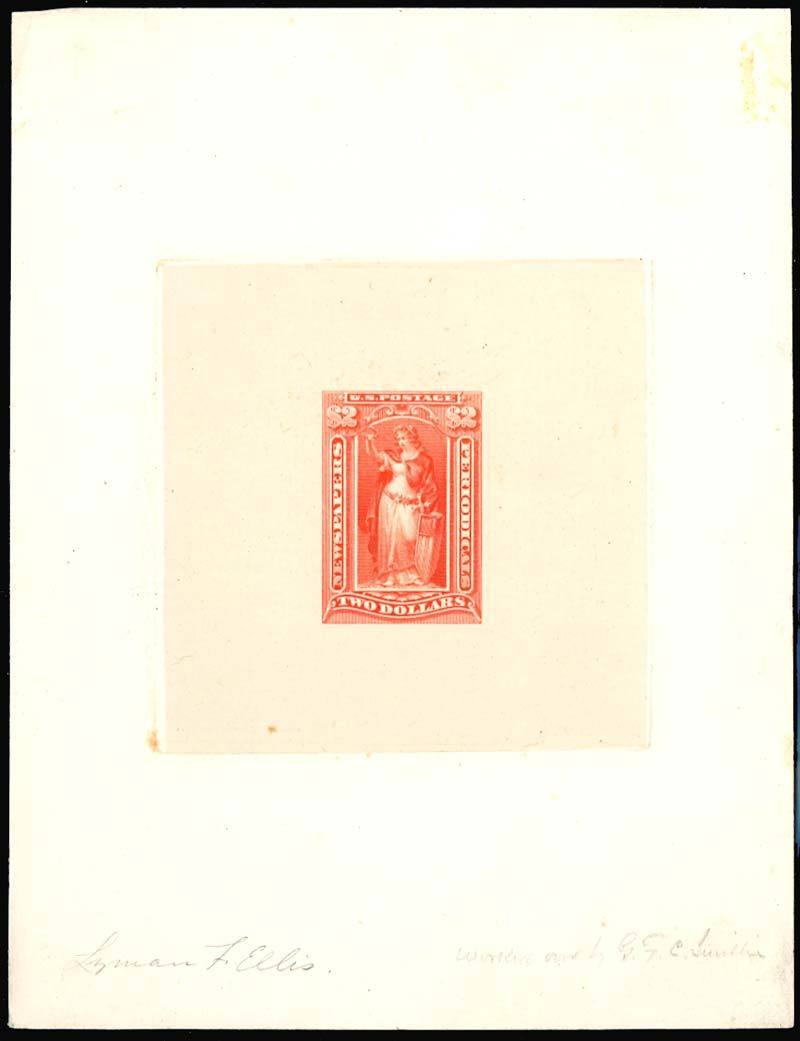 The $2 stamp was issued in 1895 and printed by the Bureau of Engraving and Printing. But the Victory design was used as early as 1875, on the $3 stamp. That stamp was printed by what was then the Continental Bank Note Co (later the American Bank Note Co). So would that original engraving of 1875 have been used by the other printers for the 1895 version? If yes, then Smillie would have engraved the Victory design in 1875. If no, then somebody else will have done that, but that would mean that there should be differences, however minute, between the two engravings. I checked my database and have an entry for 1874 for Smillie, so he could well have engraved the 1875 version. So that didn't help much. Now unfortunately I have none of these stamps, but I'm sure someone out there will have both that $3 and $2 stamp and can tell me whether the vignette is identical or not. As in pretty please?  |
|
Send note to Staff
|
|
|
|
Valued Member
Canada
67 Posts |
|
|
Sad News: Doyen of Spanish Portrait/Picture engraving, artist, painter and many things artistic, Antonino Sánchez Gutiérrez, passed away on October 09, 2017. He was born in 1932.
Let me on behalf of the philatelic community send heartfelt condolences to the family. Let his soul rest in peace.
cNA |
|
Send note to Staff
|
|
|
Valued Member
Australia
437 Posts |
|
|
Bedrock Of The Community
Australia
38679 Posts |
|
|
Valued Member
Australia
437 Posts |
|
|
Computers don't "think" like humans. They expect you to be completely accurate with what you tell them, in fact, I read somewhere that the world's most expensive grammatical error was a message to a satellite that missed a hyphen. Instead of a minor adjustment to the satellite's course, it caused it to self-destruct. It isn't rare for me to find mistakes I have made in the database, usually by spelling a name wrongly but I expect the engravers to know how to spell their own names. Sometimes, when an engraver works for two countries they might use both forms of their name. Karl Freidrich preferred to use Karel, the Czech version of his name and moved to Holland during ww2, apparently to avoid working for the nazis. I've found plenty of stamps by Jaroslav Goldschmied and up until now, they all agreed with the catalogue spelling of his name.  Then today, I found an earlier stamp from the air set of 1955 where he has spelt the name without the "e".  Perhaps Florian can tell us whether this is an alternative spelling or did he perhaps make a mistake when he was engraving his signature? |
|
Send note to Staff
|
|
|
|
Pillar Of The Community
Czech Republic
623 Posts |
|
|
Valued Member
Australia
437 Posts |
|
|
Thankyou Florian. I had guessed that there were simply alternative spellings so it is good to have that confirmed. For the database, I will have to stick with one spelling but I'll add a note that it varies.
My collection of engraved stamps from Czechoslovakia is slowly growing and in my opinion they include some of the finest engraved stamps ever produced. Moreover, while so many other countries have abandoned engraving, they have continued on into the two new republics and are still producing superb engraved stamps.
I think it was very appropriate that the last stamp for Czechoslovakia in my catalogue, engraved by Bedrich Housa, depicts Jindra Schmidt at work. Unfortunately, I don't have that one yet to show here. |
|
Send note to Staff
|
|
|
|
Replies: 3,985 / Views: 1,945,941 |
|



 Posted 07/02/2017 04:54 am


