| Author |
 Replies: 3,985 / Views: 1,945,581 Replies: 3,985 / Views: 1,945,581 |
|
|
|
Pillar Of The Community
Canada
5821 Posts |
|
|
Hi jjarmstrong47, FACIT is the specialized for Scandinavian countries for sure. I've borrowed the 2015 edition from the Harry Sutherland Library at Vincent Graves Greene Foundation a few times. This edition is partly in English and very easy to use. Regarding the Finland 1938 Red Cross issue here is the the part from the 2015 FACIT.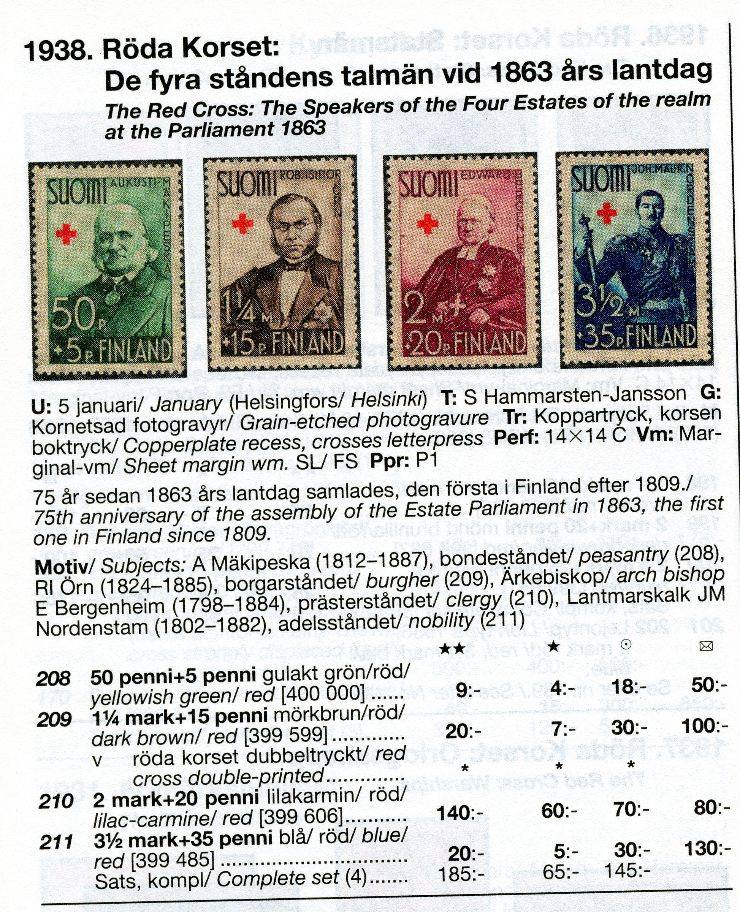 G: G: (engraver or engraved method)= Grain-etched photogravureTr: Printing process = Copperplate recess (really?) crosses letterpress. Michel(204 -207) states that the stamps were printed via photogravure( Rastertiefdruck) but the cross was typography/letterpress (Buchdruck) Scott claims that Finland B27 - B30 were engraved.So there you have it. Lots of conflicting information in the various main catalogues. |
Send note to Staff 
|
|
|
Valued Member
Canada
67 Posts |
|
|
Czech Post will issue a stamp in January 2020 honoring engraver Bedrich Housa, who is keeping well.
The design will show him holding a graver in his right hand.
Denomination "A"
cNA |
|
Send note to Staff
|
|
|
Pillar Of The Community
Czech Republic
623 Posts |
|
|
Farewell to the Czech Engraved Stamp Bidden by Bedrich Housa The doyen of the Czech postage stamp engravers and designers, Mr Bedrich Housa, born in 1926 and active in the trade for 62 years, between 1949 and 2011, bade farewell to the Czech engraved stamp at the Czech Post press conference ( https://www.kf0015.cz/?p=58348 ) held to introduce the first stamp issues in 2020, from now on to be entirely executed in offset printing, one of which now appearing in honour of the master engraver himself. The last WIFAG rotary press used for printing stamps in intaglio in Czechia was scrapped in 2018 due to ever-decreasing print runs while the very last stamp printed on the Waite & Saville flat plate press by the PTC a.s. Praha printer was issued on Nov. 13, 2019. Even if the above printer ceased the production of stamps in intaglio printing owing to a variety of reasons, the last but not least of which was the ageing of the highly skilled personnel required in the printing of stamps in pure multicolour line-engraving, those triumphs for designer, engraver and printer will continue to manifest their resplendent facture in the collections of stamp lovers. Certain FDCs will, however, continue to be printed on a Waite & Saville flat plate press, such as https://www.ceskaposta.cz/en/sluzby...ctId=5007409or https://www.ceskaposta.cz/en/sluzby...ctId=5007410both of them appearing on the same day, the former engraved by Martin Srb (b. in 1954), the latter by Jaroslav Trvdon (b. in 1950). |
|
Send note to Staff
|
| Edited by florian - 02/04/2020 04:37 am |
|
|
Valued Member
United Kingdom
33 Posts |
|
|
Hello everybody
I've taken out my engraved stamps collection again.
Does anyone know anything about the Russia 1913 Romanov Tercentenary issue? My Gibbons tells me the stamps were engraved by F. Lundin, P. Ksidias and F. Schirnbock, but it doesn't indicate which engraver did which stamp. Or did one of them do the vignettes and another the frames?
I have a lot of Schirnbock's stamps and I know he became a professor. His work on the Romanov issue is included without any detail in the Stamp Engravers BlogSpot.
I've got two other stamps by Ksidias - the 1921 triumph of the revolution and the 1927 Smolny Institute.
Did Lundin engrave any other stamps?
Best to you all for 2020 - Neville
|
|
Send note to Staff
|
|
|
Valued Member
United Kingdom
257 Posts |
|
|
Strider,
I checked Sendlhofer's book on Schirnböck but it does not give much information. However, my understanding has always been that Schirnböck engraved the recess-printed values, with the other names presumably responsible for the letterpress engravings. However, Sendlhofer also includes pictures of these letterpress stamps so that does not rhyme with my theory. But then, Sendlhofer also states that the whole set is recess-printed and that is most certainly not true.
So I suppose we need another source of information! I know Schirnböck's work has been dealt with in one of the Essay Proof Journals, but I do not have any time tonight to look into that. Maybe later..... |
|
Send note to Staff
|
|
|
|
Valued Member
United Kingdom
257 Posts |
|
|
I just found the passage in the Essay proof Journal, which reads as follows:
The collectors of Russia also have the works of Schirnbock in their albums. In 1913 he was commissioned to do the series commemorating the tercentenary of the founding of the Romanoff dynasty. It was a most important order and a tribute not only to Schirnbock but to the Staatsdruckerei as well. The designs were sketched by Bilibin, Sarrinsch and Lancery. There were seventeen stamps (A16-32), of as many designs, all but three being portraits. The thirteen lower values were typographed, the four highest recess printed, all of them a delight to the connoisseur. Proofs are in existence, but quite scarce.
So it's not conclusive, but still points towards Schirnböck being the engraver. |
|
Send note to Staff
|
|
|
|
Pillar Of The Community
Canada
5821 Posts |
|
|
Florian Sad to hear that the fabulous era of engraved Czech stamps has come to an end. But as you say there are many examples of the past engraved beauties we can still admire. Well that basically leaves France as the only country that regularly still prints & issues engraved stamps as of 2019. Included there would be areas of the French sphere such as Monaco, French Andorra and dependencies like French Polynesia, Saint Pierre and Miquelon, French Antarctic Territories etc etc. Once the French government printer Phil@poste scraps the recess printing presses then that's it for them also. A few countries including Spain, Italy, Belgium, Poland and China also issued one or two engraved stamps in 2019 but who knows what will happen in 2020. Canada has issued the odd engraved (combined with offset) high value every few years, last one the $4 Bighorn sheep in 2018.   |
|
Send note to Staff
|
| Edited by lithograving - 02/05/2020 5:13 pm |
|
|
Valued Member
United Kingdom
33 Posts |
|
|
Thanks, Adrian, for the info re the 1913 Romanov set.
I should have looked more carefully at my Gibbons. It says quite clearly that the kopek values were litho, and the rouble values engraved. And I just bought a complete set of the kopek values! Doh!!!
So I'm now looking for the rouble values. Heigh ho.
Any info on the work of the other engravers mentioned?
Cheers - Neville |
|
Send note to Staff
|
|
|
Pillar Of The Community
Canada
5821 Posts |
|
|
Hi strider/Neville You wrote Quote:
It says quite clearly that the kopek values were litho I'm curious why Gibbons says litho when both Scott and Michel state that the lower values were printed via typography. I only have the 4 kopek and it sure looks like typo to me, not lithography. |
|
Send note to Staff
|
|
|
Valued Member
United Kingdom
33 Posts |
|
|
Pillar Of The Community
Czech Republic
623 Posts |
|
|
Ramon A. (see his blog https://sellosyartistas.blogspot.co...irnbock.html and https://sellosyartistas.blogspot.co...-goznak.html ) has informed me that he had spent a week trying to identify the engravers of each stamp of the 1913 Romanov set, and starting from the very detailed initial information of Alexandr Savka on https://stamps.ru/blog/marki-yubile...ot-zamysla-k and having seen some evidence from auctions, he was able to make sure that these are : Designers: - Ivan Yakovlevich Bilibin: 1, 7, 25 and 70 kopecks; 1 and 3 roubles - Yevgeny Yevgenyevich Lansere: 4 (based on portrait by Sir Godfrey Kneller), 14, 35, 50 kopecks; 2 rouble - Rihards Zarinš: 2, 3, 10, 15, 20 kopecks; 5 roubles. Engravers: - Ferdinand Schirnböck: 1, 15, 25 and 35 kopecks) - Pericles S. Ksidias: 2, 14 and 50 kopecks; 1 and 2 roubles - Fiodor Lundin: 3, 4, 7, 10, 20 and 70 kopecks; 3 and 5 roubles. F. Schirnböck did not engrave any of the stamps printed in line-engraved intaglio; he only engraved in relief the four stamps printed in typography. For more info see also: https://en.wikipedia.org/wiki/Ivan_Bilibinhttps://en.wikipedia.org/wiki/Eugene_Lancerayhttps://en.wikipedia.org/wiki/Rihar...%C5%86%C5%A1https://www.askart.com/artist/Peric...ias/11190526https://en.wikipedia.org/wiki/Goznak |
|
Send note to Staff
|
| Edited by florian - 02/10/2020 08:56 am |
|
|
Valued Member
United Kingdom
257 Posts |
|
|
Thanks Florián, for unearthing all that information on Schirnböck, absolutely fantastic.
And isn't Ramon's blog just the best ever?! So much detailed information. I've been comparing some of it with Sendlhofer's book where they differ in opinion and Ramon seems to prove his point with signed items and everything, so his word must be way more reliable. Time to finally read his whole blog, methinks! |
|
Send note to Staff
|
|
|
|
Valued Member
United Kingdom
33 Posts |
|
|
Hello everyone
I've read on the Armstrong engraved stamps database that the 1934 Mexico university set aren't recess printed, as shown in Gibbons, but printed by unscreened photogravure. Are there other stamps shown as recess printed by SG, but actually not?
Armstrong also notes that Mexico was recognised as a world leader in stamp printing - do you agree with that? And who were the engravers?
Cheers - Strider |
|
Send note to Staff
|
|
|
Pillar Of The Community
Canada
5821 Posts |
|
|
Pillar Of The Community
Czech Republic
623 Posts |
|
|
IN MEMORIAM Bedrich Housa (1926 - 2020)     (Images by courtesy of Ramon https://sellosyartistas.blogspot.co...latelia.html for more information) The dean of Czech engravers and stamp designers Bedrich Housa, active from 1949 (see Scott Czechoslovakia #394 depicting 13th-century silver miners in Kutná Hora) to 2011 (see Sc. Czech Rep. #3484 issued in honour of the engraver and stamp designer Josef Hercík /1922-1999/ and his work "Mail Coach on Charles Bridge, Prague"), died on May 7, 2020 at the age of 94. |
|
Send note to Staff
|
| Edited by florian - 05/20/2020 02:01 am |
|
|
Replies: 3,985 / Views: 1,945,581 |
|




 Posted 11/03/2019 4:45 pm


