| Author |
 Replies: 3,980 / Views: 1,934,949 Replies: 3,980 / Views: 1,934,949 |
|
|
|
Pillar Of The Community
Czech Republic
623 Posts |
|
|
lithograving - I do see the 1985 Garsten stamp (Scott 1316) for the first time wondering how many sheets of these deffective prints exist and what could have caused this awful (as far as Austrian stamps go) misregister: all colours in perfect register but the brown remarkably out of it. Is it not strange?
You might be in possession of an extraordinary variety or rather a reject that escaped the printers' attention, don't you think?
The Austrian State Printing Works' achievement in combining one colour engraving and multicolour photogravure does take some beating, indeed. |
Send note to Staff 
|
| Edited by florian - 11/05/2012 07:31 am |
|
|
Pillar Of The Community
Czech Republic
623 Posts |
|
|
Quote:
Alfred Nefe (1923 - ) used very fine lines and dots, like he was very light on the burin.
lithograving - True. In my opinion, Alfred Nefe tries to do his best to interpret faithfully what the design requires of him. Compare e.g. his rendering of Adalbert Pilch's simple design for the 1966 Rettet das Kind stamp with what you posted on p. 71 by the same designer and again on p. 72 when working for other designers.
I admire A. Böcskör's layout of the central detail of the Hundred Guilder Print by Rembrandt for the stamp in Alfred Nefe's interpretation even if Christ seems rather fat in the face against the original - for me a failure, Böcskör's or Nefe's? Still, a great stamp.
The other two stamps engraved by Alfred Nefe are again a joy to view in detail. Thanks! |
|
Send note to Staff
|
|
|
Pillar Of The Community
7838 Posts |
|
|
Gary M. Chaconas (1949- ) studied art at the University of Kansas School of Music and Art, and at a number of other American universities. He joined the U.S. Bureau of Engraving and Printing (BEP) in 1971, and served his apprenticeship under several master engravers, including Edward P. Archer and Arthur W. Dintaman. Here are images of five examples of Gary Chaconas's engraving work on the vignettes of stamps designed by various American artists and illustrators, and issued by the USA. - nethryk Coming Through the Rye, designed by Paul Calle after a bronze sculpture (1902) by Frederic Sackrider Remington (1861-1909), issued on October 9, 1981, Scott No. 1934. Lettering: Robert G. Culin, Sr.  Margaret Munnerlyn Mitchell (1900-1949), American author and journalist, designed by Ron Adair, and issued on June 30, 1986, Scott No. 2168. Lettering: Gary J. Slaght.  Lunch Wagon, 1890s, designed by Robert Brangwynne, and issued on April 12, 1991, Scott No. 2464. Lettering: Gary J. Slaght.  Tractor Trailer, 1930s, designed by David K. Stone, and issued on May 25, 1994, Scott No. 2458. Lettering: Gary J. Slaght.  Circus Wagon, 1900s, designed by Susan Sanford, and issued on March 20, 1995, Scott No. 2452D. Lettering: Gary J. Slaght.  |
|
Send note to Staff
|
| Edited by nethryk - 11/05/2012 11:13 am |
|
|
Pillar Of The Community
Canada
5821 Posts |
|
|
Thanks for all your comments florian I always enjoy reading them. I have checked 3 used copies of Austria Scott 1316 and found 2 where the colours are fairly well registered as you can see here.  On the other used copy though the blue and yellow colours are shifted. Notice the blue date below the black almost like a halo. 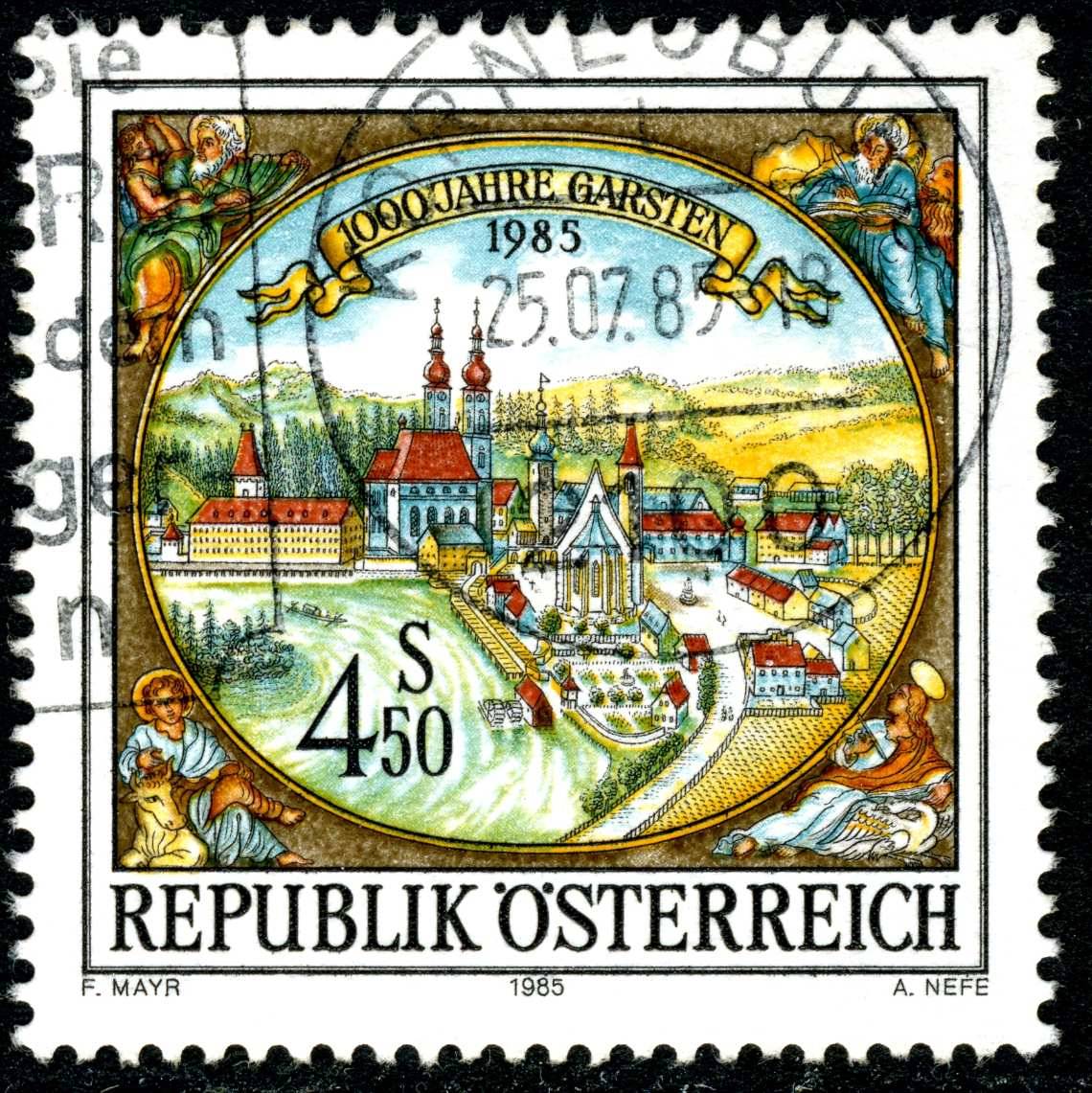 Since the downward shift in the yellow and blue (cyan) photogravure colours appears to be the same, where these 2 primary colours (the green of course a combination of both) applied on the same pass ? And then magenta for the red- brown and gold ? Would the black engraved portion have been applied before the Photogravure colours or on top as the final pass ? |
|
Send note to Staff
|
| Edited by lithograving - 10/07/2019 10:17 pm |
|
|
Pillar Of The Community
Canada
5821 Posts |
|
|
I really like those Transportation coils nethryk, hope you have the whole set for us.
BTW any particular reason for the light background ? |
|
Send note to Staff
|
|
|
Pillar Of The Community
Canada
5821 Posts |
|
|
Anthony, I'm sure you have a lot of more important things to do and probably  have a live outside of this forum but is there any chance in the future to get the engravers' list updated? I usually check page 47 to prevent duplication. |
|
Send note to Staff
|
|
|
Pillar Of The Community
Czech Republic
623 Posts |
|
|
lithograving - Actually, I had not noticed the blue colour shift to the right of the year 1985 until you pointed it out to me. Of course, the less noticeable with light colours the more conspicuous with dark colours where, with such a degree of the red-brown colour shift, the onion-shaped cupolas and roofs look as if falling down in the throes of an earthquake especially if the rest of the scenery seems in perfect order as for colour. It does look as if something went wrong with the printing of this issue. Thank you for showing your other copies of the stamp. In my country, photogravure colours are printed on separate passes each first and the engraved portion on top as the final pass if I understand it correctly. I think the process is much the same in Austria. Our combination prints, however, fail to achieve that marvelous fineness of engraved line which Austrian stamps are famous for. See e.g. WNS: CZ042.10 (Works of Art on Stamps - Paris and Helena) on http://www.wnsstamps.ch/enThe above-mentioned printing is, however a combination of offset and a single colour engraving printed from a flat plate on a Waite & Saville diestamp print press, not a combination print one colour engraving and multicolour photogravure on a WIFAG rotary press. (The rest of the 2010 Works of Art on Stamps set was printed in the traditional pure multicolour line-engraving on Waite & Saville diestamp print presses, of course.) |
|
Send note to Staff
|
| Edited by florian - 11/07/2012 08:46 am |
|
|
Pillar Of The Community
Canada
5821 Posts |
|
|
Thank you florian for the additional information regarding the types of printing presses. Always appreciated. I'm just wondering whether the Austrian State Printer used the same WIFAG press(es) since they began printing multicolour combination recess & photo in the late sixties ? The quantities produced at least for Austrian commemoratives was usually between 3 and 4 million and for the last decade down to around a million and for many issues much less. Of course then you have the foreign orders on top of that, like Liechtenstein, UN Vienna etc. Therefore there wouldn't have been that much wear and tear on these presses and they could still be in service. On the other would they still employ the old mechanical presses instead of modern high tech computerized, precision, high speed low labour intensive equipment ? Hard to get answers to these questions. About a week ago I sent an email to the guy in charge of Canada Post's philatelic section asking if he could provide info regarding printing presses used in the past by the various printers No answer yet. |
|
Send note to Staff
|
|
|
Valued Member
United Kingdom
314 Posts |
|
|
I have been working for some time on a Cinderella stamp display about the dummy stamps produced on WIFAG rotary stamp presses. I had as my source a listing produced by a WIFAG salesman of installations by them worldwide, as kindly supplied by a fellow collector. Austria is not on that list, despite their mention in other posts on this thread.
Can anyone please confirm either way as to whether WIFAG presses were ever used by OeSD? Often WIFAG stamps had two tell-tale extension pins in the margins (until Goebels also adopted this!) and I have not noticed this phenomenon on my Austrian dummy stamps.
Incidentally, the listing mentioned above showed that WIFAG presses were installed in Belgium, Brazil, China, Czechoslovakia, Egypt, Finland, Mexico, Poland, Russia, Sweden and Switzerland. I have the dummies from every one of these installations. If anyone can confirm other countries that are missing from this list, then I would naturally love to hear about them, preferably before I mount-up my pages!
GLENN MORGAN |
|
Send note to Staff
|
|
|
Pillar Of The Community
Czech Republic
623 Posts |
|
|
lithograving - As Glenn Morgan points out ÖSD will have never used a WIFAG press.
I believe they still use an improved and modernized version of their 1950s technology, i.e. detailed line-drawing of the design (eight times the size of the stamp) reduced by pantograph and shallowly etched into a steel plate to be worked on by the master engraver and then duplicated by electrotypy and finally printed on high-tech Koenig & Bauer – A.G. presses (see my post on p. 67).
Compare the fineness and density of the engraved lines in e.g. Georg Wimmer's 1947 engraving of the 1S.+40g. P.O.W. stamp posted by AnthonyUK on p. 73 with e.g. such an extreme case as that of the 1983 Linz Oberösterreichisches Landesmuseum stamp (Michel No. 1758).
And, finally, a perfect single-colour engraving is crowned with a perfect multicolour photogravure job as in your posting of Arik Brauer's Lieber Augustin in Wolfgang Seidel's interpretation on p. 71.
Of course, this is only my guess. But do you know any other printer achieving results of similar special quality? In my opinion, these are unique to ÖSD. |
|
Send note to Staff
|
| Edited by florian - 11/08/2012 05:16 am |
|
|
Pillar Of The Community
Czech Republic
623 Posts |
|
|
65170 - Thank you, Glenn, for the valuable list of countries where WIFAG rotary postage stamp presses have been in operation.
Might I ask when it was compiled and if there are any dates attached to it?
Also, could you explain or illustrate what you mean by 'two tell-tale extension pins in the margins' later on adopted by Goebel as well?
Thank you again.
Florian
|
|
Send note to Staff
|
|
|
Pillar Of The Community
United Kingdom
1361 Posts |
|
|
Next time I have some time off I try to set aside some time to update the index. There is some great info here now regarding print technology which is most welcome. I bought a small postwar Austria collection recently which I am sorting through  There are some great Nefe examples if nothing else so it wa good to see him mentioned again. |
|
Send note to Staff
|
|
|
Valued Member
United Kingdom
314 Posts |
|
|
Florian, Glad that the WIFAG listing was of use. I cannot find the scan of the salesman's listing at this time, but promise to search further over the coming days. All installations are dated and these are being compiled by me into a proper illustrated listing at this time to help make sense of it all before mounting-up material. The "two extension holes..." are best illustrated with a dummy stamp scan (Czechoslovakia, Jirasek design chosen with the additional benefit of showing how WIFAG numbered sheets and displayed date of printing). GLENN MORGAN 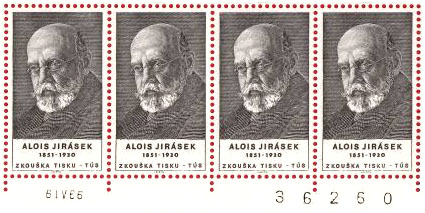 |
|
Send note to Staff
|
|
|
Valued Member
United Kingdom
314 Posts |
|
|
The listing of press installations shown below is by a single manufacturer, WIFAG, and in installation date order. It is based on the salesman's list, other philatelic research by myself, plus contributions by Derrick Slate, John Larson, Dave Cockrill and Rein C Bakhuizen van den Brink.
Other makes of press (especially Goebels and Stickney) will generally have been used by the printers mentioned before and / or after WIFAG presses were in vogue, but these are outside of the scope.
KEY: At the end of each entry on the final line are the letters I = Intaglio (recess), L = Letterpress (typography) or P = Photogravure. If the letters are repeated (say, PPP) this signifies that there was more than one of that type of printing unit on the press to enable more than one colour to be printed in a single pass. IPPP would therefore imply that one intaglio and three photogravure printing units were installed.
Here we go......
SWITZERLAND
Press(es) used 1945-1984 by Wertzeichendruckerei PTT (PTT Stamp Printing Works). This printing company was Founded 1930.
I (press known internally as SSR-2)
SWEDEN
Press(es) used 1949-1964 by PFA Stamp Printing Works. Founded 1920.
I
RUSSIA (USSR)
Press(es) used 1950s-____ by GOZNAK (State Printing House). Founded 1818.
IPPP
MEXICO
Press(es) used 1950s-____ by Talleres de Impresión de Estampillas y Valores [TIEV] (Stamp Printing Works). Founded 1875.
IP
BELGIUM
Press(es) used 1950-1978 by Algemene Werkplaats van het Zagel (Stamp Printing Office). Founded by 1849.
I
BRAZIL
Press(es) used 1951-____ by Casa da Moeda do Brasil (Brazilian State Mint). Founded 1694.
IPPP (two identical models with same configuration supplied)
CZECHOSLOVAKIA
Press(es) used 1951-1978 by TUS.* Founded 1951.
* Technická úst#345;edna spoj#367; (Technical Exchange of Postal and Telecommunication Services) then known as Poštovní Tiskárna Cenin Praha A.S. (Postal Printing House of Securities) from 1992.
IP (press known internally as WIFAG I)
POLAND
Press(es) used 1952-1978 by Panstwowa Wytwórnia Papierów Wartósciowych SA [PWPW] (Polish Security Printing Works). Founded 1919.
ILP
FINLAND
Press(es) used 1954-1990 by Suomen Pankin (Bank of Finland Security Printing House). Founded 1885.
IL
BRAZIL
Press(es) used 1956-____ by Casa da Moeda do Brasil (Brazilian State Mint). Founded 1694.
I
BELGIUM
Press(es) used 1956-1997min* by Algemene Werkplaats van het Zagel (Stamp Printing Office). Founded by 1849.
* Seen in-situ at stamp printing works by the compiler of this listing on a private visit to the works that year.
IPPPP (FLORIAN - note correction, by my addition of extra 'P' since initial posting. Sorry.)
CHINA (PRC)
Press(es) used 1959-2003 by Peking (now Beijing) Stamp Factory, also now known as Beijing Security Printers. Founded 1959.
Three presses installed at same time: 1) PPPP, 2) IPP, 3) I
EGYPT (UAR)
Press(es) used 1959-1971min by Postal Printing Authority Press. Founded 1959.
Two presses installed at same time: 1) PPP, 2) IPPP
RUSSIA (USSR)
Press(es) used 1961-___ by GOZNAK (State Printing House). Founded 1818.
PPP
CZECHOSLOVAKIA
Press(es) used 1966-2005 by TUS / PTC. Founded 1951.
IPPP (press known internally as WIFAG II)
SWITZERLAND
Press(es) used 1966-1993 by Wertzeichendruckerei PTT (PTT Stamp Printing Works). Founded 1930.
IPP (press known internally as SSR-3)
CZECHOSLOVAKIA
Press(es) used 1978-____ by TUS / PTC. Founded 1951.
IPPPP (press known internally as WIFAG III)
Hope this is of interest. Help with any of the missing info above would be appreciated, especially withdrawal year of the presses.
GLENN MORGAN
|
|
Send note to Staff
|
| Edited by 65170 - 11/09/2012 1:14 pm |
|
|
Pillar Of The Community
Czech Republic
623 Posts |
|
|
Replies: 3,980 / Views: 1,934,949 |
|




 Posted 11/05/2012 07:21 am


