| Author |
 Replies: 9 / Views: 1,298 Replies: 9 / Views: 1,298 |
|
|
Valued Member
United States
30 Posts |
|
|
Below is a comparison of two 30c Hamilton stamps. The stamp on the left I think is Scott 165 mostly due to its color. The stamp on the left is larger in size though the dimensions of the body of the stamps are the same and both perf 12. I have not been able to find any information that explains if the larger size of the stamp on the right is pertinent to its identification. I think the stamp is unused. The second picture compares the back of the two stamps. Help! 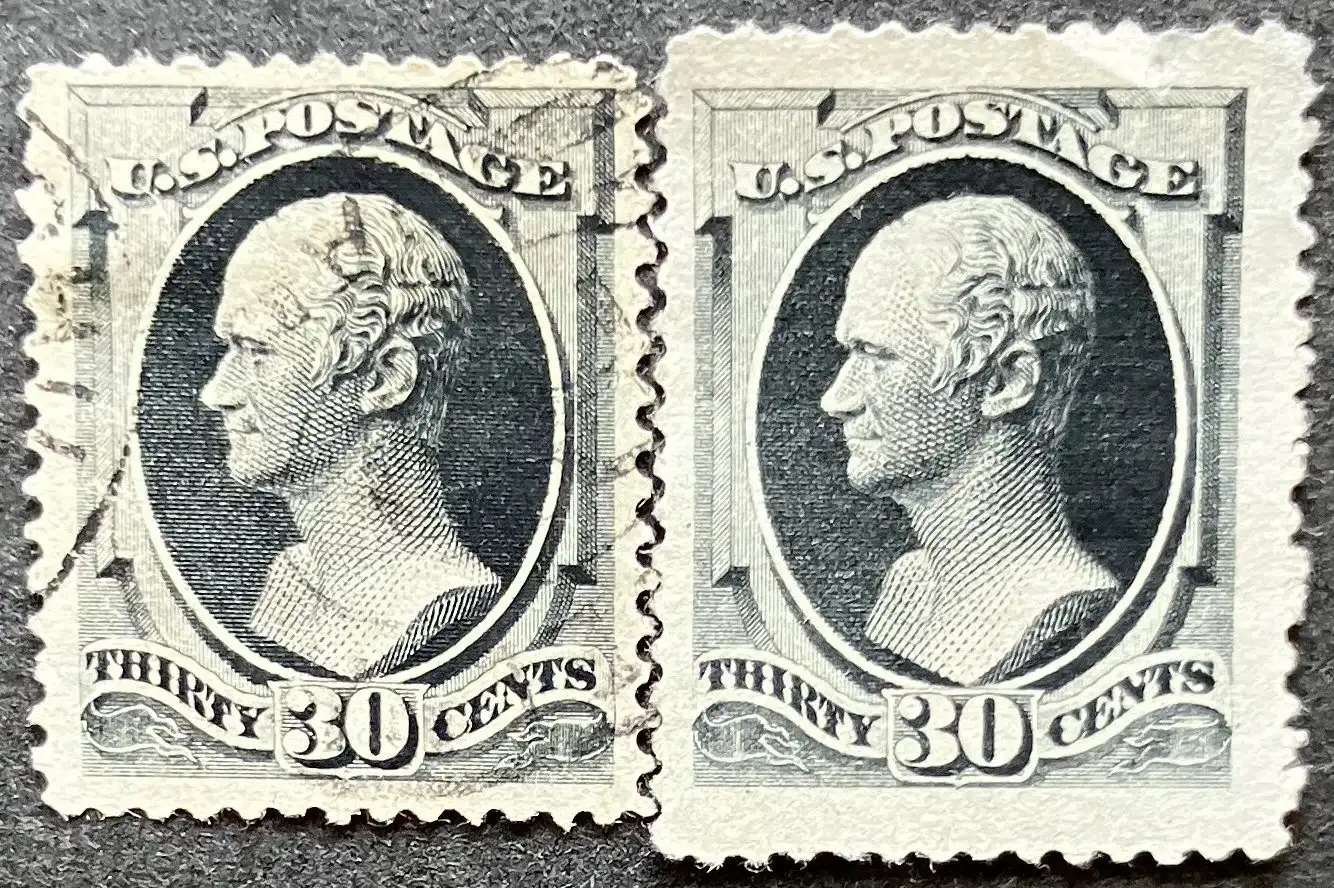 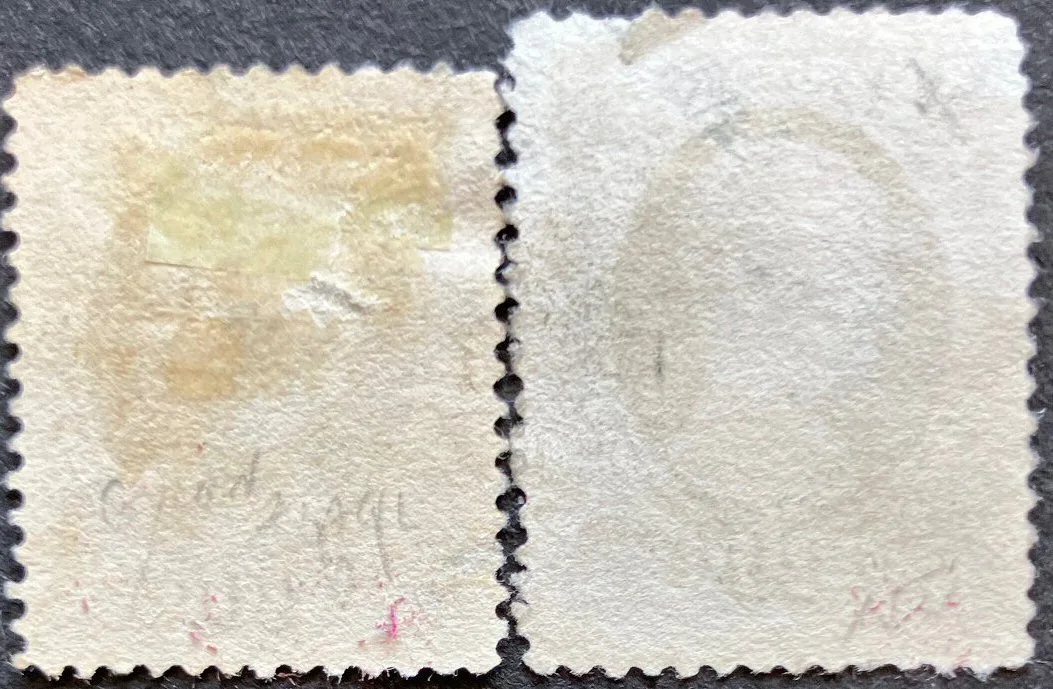 |
|
Send note to Staff
|
|
|
|
|
Pillar Of The Community
United States
1112 Posts |
|
|
Not the expert, but from the softness of the perforations and the images of the back, they both look like Scott #190. Can't really tell without stamps in hand. Hold them up to a lighted background. If mottled appearance, then they are #190. |
Send note to Staff 
|
|
|
Valued Member
United States
30 Posts |
|
|
So the absolute size of the stamp has no impact on identification of the stamp?
|
|
Send note to Staff
|
|
|
Pillar Of The Community
United States
1043 Posts |
|
|
Agree with Nicholas
Probably both 190
Jumbo margin stamps like bottom one are a characteristic of some soft paper American Bank note stamps, very rarely found on National with jumbo margins like that.
The actually size of the vignette is not a way to identify the Scott number. I wish it was that easy |
|
Send note to Staff
|
|
|
Valued Member
United States
30 Posts |
|
|
I was not focusing on the vignette but on the overall size of the stamp. I have reposted an image of the two stamps which is truer to the color of the stamps. The original photo washed out the color making it appear to be only black. I think the stamp on the right is greenish black and it has no grill so appears to be Scott 176 or 201. Holding it up to a lamp the paper appears to be soft porous so leaning towards 201, I thought the stamp on the left was more gray black in color but this photo indicates it is closer to a greenish black. Is this correct? Thanks! 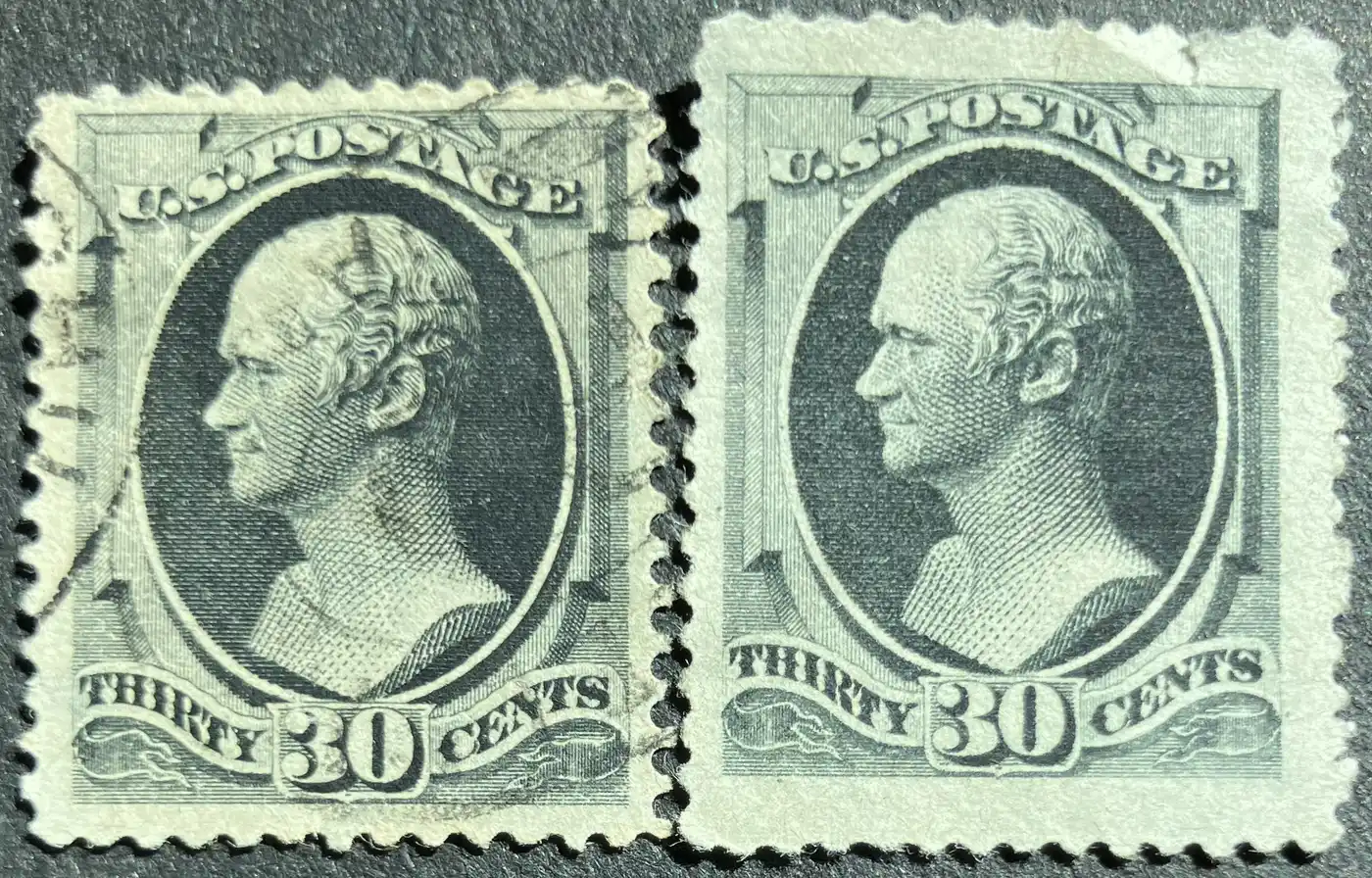 |
|
Send note to Staff
|
|
|
Valued Member
United States
30 Posts |
|
|
My mistake here. I see that 190 also has greenish black listed. I was relying on the Identifier of definitive issues which only states one color. I need to be more complete in my analysis.
|
|
Send note to Staff
|
|
|
Bedrock Of The Community
United States
10869 Posts |
|
|
I agree that they are both 190. The size difference occurred because the perforating wheels were adjusted differently for each sheet. This happened all the time, which is why centering varies so much. |
|
Send note to Staff
|
|
|
Valued Member
United States
30 Posts |
|
|
In a previous post I indicated that I did the light trick and they both did appeared to be soft paper. Thank you all. Your experise is greatly appreciated.
JT
|
|
Send note to Staff
|
|
|
Valued Member
United States
10 Posts |
|
|
The 30 cent Bank Note stamp was also printed on "double paper", listed as a variety of Scott 165, but examples are extremely rare. Under long-wave UV light, soft paper, like that used to print Scott 191, is "dead" or gray looking, front and back. Hard-paper Scott 165 examples would reflect more light, front and back. Some double paper examples reflect gray from the front and white from the back under UV. Others are bright front and back. Double paper stamps, aside from peeling if delaminated, are thick with an incoherent pattern when examined under strong back light. Thicker, fluffier American Bank Note soft paper, shows a clear pattern. To further confuse new collectors, Scott chose to classify stamps by the vendor instead of the paper. The Continental Bank Note Company moved transitioned from hard to intermediate and then to soft paper in their final year before the name plate on the door was changed to American Bank Note Company. Soft paper stamps produced by Continental Bank Note Company are priced as American Bank Note Stamps unless a clear date before Feb 4, 1879, is visible on the stamp or cover.
To make life even more complicated, a few stamps on hard paper exist with the American Bank Note Company Logo. This variety was discovered and reported by 1920. Only a handful of examples of 1 cent and 3 cent stamps are known. Other denominations may also exist. Stamps without logo capture in the margin or on attached selvage cannot be distinguished from Continental Bank Note hard paper. Evidence that the American Bank Note Company ordered a small amount of hard paper for an experimental printing is documented in a USPCS article by Ron Burns. |
|
Send note to Staff
|
| Edited by clarkphilatelics - 03/18/2026 01:48 am |
|
|
Pillar Of The Community
United States
1946 Posts |
|
|
revcollector wrote:
"The size difference occurred because the perforating wheels were adjusted differently for each sheet. This happened all the time, which is why centering varies so much."
This is a common misconception. Jack Reinhard in Strictly U S back in 1976 provided a detailed/labelled schematic of a 200 subject plate layout of the period, and shows that all the stamps on the edges of the plate all around have additional margin for the perforations. These positions have extra margin above or below or top or bottom. Resetting wheels had nothing to do with it for the general run of things. |
|
Send note to Staff
|
|
| |
Replies: 9 / Views: 1,298 |
|



 Posted 03/07/2026 2:54 pm


