Back on topic....
Quote:
In my twenties, I could wait for an item to come around again as it was easy to "outlive" the collector's interest. Now at 70, such is not a good guarantee of success. I will be posting such an item I recently purchased in this thread once it is in hand,or at least out of the hands of the seller.
This item's purchase was one which placed me squarely in the quandary laid out in this thread. It came at a time I did not want to really spend money on anything but a targeted purchase. And that is the problem in these circumstances, things appear without warning and are a serious addition to a collecting area. That is how we all get on the horns of a dilemma as described in the OP.
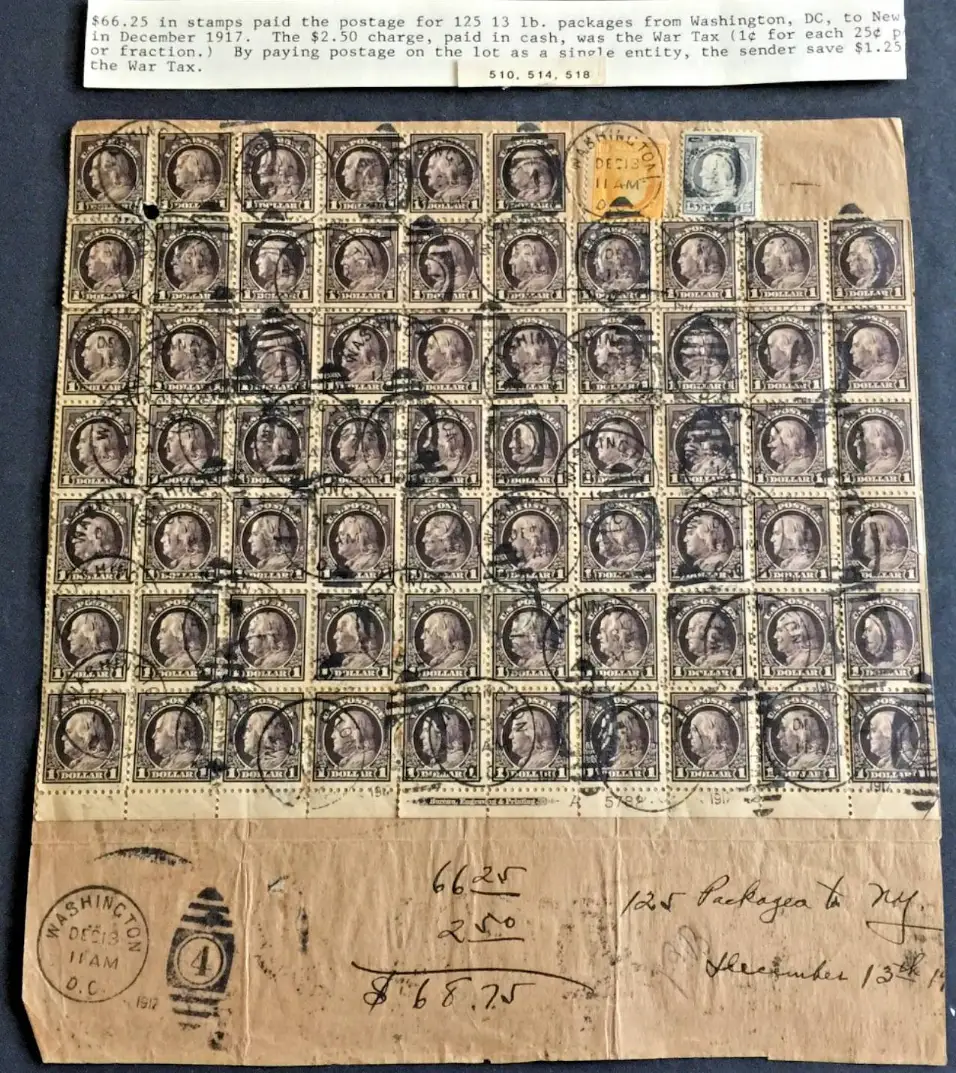
The item's background needs some explanation as it is not really obvious due to the blinding effect of 66 $1.00 Scott #518s which includes a full plate block of 6.
In response to the costs of WWI, the US Government needed to raise money and did so with many types of taxes and quasi-taxes. This extended to the Post Office. Beginning 11-2-1917 the cost of first class was raised from 2 to 3 cents, ending after 6-30-1919.
The same law raising postage created the WWI Parcel Tax for domestic parcel post. A fee (tax) of 1 cent for the first 25 cents of Parcel Post postage and 1 cent for each 25 or fraction cents thereafter was imposed. Additionally a little known incoming foreign Parcel Tax was also collected based upon the value of the parcel, not postage, and applied to a zero value and up. Both parcel taxes were to be collected and shown as paid by use of documentary stamps (Scott 1917 Series beginning with Scott #R228). The WWI Parcel Tax did not start to be collected until 12-1-1917, continuing through 12-31-1921. I collect such material and it is generally uncommon at best.
Next we need to understand that multiple packages can be sent from one sender to one addressee as a group with the postage being paid all at once on the entire bag, bin or box of two or more packages. This saved money at times and also allowed for smaller multiple shipments to be sent together when for example a company's private insurance would only cover a lost package up to a certain amount. I have examples of Platinum being mailed out of Alaska in small packages rather than one large package.
The item shown was postage for 125 packages from a sender in Washington, DC to an addressee in New York City. Parcel Post postage total was $66.25 with the WWI Parcel Tax then being $2.50 for the group. If the tax was paid on the individual parcels it would have totaled $3.75 in WWI Parcel Tax, thus the group mailing saved $1.25 in addition to any postage savings. The weight per package in the text is close, but not spot on.
Lastly this was an example from the first month of the application of the WWI parcel tax.
This was not an item I had seen in my decades of collecting such WWI Tax items, nor did I expect it to surface again in my lifetime. So what to bid? That was my dilemma. I calculated what I could afford right now and hoped for the best. I won but there were 7 bidders and two snipes in the 24 bids posted. Now if it showed the documentary stamps, the price calculus by me would have been different (higher) as I would have dropped some other material which I planned to purchase as this item would be a hill to die on.
While prepared to win at my max, I would have been happy to get the item but quite unhappy about the price as that "extra money" had better places to be, if possible.





 Posted 04/12/2026 7:02 pm