| Author |
 Replies: 16 / Views: 3,984 Replies: 16 / Views: 3,984 |
|
Pillar Of The Community
United States
1518 Posts |
|
|
|
I'm still trying to figure out a lot of things and I've some questions about plate blocks, numbering,
Is it better to have a block of six, or four, with numbers seem to be more desirable than those with zip code or etc. Are consecutive or same numbers better?
Any advice on selling? Are Numbers and inventory sufficient, or is it better to scan each one?
|
|
Send note to Staff
|
|
|
|
|
Pillar Of The Community
United States
6756 Posts |
|
|
Quote:
Is it better to have a block of six, or four, with numbers The size of the plate block depends on the issue. While it is true that most plate blocks are in blocks of 4, some plate blocks must be collected in larger sizes because of the type of plate or the type of stamp issue. Many of the early plate blocks are often collected in strips of 3, and then blocks of 6. It was not until the 1930's that plate block of 4 became the more common standard. Later on in the 1960s-1980's, plate blocks had to be collected in blocks of 6 to as much as blocks of 20 (for the combination press). You should check your Scott US Specialized catalog to determine the proper plate block size. Have the wrong plate block size, and you lose the premium -- ending up with nothing more than the equivalent of a bunch of singles. Quote:
with numbers seem to be more desirable than those with zip code or etc. From a retail point of view, yes; but only because there are more plate block collectors than zip block collectors. I really enjoyed collecting matched sets of Mr. Zip blocks, but I am part of a dying breed.  Quote:
Are consecutive or same numbers better? In general, the value of a particular plate number does not depend on how numerically "interesting" the number may be. Rather, it depends on the scarcity (or lack of availability) of that plate number. The Durland plate block catalog provides an excellent guide to the scarcer plate numbers. There are also a few "interesting" plate numbers (e.g., inverted plate number...) that are not necessarily scarce but do have a very slight premium simply because of they are odd-balls. Quote:
Any advice on selling? Are Numbers and inventory sufficient, or is it better to scan each one? If you are selling them at face value or less, I see no reason to scan each one. If you are selling them above face, then yes, it would be wise to scan each one unless the buyer knows/trusts you. A collector who is trying to plate all the numbers will want to know the plate number and the position (e.g., UL=UpperLeft, UR=UpperRight...). |
Send note to Staff 
|
|
|
Pillar Of The Community
United States
5894 Posts |
|
|
Excellent, khj! I would only add that some collectors (dedicated people) collect the same plate block number in all four positions of the sheet. I am trying to find the Durland catalog. They don't have it at my local shop right now. Hard to believe I have been collecting US plate blocks for over 30 years (on and off). |
|
Send note to Staff
|
|
|
Pillar Of The Community
United States
6756 Posts |
|
|
Quote:
I am trying to find the Durland catalog. I have 1 or 2 older used Durlands if you are unable to find one. However, because I normally don't sell supplies, the price will not be competitive. If you cannot buy one elsewhere, then email me if you are interested and I will give you a price quote. |
|
Send note to Staff
|
|
|
Pillar Of The Community
United States
6756 Posts |
|
|
Quote:
some collectors (dedicated people) collect the same plate block number in all four positions of the sheet. Yes, and some collectors (insane people) collect the same plate number in full panes for all possible positions of the original press sheet. We won't mention any names to protect the guilty. |
|
Send note to Staff
|
|
|
Pillar Of The Community
United States
5894 Posts |
|
|
Yeah, I was going to mention these people using that same appellation. Along with the appellation of wealthy. Or perhaps both, insanely wealthy. |
|
Send note to Staff
|
|
|
Pillar Of The Community
United States
1518 Posts |
|
|
So... how does that happen? I'm missing something. I've some items which have a number / nextcolumn odd number; then another set with the next set of numbers up. Explain please. |
|
Send note to Staff
|
|
|
Pillar Of The Community
United States
6756 Posts |
|
|
Most stamps were printed by more than one plate. The plates are numbered in the order of production (put into press). So sometimes, for a given stamp, there may be sequential plate numbers with no skipping, or sometimes there will be a jump from one plate number to another quite different number. That means in between, some other plates were created for printing OTHER stamps.
If you can give some specific examples (e.g., the Scott number, and also the different plate numbers you see for that Scott number), then I can more specifically answer your question. |
|
Send note to Staff
|
|
|
Pillar Of The Community
United States
6756 Posts |
|
|
Quote:
So... how does that happen? I'm missing something. I've some items which have a number / nextcolumn odd number; then another set with the next set of numbers up. Explain please. Without a specific example, I can only guess you are referring to PBs issued starting in the 1980's. During that decade, BEP switched from the unique 5-digit sequential numbering system for each plate, to a individual single-digit number system for each plate color. So for a given stamp, you may see something like #A11111, #A22222, #A22232... Whenever a plate color is replaced, that digit of the plate number is incremented by one. In the old system, it would have went something like this 28676, 28677, 28678, 28679... Again, if you give a specific Scott number and plate numbers, I can explain more specifically. |
|
Send note to Staff
|
|
|
Pillar Of The Community
United States
5894 Posts |
|
|
I liked the old system better (with one plate block number, not these 8-10+ stamp plate blocks). |
|
Send note to Staff
|
|
|
Pillar Of The Community
United States
752 Posts |
|
|
for us stamps, in older day's, say the 1940's to 1970's a plate block of 4 with the plate number attached to the margin was considered standard except in those issues where the plate number was not on a margin but in the middle of selvage for a block of 6. As you started having bicolar, then tricolar plate numbers like with the eagle and shield where the entire selvage essentially was a plate number, things really started getting out of hand. Except for something like Scott #1053, the $5 Hamilton, I think the market for plate blocks went the same way as the market for mint sheets that were hoarded in the 1950's with the idea that they were going to appreciate and turned out to be worth nothing. Today, I would soak a plate block that found its way on postage but otherwise would not consider saving mint PB's and the only PB's I would consider spending money on would be on classic US, pre 1920 |
|
Send note to Staff
|
|
|
Pillar Of The Community
United States
1518 Posts |
|
|
Ok, here's my "sample" for Scott 1306; and I'm not getting a layout which would do this. 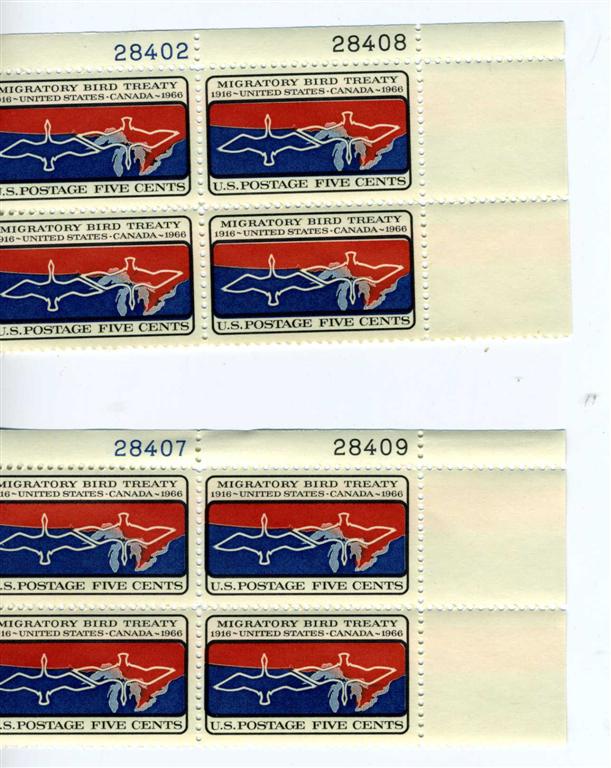 |
|
Send note to Staff
|
|
|
Pillar Of The Community
United States
5894 Posts |
|
|
US 1306 plate blocks feature two plate numbers, the first number (closest to corner) is for the plates with the red ink, and the black ink. The second number (furthest from the corner) is for the plate with the blue ink. These are therefore, as they should be, plate blocks of four in the UR (upper right) position. The other positions would be in the other corners of the pane (of four sheets).
With this style of plate number, every successive plate that was used was given a plate number of one greater than the previous. Rarer plate numbers are usually those at the end of the production run of stamps, where the plates had not been used up, or where a plate was damaged or worn prematurely. In your example, the first one bears an earlier plate numbers than the second example. The Durland catalog would tell you how many stamps were printed with a particular (or particular set) of plate numbers. |
|
Send note to Staff
|
|
|
Pillar Of The Community
United States
6756 Posts |
|
|
Pillar Of The Community
United States
1518 Posts |
|
|
Thanks all of you! I'm just trying to create spread sheets and inventory what's here, and I'm asking questions as they seep into my brain. So busy with the former, I've not lots of leftover time to research answers... that's be next week. :) |
|
Send note to Staff
|
|
|
Pillar Of The Community
United States
5894 Posts |
|
|
I do not advise using spreadsheets to track stamps, especially if you are at all familiar with using a database. A database offeres much greater versatility, and can hold much more information. khj: Well, this is one area of philately where I know a little bit about it (I mean that literally, I have much to learn).  |
|
Send note to Staff
|
|
|
Replies: 16 / Views: 3,984 |
|




 Posted 07/26/2010 9:26 pm


 k
k
