| Author |
 Replies: 11 / Views: 2,118 Replies: 11 / Views: 2,118 |
|
|
Bedrock Of The Community
United States
12128 Posts |
|
|
I happen to like these Special Handling Stamps because of their ornate designs, very similar to what you'd find on U.S. currency: 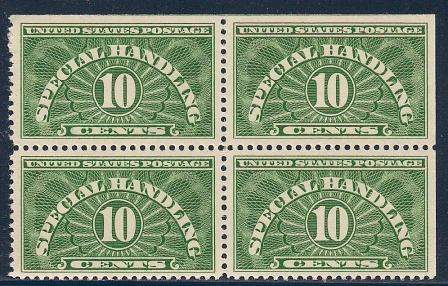 While I know this particular block isn't worth all that much, even though it is MNH, I have a question about its straight edges. It looks to me as though the straight edges are right out of the UR corner of a pane of these stamps. Am I right? I'm only questioning it because I am used to seeing most U.S. stamps having a narrow perforated selvage on all sides and not the straight edges shown. Just wondering if this is considered typical for this issue? |
|
Send note to Staff
|
|
|
|
|
Pillar Of The Community
United States
5894 Posts |
|
|
Yes, it is. Stamps from the straight-edge border are considered less desireable. |
Send note to Staff 
|
|
|
Bedrock Of The Community
United States
12128 Posts |
|
|
Thanks. It's what I thought, I just wanted to make certain. Less desired or not, I still like the way you can easily tell where it came from within the pane of stamps.
I suppose this example is a typical example of why straight edges are found on so many of the commemoratives and regular issues of the early 20th century. |
|
Send note to Staff
|
|
|
Pillar Of The Community
United States
5894 Posts |
|
|
True enough. I like your margin block of 4 and I like that you can indeed tell what part of the sheet it came from. My temptation would be to get a plate block of them. |
|
Send note to Staff
|
|
|
Pillar Of The Community
United States
4106 Posts |
|
|
wt1..I am not sure why some people think straight edges are less desirable. I guess it's a matter of opinion.
Stamps are stamps. I do like your margin block. |
|
Send note to Staff
|
|
|
Pillar Of The Community
United States
2480 Posts |
|
|
Quote:
I'm only questioning it because I am used to seeing most U.S. stamps having a narrow perforated selvage on all sides and not the straight edges shown. WT1, Here is a "margin block of four with plate number" (edited to correct terminology) of the QE1 showing the selvage that you were referring to. I haven't confirmed it but the difference between your block and mine may be associated with the wet and dry printing methods used on the first three stamps of this issue. Steve  |
|
Send note to Staff
|
| Edited by tomiseksj - 10/21/2010 9:35 pm |
|
|
Bedrock Of The Community
United States
12128 Posts |
|
|
I never much thought about it, but you maybe right about the wet v. dry printings, although there isn't much difference in value between them. Although not a plate block, I do have this MNH margin block of the 20 cent variety (QE3) and IMO it shows a distinctly yellow green color, much lighter than that of the 10 cent variety. 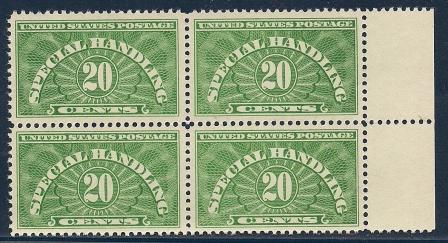 BTW, aren't plate blocks of this issue supposed to be collected in blocks of 6? |
|
Send note to Staff
|
| Edited by wt1 - 10/21/2010 6:48 pm |
|
|
Pillar Of The Community
United States
5894 Posts |
|
|
It is my experience that dry-printed stamps are lighter in color and inking than wet-printed stamps which seem to have darker and stronger colors. |
|
Send note to Staff
|
|
|
Pillar Of The Community
United States
1721 Posts |
|
|
[quote]BTW, aren't plate blocks of this issue supposed to be collected in blocks of 6?[/quote}
Yes, that is correct. Here is the BIG but. Up until the mid 1970's all P.B.'s were 4. Then Someone decided that was not sufficient. The following year Scott changed all that were not in the corner to 6. I vividly remember looking up my Plate Blocks and being very upset that they were no longer considered P.B.'s.
|
|
Send note to Staff
|
|
|
Bedrock Of The Community
United States
12128 Posts |
|
|
Quote:
Up until the mid 1970's all P.B.'s were 4. Then Someone decided that was not sufficient. The following year Scott changed all that were not in the corner to 6. Very interesting. I never knew about this change in the 1970's. I do know that there are some modern issues of the 70's and 80's that had to be collected in multiples as plate number strips, claiming that the printing types demanded multiple plate numbers, and then all of a sudden it seemed that most of the newer issues went back to plate blocks of 4 a few years later. I wonder who made the change from a PB of 4 to 6 on the earlier issues? Was is only based on the Scott catalog? Could there have been an ulterior motive behind it (i.e. an attempt to devalue PB's or 4 that were already in collector's hands)? It just seems to me there would have been a big uproar in the stamp collecting community when that happened. Come to think of it, a similar situation exists with plate number coils and line pairs. I used to collect some and was always taught to collect line pairs by 2 ... then plate numbers appeared on the newer stamps and I started collecting them in strips of 3 with the center stamp having the plate number, then all of a sudden it went to strips of 5. |
|
Send note to Staff
|
| Edited by wt1 - 10/21/2010 8:49 pm |
|
|
Pillar Of The Community
United States
2480 Posts |
|
|
Quote:
I do have this MNH margin block of the 20 cent variety (QE3) and IMO it shows a distinctly yellow green color, much lighter than that of the 10 cent variety. Here is another QE3 block of 4 that to me appears much darker than either of the images you posted. Again, the wet vs. dry may be at play here. The Wet and Dry Printings explanation in my 1983 Scott US Stamp Catalog indicates that the "dry" printings show whiter paper, a higher sheen on the surface, feel thicker and stiffer, and the designs stand out more clearly than on the "wet" printings. On that basis, I believe this block was dry printed.  |
|
Send note to Staff
|
|
|
Pillar Of The Community
United States
2547 Posts |
|
|
The dark green are the wet printing, the lighter yellowish green are the later dry printings. |
|
Send note to Staff
|
|
| |
Replies: 11 / Views: 2,118 |
|




 Posted 10/21/2010 1:59 pm


