| Author |
 Replies: 9 / Views: 2,281 Replies: 9 / Views: 2,281 |
|
|
Pillar Of The Community
United States
6668 Posts |
|
|
This could be one of the hardest Stamps to figure out the color / Shades of. Many of us are chasing the proverbial "Pot of gold at the end of the Rainbow" and trying to find the elusive Pigeon Blood Pink /Pink / Lake or Scarlet. Here is a scan showing 10 Stamps that all have a different shade, but yet are all the same color (I think). I'm 99% sure all shown here are Rose.  |
|
Send note to Staff
|
|
|
|
|
Moderator

United States
4788 Posts |
|
|
Good point stallzer. I think the issue is further complicated when computers get involved -- the proper calibration of scanner and video color palettes is a black art at best. A friend of mine has a Sypder but only because of her work. For most people, it's just too much trouble to keep everything "perfectly" calibrated. KirkS |
Send note to Staff 
|
|
|
Pillar Of The Community
United States
644 Posts |
|
|
None of those are pinks. True Pinks have a true pink shade to them... think bubblegum, 59 Cadillac, Barbie Corvette..etc. Pigeon Blood Pinks, once seen in person, are actually quite distinct. PGPs have a pretty distinctive bluish haze to them. |
|
Send note to Staff
|
|
|
Pillar Of The Community
United States
1947 Posts |
|
|
Why is it that the rose shades sometiomes seem to have a hint of brown in them. My concept of rose is a deep pink color with a smidgen of red in it. (not the lighter pink of the true pink shades of this stamp)
Look at the third stamp and compare it with the fourth stamp. The third is brownish, while the fourth doesn't show any brown and is closer to what I think of as rose. (All of this is my perception. Maybe others will have different takes on this) |
|
Send note to Staff
|
| Edited by rohumpy - 11/18/2010 06:13 am |
|
|
Pillar Of The Community
United States
644 Posts |
|
|
rohumpy,
A lot of it is due to actual changes of the stamp itself over 140-150 years. Many of the inks used are quite capable of reacting with the environment. |
|
Send note to Staff
|
|
|
Pillar Of The Community
United States
6668 Posts |
|
|
To expand on that it is how were thery individually stored, sunlight exposure, etc. Every stamp in the picture is Rose, AFAIK. |
|
Send note to Staff
|
|
|
Pillar Of The Community
United States
2547 Posts |
|
|
The 65 rose varies considerably from dull to bright and from brownish to reddish. Although the ink formula for the rose probably changed little during production the ink making process had significant variability. The grain size of the pigment and amount of pigment would affect the color. Additionally, the ink was heated to help thin it and this process altered the color through oxidation. The hotter it got and the longer it was heated would cause it to oxidize and become more brownish. Below is a picture of Bureau of Printing and Engraving personnel grinding pigment and mixing ink (about 1890). This would have been very similar to the ink making process used by the National Banknote Company. Not what we would consider a well controlled process. 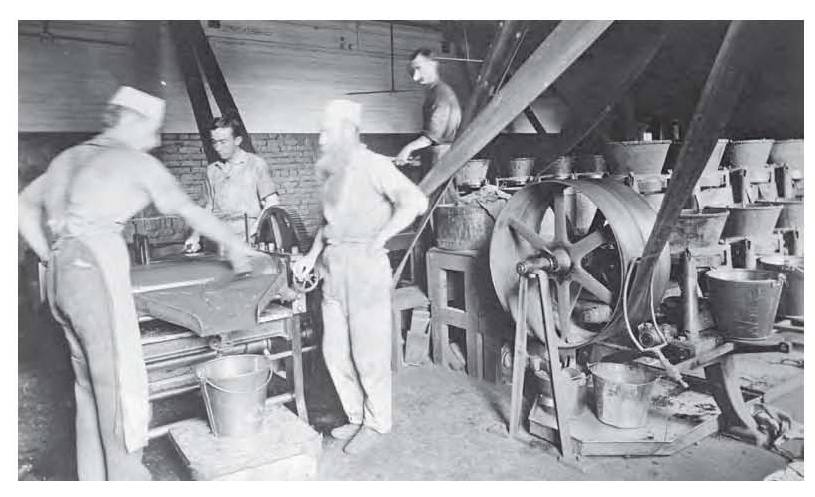 |
|
Send note to Staff
|
|
|
Pillar Of The Community
United States
644 Posts |
|
|
Russ basically nailed it, they made, what, 1.75 Billion of these? I'm surprised they managed to be as consistent as they were.
They made about 10 million 24c stamps during the same period, and look at the color variations on *_those_* |
|
Send note to Staff
|
| Edited by billw2 - 11/18/2010 7:31 pm |
|
|
Bedrock Of The Community
Australia
38679 Posts |
|
|
Rest in Peace
Canada
5701 Posts |
|
| |
Replies: 9 / Views: 2,281 |
|




 Posted 11/17/2010 06:30 am


