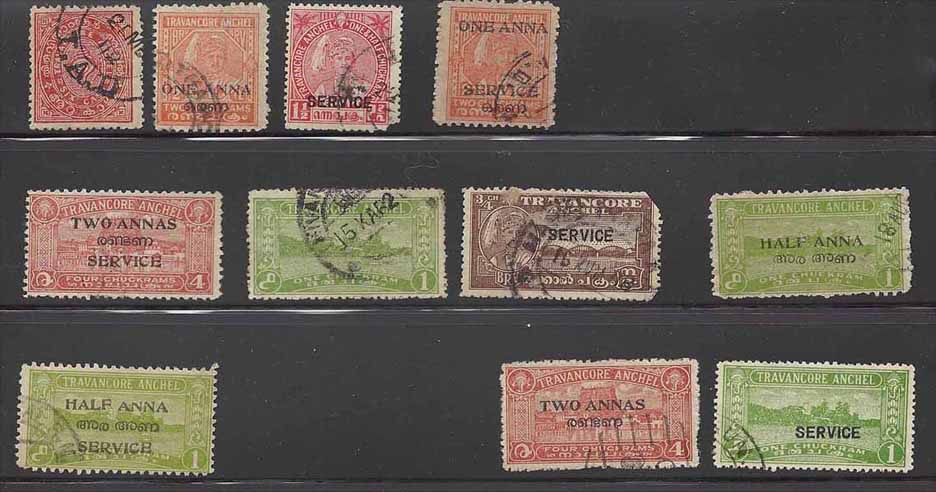
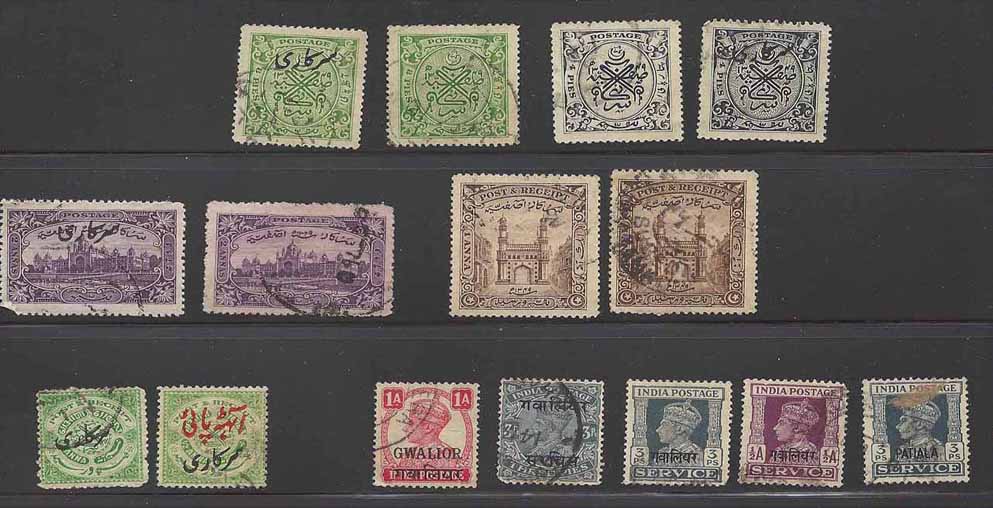
Stampdog, you've turned up a few curly ones. Anyway, running through your stamps row by row:
Row 1: Travancore, Travancore-Cochin, Travancore, Travancore-Cochin
Travancore-Cochin was formed in 1949, by combining the old States of Cochin and Travancore. Travancore had had its own currency, but the new combined State used Indian currency. This meant that the old Travancore stamps had to be surcharged with their equivalent (or near equivalent) values in the Indian currency used by the combined State. You can find combination covers of stamps of the former Cochin State used with these Travancore State stamps surcharged in Indian currency. This is an example (stamps for government use):

Row 2: Travancore-Cochin, Travancore, Travancore, Travancore-Cochin
Row 3: Travancore-Cochin, Travancore-Cochin, Travancore
Rows 4 and 5: Hyderabad
Hyderabad was the largest of the Indian States, and might have been big enough to stand alone as an independent country. It (almost) always felt that it was beneath its dignity to put its name on its stamps. The stamps in row 4 show the monogram of the ruler, the Nizam (who was, at the time, reputedly the richest man in the world). The stamps with the black overprint were Service (= official use) stamps.
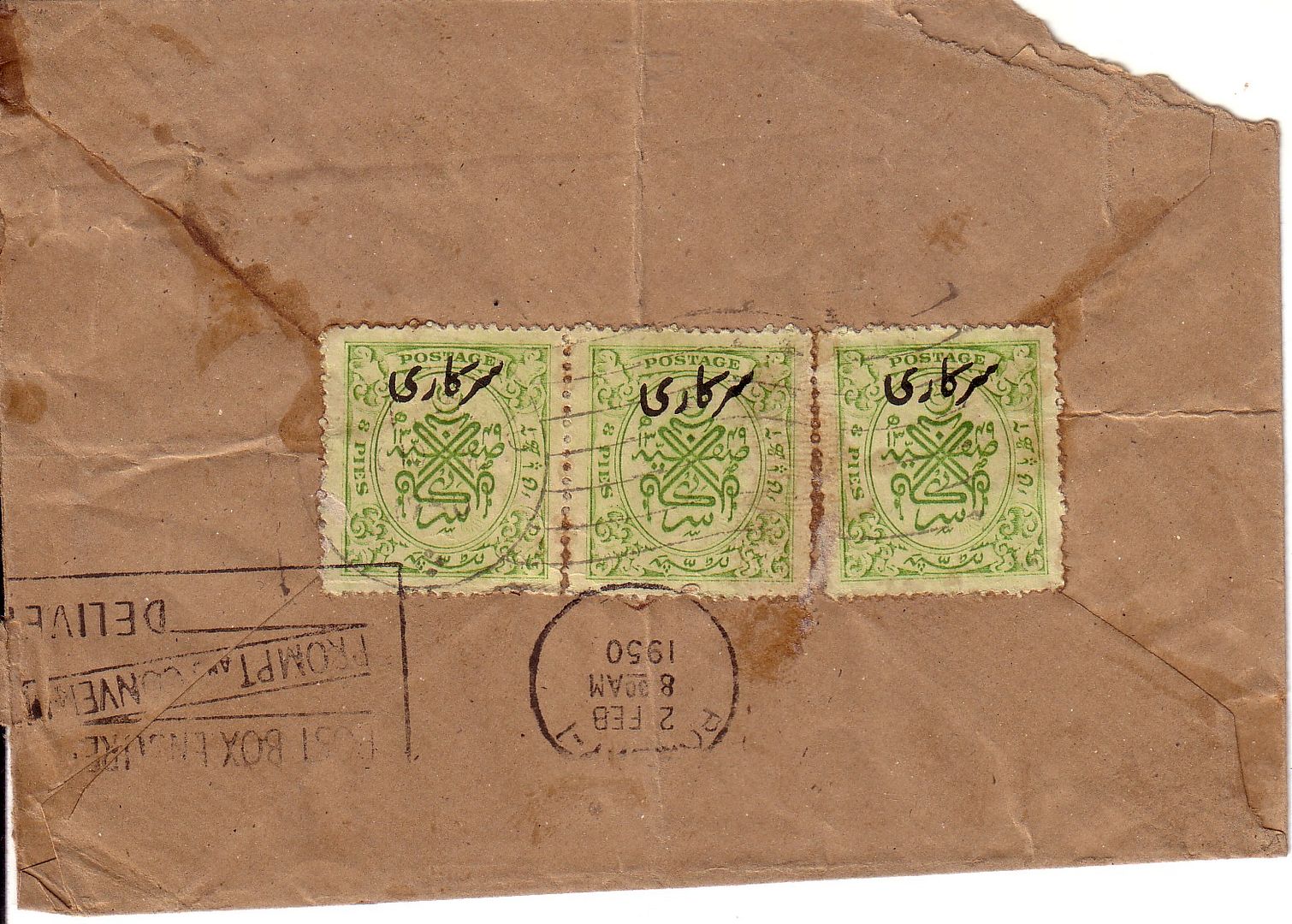
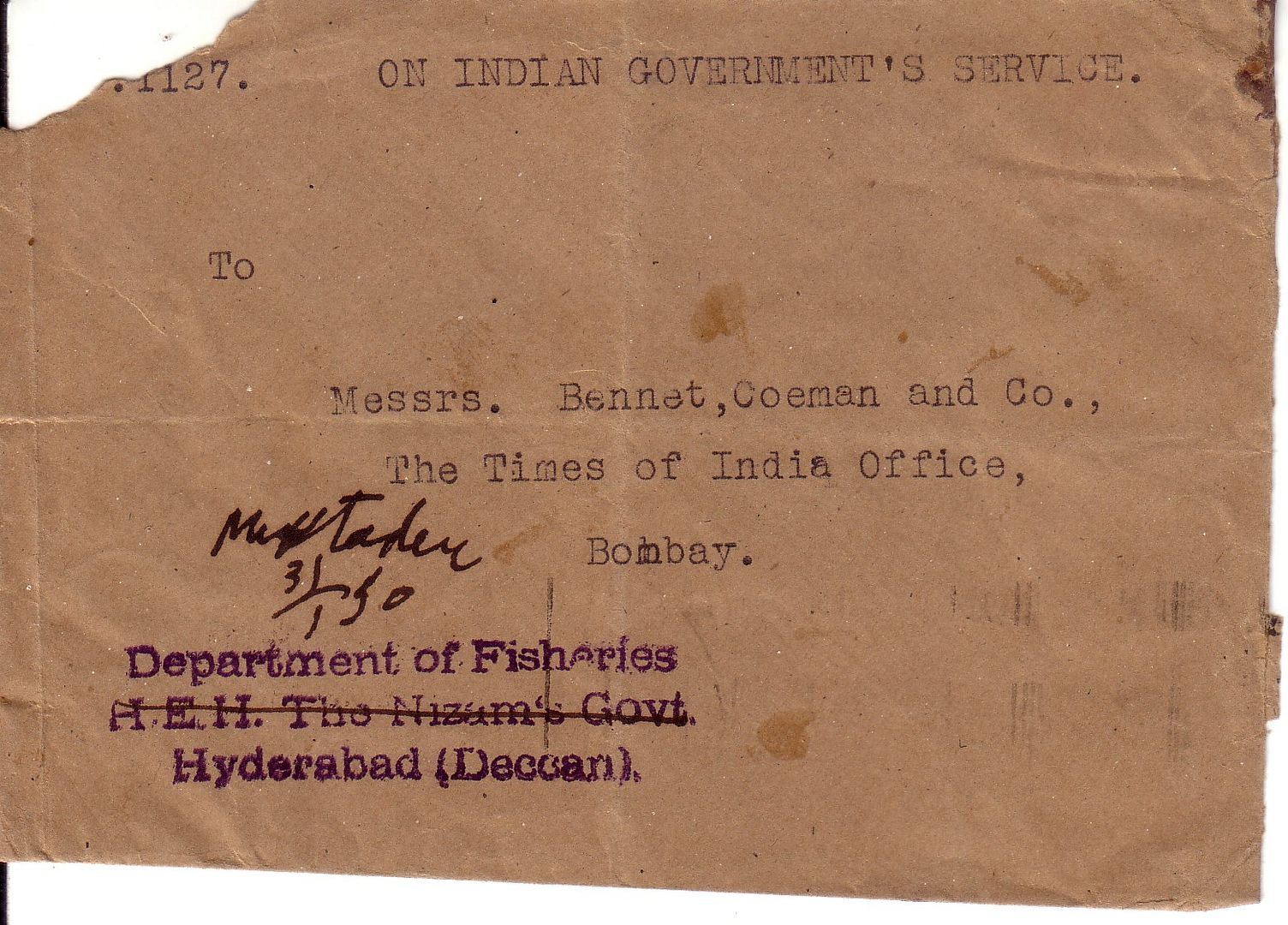
As a special concession to Hyderabad, because of its importance, the British allowed Hyderabad Service stamps to be used on official mail to the rest of India, without needing to add British Indian stamps. Here is an example, sent to Bombay, outside Hyderabad territory:
Row 6: Hyderabad, Hyderabad, Gwalior, Gwalior, Gwalior, Patiala
You'll find Gwalior and Patiala listed under the Convention States. In 1885, several States agreed to use British Indian stamps overprinted with the name of the individual State. In return, the stamps were valid for destinations throughout India, unlike non-Convention states. Their stamps were mostly valid only within the State boundaries. Gwalior was the biggest of the Convention States, and one of the biggest of all the States. As a special concession to Gwalior, it was allowed to include its name in Hindi, and to use only Hindi on its Service (official) stamps. This is an example of a Gwalior stamp being used to Sambhar in Jaipur State, and a centre of the salt trade - a destination outside Gwalior

This would not have been possible if Gwalior wasn't a member of the Postal Convention. Jaipur State also issued its own stamps, but the return letter from Sambhar to Gwalior, would have had to use British Indian stamps, because the Jaipur State stamps weren't valid outside Jaipur.





 Posted 01/03/2011 8:30 pm