The English writer, Nancy Mitford, writing about her father, Lord Redesdale, to another English writer, Evelyn Waugh, in 1950:
"A letter from my Dad, to whom I write saying if you don't hear from me as often as you ought to it's because I have such a mass of writing. He says yes don't people write a lot of meaningless letters I can't think how they can afford it I imagine they must steal stamps from their servants. Quite a new idea to me."
Preventing the servants from stealing the stamps, or perhaps the peerage from stealing the servants' stamps, was a great preoccupation in 19th Century India. Senders of letters went to great lengths to achieve it, and to stop tampering with their mail.
A common stratagem was to write 'Stamped' across the stamp, before or after it was stuck to the envelope. This was most often used by the British, but here is an example on a cover from Jammu & Kashmir to Calcutta:

This may have preserved the Jammu & Kashmir stamp. However, mail from Jammu & Kashmir to British India required an Indian stamp for carriage into India. The reverse of the cover

doesn't have one, although it does have a suspicious blank space, and half a cancellation at the top, where a stamp may have been removed. That didn't save the recipient from a 1 Anna (say 1 cent) postage due charge.
Some other letter writers in Jammu & Kashmir went to more extreme lengths to 'pre-cancel' their stamps on their covers. Pen strokes all around the stamp were popular:

and

Another method of preventing tampering with letters was to write '74½' in front of the address. From Frits Staal's
The Stamps of Jammu & Kashmir, pp124-125:
'Envelopes even more than single stamps are often marked with scribbles, lines, dots, or other symbols that are supposed to prevent them from being taken away or opened by unauthorized outsiders. A similar practice adopted by Hindus in Jammu and Kashmir, Indore, Jaipur, and so on is to write: //74// at the beginning of the address to insure safe delivery of the letter. ... Professor Bruce Pray has drawn my attention to a story translated from the Hindi in Linguistic Survey of India, vol. VI, pp48-49 about the miraculous powers of song. The singer Tan-sen sang with such force that all the lamps at the court of Emperor Akbar lit themselves, and Tan-sen himself burst into flames and fell down dead. Earlier, he had warned that if such a thing would happen, he could be brought to life only by Queen Kamla of Chittaur. The Emperor therefore attacked Chittaur and a terrible battle ensued. Seventy-four and a half maunds (one maund being equal to approximately 80 lbs.) of sacred threads were collected from the corpses of the slain. Queen Kamla was taken prisoner, and when ordered to sing, she sang with such force that her soul burst its way through her skull and went to heaven, leaving the audience with their mouths open in astonishment. The number 74½ is still written on letters as the strongest of seals, for "the sin of the slaughter of Chittaur" is thereby incurred by all who violate the letter.'
Once you start looking for this on old Indian covers, it bobs up quite frequently. Here it is, at the beginning of the address, in the top line, next to the stamp (Jammu & Kashmir again)

And here it is, written extra large at upper left, on a cover from Jaipur:
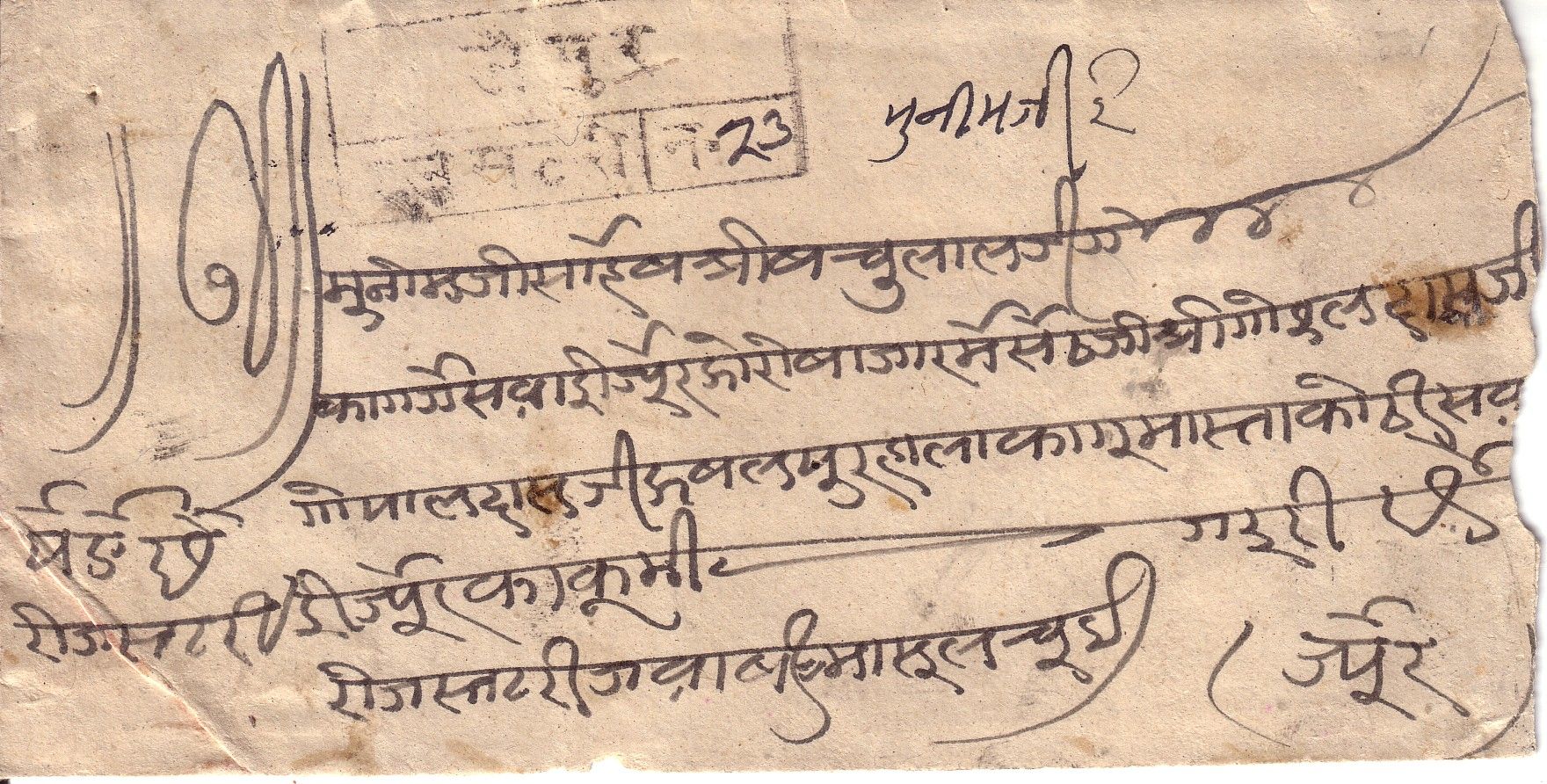
Senders also tried to prevent tampering in other ways, as in this example from Jaipur:

Altogether, quite an interesting little sideline!





 Posted 01/21/2011 12:28 am


