| Author |
 Replies: 9 / Views: 2,253 Replies: 9 / Views: 2,253 |
|
|
Pillar Of The Community
United States
3568 Posts |
|
|
OK I need a little help here. This should be India, but didn't the colonies follow the same rules about changing stamps as England. Victoria had been dead for 4 years now in December 1905. But all that aside. I still don't have any book to give me a catalog for BOB world. So I could use some help and I will thank everyone ahead of time. I have been collecting for over 50 years and that means an accumulation of lots of "oh my gosh another question mark". Thanks to everyone for help and patience. There will come a time when I can help back. 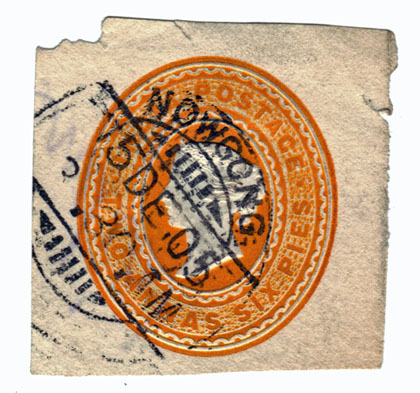 |
|
Send note to Staff
|
| Edited by jhlovell - 01/24/2011 10:15 pm |
|
|
|
|
Pillar Of The Community
2664 Posts |
|
|
well I got a 6 yr old prestamped enveleope fromthe post office so thats no biggie.
yes that is india although I think its naigaon instead of nowgong. you know like chattogram was made into chittagong.
but all things aside vicky inspite her faults looked pretty on those enveleopes and on her earlier coins |
Send note to Staff 
|
|
|
Pillar Of The Community
Australia
3547 Posts |
|
|
Yes, I agree with Spock. A couple of years later was no big deal. The British Indian Post Office was extremely frugal. It never threw out anything, and certainly not just because there was a new monarch. I have this piece from Patiala State  Probably philatelic, but equally, I'm sure it could have simply represented the stamps of those values sitting in the counter book on the day. |
|
Send note to Staff
|
|
|
Bedrock Of The Community
Australia
38679 Posts |
|
|
Please excuse me, but I think Spock is in error.
The name he quotes is a railway station
I think Nowgong should be Nagaon
I am happy to stand corrected.
BTW great cancel
beautiful stuff to those of us who collect them.
|
|
Send note to Staff
|
| Edited by rod222 - 01/25/2011 04:51 am |
|
|
Pillar Of The Community
Australia
3547 Posts |
|
|
In the 1880s, there was a Nowgong was in the Northern Circle, and another in the Bengal Circle. According to Wikipedia also, there are two Nowgongs: one now in Bangladesh, the other, "Nowgong, also called Naogaon, town, northern Madhya Pradesh state, central India. Nowgong is connected by road with other centres and is a major agricultural distribution centre. Chemical and pharmaceutical works and a distillery are the major industries. An important civil centre and military cantonment, Nowgong served as the British headquarters of the Bundelkhand Agency. The town has a hospital, a government polytechnic institute, a college affiliated with Awadesh Pratap Singh University, and a college for officer training. Pop. (2001) 33,024."
I like the second. The 'civil centre and military cantonment' makes it a likely source of mail. |
|
Send note to Staff
|
|
|
Pillar Of The Community
United States
3568 Posts |
|
|
Thanks to everyone. I got quite the lesson in Nowgong history. And no one mentioned much about the stamp, so I assume it's a "nothing". Thanks to all. Catch you all at the next question mark! Jeff |
|
Send note to Staff
|
|
|
Bedrock Of The Community
Australia
38679 Posts |
|
|
Quote:
so I assume it's a "nothing". Jeff, please send your "nothings" to me  I will gratefully accept and look after these babies. That cut square has a story to tell. Quote:
In the 1880s, there was a Nowgong was in the Northern Circle, and another in the Bengal Circle. Nice overview Tony,  can you please explain further your "circle" descriptions for the entire India? |
|
Send note to Staff
|
|
|
Pillar Of The Community
Australia
3547 Posts |
|
|
But of course, Rod.
British India was, a huge area with a huge population to administer for postal purposes. This led the British Indian Post Office to divide the country innto a number of 'Circles', based around the major cities. So there was for example a Bengal Circle, centred on Calcutta, a Bombay Circle, centred on Bombay, and a Northern Circle, which took in a large slab of northern and central India, based for a time on Agra. The Circles were subdivided (Punjab and Central India Circles were carved out of the Northern Circle) and reorganized regularly, but I think (perhaps a modern India specialist can correct me) the modern India Post Office still retains the theory of Circles.
Between 1873 and 1884, the India Post Office used various types of duplex cancellations. The left hand part was a conventional circular date stamp, with the town name and date (often without the year), and the right hand part usually a square killer, and usually with a code letter and number indicating the post office. The system became quite involved as it evolved, to show the Circle code letter (B, C, M etc), a code for the main post office, and lower levels of post office reporting to the main office. Robson Lowe's Encyclopaedia of British Empire Postage Stamps shows examples of an R-15 cancellation for Thayetmo in Burma; R being for the Rangoon Circle, 15 indicating that Thayetmo was main office number 15 in the Circle. He also shows an M-11/2 cancellation: M for Madras Circle, 11 for the Bangalore main office, and 2 for Conjeeveram, as the second subsidiary office under Bangalore. |
|
Send note to Staff
|
|
|
Pillar Of The Community
United States
3568 Posts |
|
|
Each stamp does have its' own story. I can't tell you how many people (strangers) I have called to find out if they were related to the recipient of one of the covers I have. Many interesting connections and whether the people were related or not, I always came away with a story and a smile. |
|
Send note to Staff
|
|
|
Pillar Of The Community
2664 Posts |
|
|
specilaist you say we even have philatelic circle these days my dear tony |
|
Send note to Staff
|
|
| |
Replies: 9 / Views: 2,253 |
|




 Posted 01/24/2011 7:28 pm


