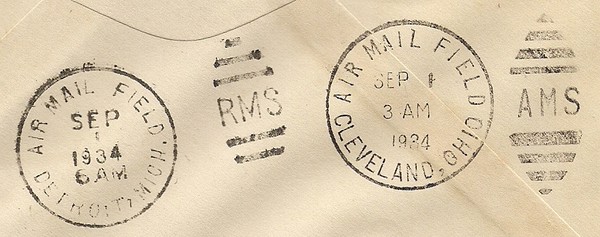
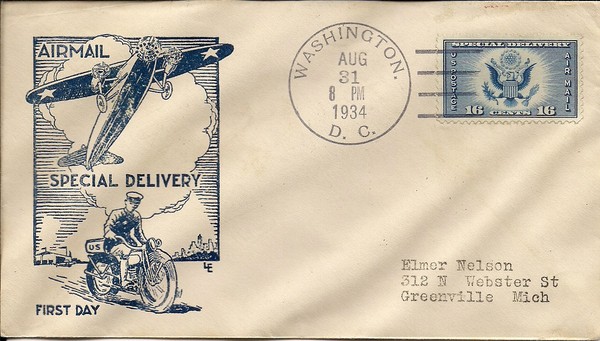
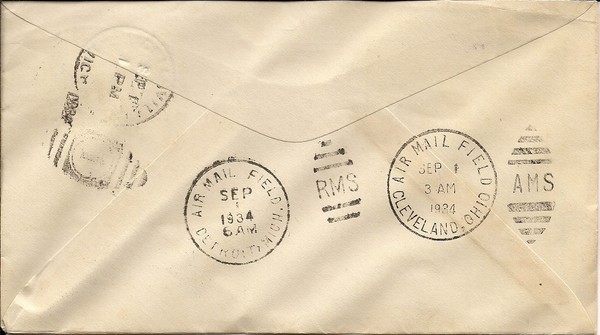
Quote:
Still one more question: Who's the cachet maker?
I did some research and looked this up (as I had no idea who the cachetmaker was either). An old newsletter from the AFDCS answered my question in an article about some common names used in addressed FDC's of that period ... sure enough, my cover has the "Fairway" watermark, and his name is the addressee, so it can most certainly be attributed to him. (Another website suggests this type of cachet is "thermographed":
Quote:
Elmer Nelson also operated in Washington DC where
he worked for the Internal Revenue Service and the Social
Security Administration. He is best known for his Fairway
cachets, so-named for the Fairway watermark found on the
envelope paper that he first used.
The "problem" with the internet, is you can easily get "information overload" as the history below about this cachetmaker reveals, which is probably more than you wanted to know

:
Quote:
About Fairway Cachets (1923-1941) and Elmer Nelson Servicing Uncacheted FDCs (1926-1931) [Revised 1/22/11]
Elmer Nelson owned and operated the Fairway Cachet brand in Washington DC, from 1923 to 1940. Nelson's address in 1932 was 612 F St., N.W. Room 205, Wash DC according to a #724-18a stuffer I have seen, and in 1935 was 610 F. St. N.W., Washington D.C., according to a #771-12, 16c Farley Reprint Special Delivery which I have seen. I also have a #720b-4c Fairway Cachet on Air Mail Envelope addressed to Elmer Nelson at 312 N. Webster St, Greenville MI (perhaps a seasonal or temporary address he used for FDCs posted via Air Mail from Washington DC).
Fairway is best known for producing Cacheted FDCs for Commemorative issues. The First Fairway Cachet was #610-2, issued with a 9/1/23 Washington DC postmark for the Harding Memorial Commemorative. This was the same day George Linn issued his historic "First True FDC Cachet" for the same stamp, in Marion Ohio. Fairway's #610-2 consists of a brown printed reply envelope addressed to Walter I. Plant of Washington D.C., with a printed general purpose eagle icon that was probably added later. (Monty et al., First Cachets Revealed, 2006, p. 5; Mellone, Planty Vol. I, 1994, p. 2). According to Monty, the Last Fairway Cachet was Scott #902-16, 3c Thirteenth Amendment, 10/20/40 (Monty et al., First Cachets Revealed, 2006, p. 5; Mellone, FDCs of the 1940s, 2006, p. 33). I have seen a later Fairway Cachet, however, the 30c denomination from the #C25/C31 Air Transport Series, with a First Day of Sale on 9/26/41.
Less well known today is that Elmer Nelson simultaneously serviced Uncacheted FDCs for at least some issues of the Fourth Bureau Regular Postage Series of 1922-1935. These uncacheted Fourth Bureau FDCs were apparently not publicly associated with the Fairway brand of cacheted FDCs, but can be attributed implicitly to Nelson by (1) envelope size of 6"x3-1/2" (the slightly smaller size also used by Servicers Nickles and Philip H. Ward Jr., and by Cachetmaker Albert E. Gorham)' and by (2) a distinctive style of addressing by typewriter and addressograph. This Nelson style uses an addressograph plate prepared with pica typewriter font (with letters somewhat closer together than the pica font of Servicer H. F. Colman, who did not use addressograph) to make the name and address as concise as possible. Nelson or his typist often sparsely abbreviated the addressee's first and middle name with initials only, and tended to eliminate words like "St" and "Ave," or abbreviating Ave as merely "A".





 Posted 01/27/2011 12:33 pm