Stamp Community Family of Web Sites
Thousands of stamps, consistently graded, competitively priced and hundreds of in-depth blog posts to read


Stamp Community Forum
 
Username:
Password:
Save Password
Forgot your Password?

This page may contain links that result in small commissions to keep this free site up and running.

Welcome Guest! Registering and/or logging in will remove the anchor (bottom) ads. It's Free!

Prestamped Envelopes - Used

 
To participate in the forum you must log in or register.
Author Previous TopicReplies: 8 / Views: 2,286Next Topic  
Pillar Of The Community
Canada
921 Posts
Posted 02/12/2011   2:08 pm  Show Profile Bookmark this topic Add backroads to your friends list Get a Link to this Message
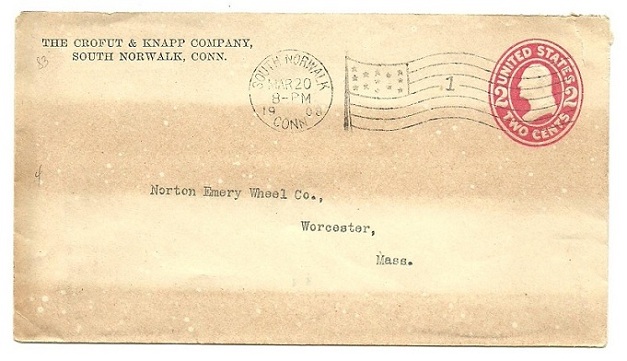
I ran across this very nice looking cover with a neat flag cancel but it raised a number of related questions which I would like to toss out to the experts.

First - it is obviously a preprinted business cover. See the return address plus the business logo on the reverse. How were these done? Did the Post Office simply sell the envelope and the business have a printer do the necessary work, or...?

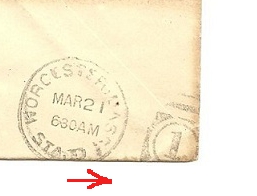
Second - there is a received post mark on the reverse. Worcester Mass Sta.D?? It has the date and time but no year. Was this common?

Third - also on the reverse, there is a number 11 in blue that appears to be on the same angle as the postmark. Is this a Post Office marking or something entirely unrelated?

Amazing, isn't it, how a simple, common cover can raise so many questions.


Send note to Staff

Pillar Of The Community
United States
5894 Posts
Posted 02/12/2011   2:18 pm  Show Profile Bookmark this reply Add smauggie to your friends list  Get a Link to this Reply
In my experience, the business bought the stamped envelope and then had a private printer add the embellishments.

To answer the question about the year, it was in between the CDS and the football (killer bars).

The red arrow points to where the year would be (if there was paper underneath the stamp at the time).


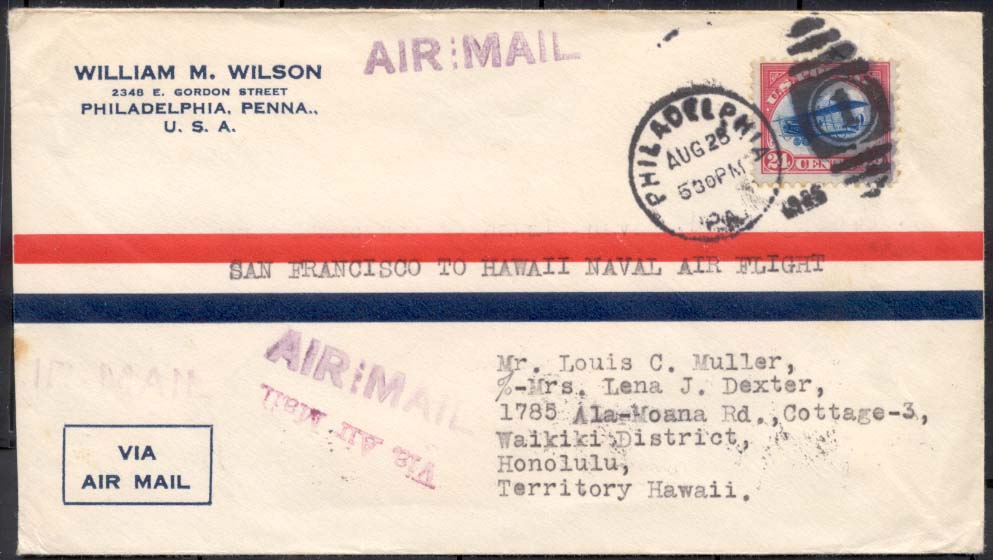
Here is an example of that type of CDS with the year.
(I realized I picked this at random from my digital archives. I do not own this cover.)

It isnt all that clear, but the year is 1918.
Send note to Staff  Go to Top of Page
Edited by smauggie - 02/12/2011 2:22 pm
Pillar Of The Community
United States
2544 Posts
Posted 02/12/2011   2:31 pm  Show Profile Bookmark this reply Add chasa to your friends list  Get a Link to this Reply
Most of the formal looking return addresses, known as "corner cards" were produced by the post office as a low-cost service to mailers. They still provide that option: https://shop.usps.com/webapp/wcs/st....ac=10004000
Send note to Staff  Go to Top of Page
Pillar Of The Community
United States
2547 Posts
Posted 02/12/2011   3:04 pm  Show Profile Bookmark this reply Add Russ to your friends list  Get a Link to this Reply
Nice flag cancel, it is a machine cancel applied by an American Postal Machine Co. Model B14. The "11" on the back was probably applied by either the sender or receiver (perhaps a department number). The receivings backstamp is a duplex handstamp. There were a lot of varieties including the "RMS" (Railway Mail Service" and "PTS" (Postal Transportation Service) and a variety of numbers, letters or just bars.
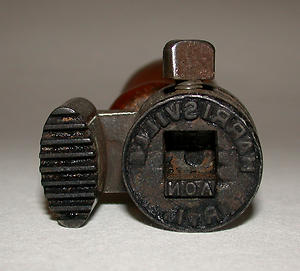
Below is an example of a duplex hand cancel without date/time slugs.
Send note to Staff  Go to Top of Page
Bedrock Of The Community
United States
12128 Posts
Posted 02/12/2011   3:15 pm  Show Profile Bookmark this reply Add wt1 to your friends list  Get a Link to this Reply
You might find this interesting as to the addressee (Norton Emery Wheel Co., of Worcester, Mass.) -- they are still in business today:


Quote:
In 1858 Franklin B. Norton and his older cousin Frederick Hancock left Bennington, Vermont, and opened a pottery shop at Washington Square in Worcester. When they had to move in 1866 because of railroad-related construction, they relocated to Water Street. At first they made only redware pottery, but soon added stoneware to their production. They supplied Worcester and surrounding towns with an incredible variety of jugs, preserve jars, storage and cooking pots, pitchers, spittoons, beer bottles and water kegs.

Of pottery and grinding wheels...
New industries created a demand for new grinding wheels that could cut metals and other hard materials better than traditional sandstone wheels. Early wheels designed to meet this need were made of wood with a glue surface that was embedded with grains of emery (an abrasive). They were temperamental at best. In 1873 Norton employee Sven Pulson invented a wheel of superior quality by mixing clay with emery and water and kiln firing it. Frank Norton applied for a patent and in 1879 expanded the business to include manufacture of Pulson's wheels. Co-owner Frederick Hancock so opposed this move that he sold his interests to his cousin and retired. The enormous demand for Pulson's grinding wheels dramatically increased the factory workload. Due to deteriorating health, Norton sold the booming wheel business in 1885 to return to the quieter routines of making jugs and pots. Five years later his pottery closed its doors, the result of a decreased demand for stoneware.

When Sven Pulson left the company in 1880, his brother-in-law and fellow employee John Jeppson took over wheelmaking. When Frank Norton no longer wanted to manage the incredibly successful grinding wheel operation, Jeppson offered to buy it, in partnership with fellow employees Walter L. Messer and Charles Lucius Allen, WPI instructors Milton Prince Higgins and George I. Alden, and Washburn & Moen employees Fred H. Daniels and Horace A. Young. The partners purchased the business for $20,000 in 1885. As part of the deal, they acquired use of the Norton name, a share of the Water Street factory, and the rights to Pulson's formula.

Of grinding wheels and fortunes...
The newly incorporated enterprise, Norton Emery Wheel Company, held an advantageous position in the market. The company was producing Pulson's wheels at a time when the American Machinist advocated, "Every complete machine shop should have at least one emery wheel if only for grinding tools." In 1887 the company moved from Water Street to a large new factory at Barbers Crossing in the Greendale section of Worcester. A single wagon containing all the equipment, followed by the workforce of thirteen, carried out the move. The building, which stood along two railroad lines, contained 17,280 square feet of floor space and two kilns. It was probably the best-equipped grinding wheel factory in the country at the time. By 1890, the plant had expanded eight-fold. For all of the company's extraordinary growth, the partners ran it much like a family.

New direction, new heights
In 1900 Charles H. Norton -- no relation of the company's founder -- left a Providence firm and came to Worcester where he met with Norton Emery Wheel officers. He showed them plans for a revolutionary new cylindrical grinding machine. Seeing its market potential, Norton officers decided to incorporate a subsidiary company for its manufacture. On February 27, Norton Grinding Company was born.

The new machine was unparalleled in its precision, speed, and grinding capabilities, and was an enormous success. Subsequent inventions kept Norton Grinding at the cutting edge of innovation. In 1919 the owners formally announced a merger of Norton Emery Wheel and Norton Grinding Wheel. Norton Company entered a period of unprecedented production.

New developments, new mergers, new horizons ...
Norton adapted as market needs changed. Steel and the rough alloys that steel plants produced required a more consistent abrasive than natural products like emery. The company bought patent rights for the artificial abrasive alundum, which soon wholly replaced emery in wheel manufacture. Because production of this abrasive required intense heat, Norton erected a furnace at Niagara Falls (the height of the falls generated the necessary power). In 1904 Aldus Higgins invented a water-cooled furnace that dramatically cut production costs and gave the company a huge competitive edge.

Today Norton is the largest manufacturer of abrasives in the world, and it has also expanded into other fields. Their production divides into three groups: abrasives, engineering materials, and petroleum and mining. After more than a century of local ownership, the company was purchased in 1990 by Compagnie de Saint-Gobain of France. Norton Company remains a significant presence in Worcester.


Interestingly (as shown on the graphic on the back of the envelope) Crofut & Knapp of South Norwalk, CT was a hat company.
Send note to Staff  Go to Top of Page
Edited by wt1 - 02/12/2011 3:21 pm
Pillar Of The Community
United States
2547 Posts
Posted 02/12/2011   3:26 pm  Show Profile Bookmark this reply Add Russ to your friends list  Get a Link to this Reply
wt1, Norton is one of the largest abrasive manufacturer in the world. They used to (maybe still do) make felt based polishing wheels and belts. Perhap Crofut & Knapp was a felt supplier to Norton?
Send note to Staff  Go to Top of Page
Bedrock Of The Community
United States
12128 Posts
Posted 02/12/2011   3:41 pm  Show Profile Bookmark this reply Add wt1 to your friends list  Get a Link to this Reply
Makes perfect sense to me!
Send note to Staff  Go to Top of Page
Pillar Of The Community
Canada
921 Posts
Posted 02/12/2011   4:56 pm  Show Profile Bookmark this reply Add backroads to your friends list  Get a Link to this Reply
Great information everyone. Everything I wanted to know and more besides.

FYI, now that I have these great sources, I have taken to printing the information and including the sheets in the binder with the item in question. A great way to enhance a collection.
Send note to Staff  Go to Top of Page
Bedrock Of The Community
Australia
38679 Posts
Posted 02/12/2011   5:10 pm  Show Profile Bookmark this reply Add rod222 to your friends list  Get a Link to this Reply
The "11" was an interesting mark.

Sometimes in Australia philately,
even up to the 1980's one could get a "20"
written on covers.
This indicated a special rate of postage
A bundle of 20 envelopes, to the same postcode
received a special low rate postage per piece.
Send note to Staff  Go to Top of Page
  Previous TopicReplies: 8 / Views: 2,286Next Topic  
 
To participate in the forum you must log in or register.

Go to Top of Page

Disclaimer: While a tremendous amount of effort goes into ensuring the accuracy of the information contained in this site, Stamp Community assumes no liability for errors. Copyright 2005 - 2026 Stamp Community Family - All rights reserved worldwide. Use of any images or content on this website without prior written permission of Stamp Community or the original lender is strictly prohibited.
Privacy Policy / Terms of Use    Advertise Here
Stamp Community Forum © 2007 - 2026 Stamp Community Forums
It took 0.2 seconds to lick this stamp. Powered By: Snitz Forums 2000 Version 3.4.05