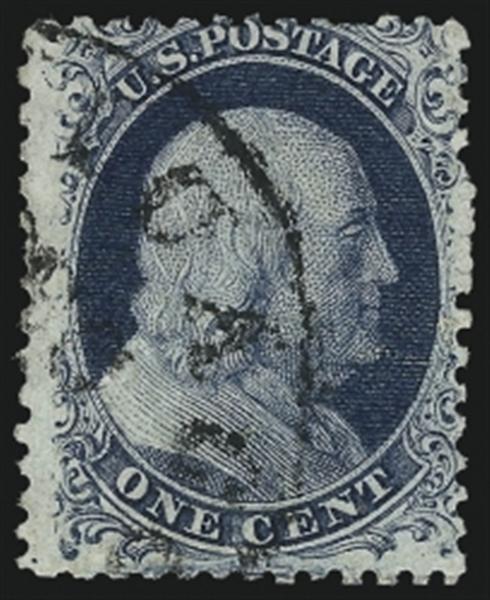
The stamp-in-question arrived in my mailbox day before yesterday. It's a sound, good looking stamp. Let's have some fun!
In the following discussion, please let's remember the following:
- I've been into philately since November 2010. So yes, I am a newbie, a greenhorn, an amatuer, inexperienced, an FNG. I don't intend to represent myself otherwise.
- In front of every statement, assume that I have prefaced it with, "I think" or "my best guess" or "I don't have enough experience to say for certain, but." If we assume it up here, I won't have to write these qualifying phrases over and over again down there.
So is it a Scott #7 with unofficial "Chicago" perforations? According to the Philatelic Foundations page on the
The One Cent Stamp Of 1851 & 1857:
Quote:
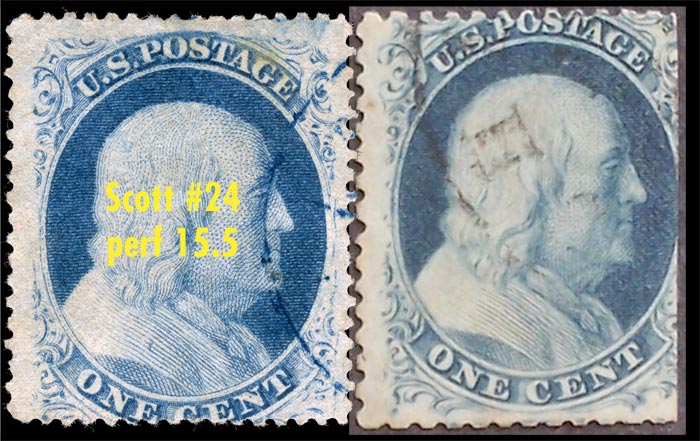
The "Chicago perfs" are imperforate One Cent and Three Cents stamps of the 1851 issue, which were unofficially perforated at an approximately 12.5 gauge. They are found used, generally from Chicago, during the latter part of 1856 and early 1857, before official government perforations, which were 15 gauge, came into general use. The history of the "Chicago perfs" can be found in J. Wagshal, "The Origin of the 'Chicago Perfs,' A Great Mystery Solved" in the Chronicle of the U.S. Classic Postal Issues 130:100 (May, 1986). Most "Chicago perfs" are found on the Three Cents denomination. Less than 20 "Chicago perf' One Cent stamps (Type II and Type IV) have been recorded.
The Siegel
listings further mention that the stamps come from plate 1 late or 2.
Necessary:
- Plate 1 late or 2
- Type II or IV (#7 or #9)
- 12.5 gauge perforations
Helpful:
To begin with, here is a 1200dpi scan of the stamp-in-question:

Type II
So the first question, is it a type II? The stamp has a straight right edge, so that should mean it came from the 10th column on the left pane of the plate. Looking at
The 1¢ Franklin Plating Archive for stamps in the tenth column of plate 2, I have a candidate in
20L2. In particular, ornaments A and K look the same, and there is a mark on the Left Full Plume that looks the same. Unfortunately, the other 20L2 markers are cut off. The Plume mark also appears on
60L2, but the K ornament is different.

Even if 20L2 is not right, in comparing the Side Ornaments at Left to 20L2 and other type II relief A examples, I am going to say it is a type II, relief A from plate 2.
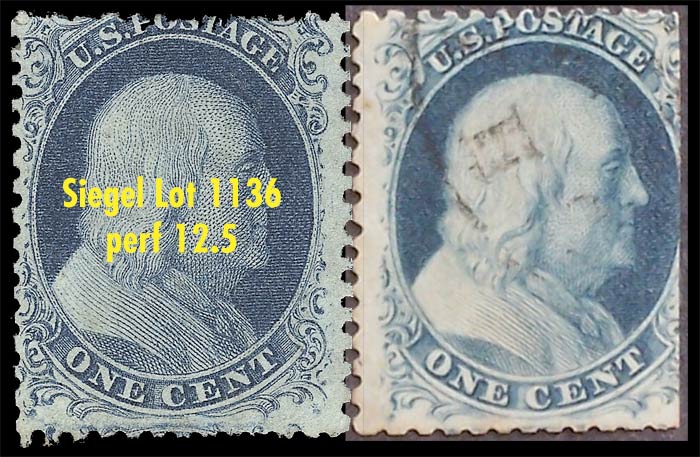
Perf 12.5
The salient feature of this variety is the perforations. Any argument against this stamp being a Chicago perf is going to have to address the fact that this stamp has perforations that gauge 12.5. I have shown this in the posts above. Now that I have the stamp-in-question, here are some photographs of the stamp on top of a gauge.

So it gauges 12.5, are they fake? From what I've read about identifying fake perfs, here are some things to look for:
- Flat perf tops that would correspond to the straight edge of the stamp that had been cut into. Stamps that have been torn apart would have fuzzy tops. Which is not to say any perf with a flat top is a fake, but it is a warning flag.
- Perf holes that are the wrong size as compared to the other sides of the stamp or stamps of the same issue
- Perf holes that are irregularly spaced
- Perf holes that are not aligned
Here's a 3200 dpi detail of some perf tops. Looks pretty fuzzy to me.

The perf tops on the bottom left edge are straight, but the rightmost perfs on the bottom are fuzzy-topped.

There is some irregularity to the spacing and alignment of the holes, but compared to known examples of the species, irregularity seems typical of the Chicago perf, which makes sense to me. Chicago perfs were perfed before perfing was cool; the equipment was probably quite primitive. Once again, here is the stamp-in-question compared to Siegel's lot 1136, but with my scan.

And so, I'll assert the perfs are not faked.
Has this stamp ever been in Chicago?
Not every example of a one cent Chicago perf on Siegel's site has a cancel from which you can identify a city, but of those that do, most come from Chicago. The cover example comes from Cherry Valley, Ill. Russ says in his post above that the cancel on the stamp-in-question doesn't look a Chicago cancel. Let's do some experimentation and research.
First, I want to see what's really there for a cancel. Here, using Photoshop's Color Range feature--whereby you select just a particular range of colors--I have endeavored to mitigate the blues and enhance the blacks and grays from the cancel. The enhanced image below shows C-H-I. We also get part of the date: the first letter of the month, A (I think the second letter is a U), and the first digit of the day, 2.

In searching the Philately Foundation's
certificate database, I found certs for several on-cover #11s with Chicago perfs and Chicago cancels. Below are cancel details of four cover images from the database. Apparently there was more than one cancel being used in Chicago at the time.

The letter spacing in the fourth one looked about right. The image below shows cutting out the cancel from the cover, reducing the opacity of the clipping so that it is transparent and overlaying it on the stamp-in-question. I then lined up the circle and rotated it until the "H"s line up. Showing and hiding the layer shows that the C and I line up perfectly. QED.

And so:
- the stamp is a type II from plate 2
- it has 12.5 gauge perfs
- the stamp was cancelled in Chicago
Take it away, Russ!





 Posted 03/03/2011 11:30 pm