I came across this in an
ebay lot consisting of two covers franked with Scott 65s and immediately knew that I had to have it.
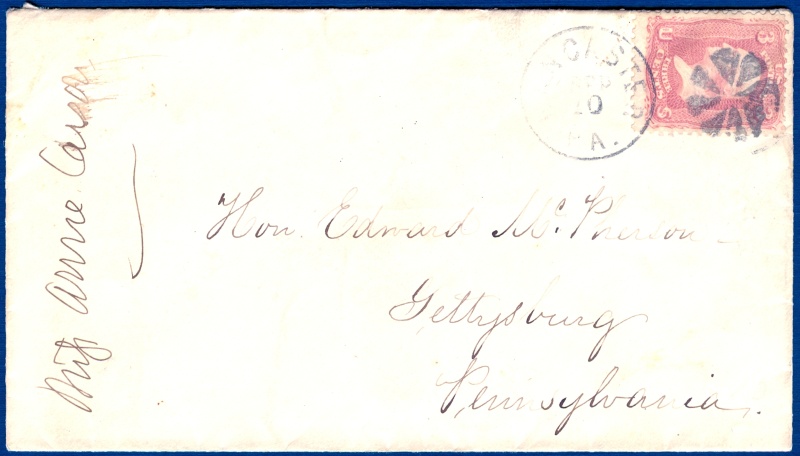
As you can see from the following biographical sketch, the addressee was a fairly prominent Pennsylvanian.
Quote:
McPHERSON, Edward, a Representative from Pennsylvania; born in Gettysburg, Pa., July 31, 1830; attended the common schools; was graduated from Pennsylvania College in 1848; studied law; edited the Harrisburg American in 1851, the Independent Whig, Lancaster, Pa., 1851-1854, and the Daily Times, Pittsburgh, Pa., in 1855; elected as a Republican to the Thirty-sixth and Thirty-seventh Congresses (March 4, 1859-March 3, 1863); unsuccessful candidate for reelection in 1862 to the Thirty-eighth Congress; appointed Deputy Commissioner of Internal Revenue in 1863; Clerk of the House of Representatives from December 8, 1863, to December 5, 1875; permanent president of the Republican National Convention in 1876; Director of the United States Bureau of Engraving and Printing in 1877 and 1878; editor of the Philadelphia Press 1877-1880; again served as Clerk of the House of Representatives from December 1881 to December 1883 and from December 1889 to December 1891; editor and proprietor of a paper in Gettysburg, Pa., 1880-1895; editor of the New York Tribune Almanac 1877-1895; American editor of the Almanach de Gotha; died in Gettysburg, Pa., December 14, 1895; interment in Evergreen Cemetery.
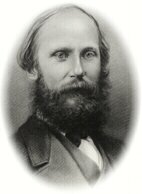
His historical prominence would have been reason enough to purchase the cover but I was driven to acquire it because McPherson's property in Gettysburg was the site of much of the fighting on the first day of the Battle of Gettysburg.
Quote:
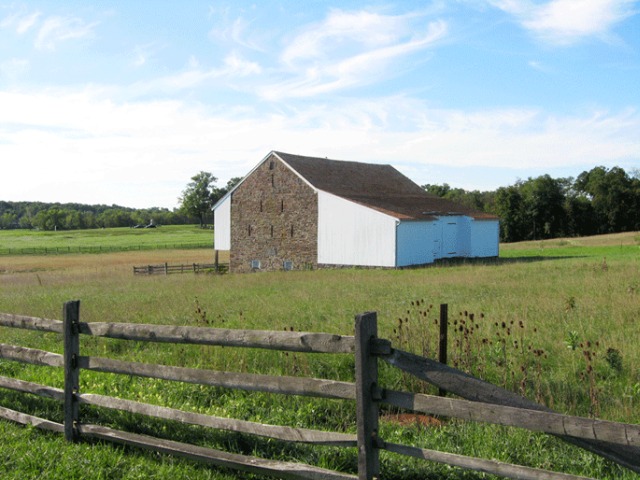
Edward McPherson's farm was a half mile west of Gettysburg, atop the ridge that also bears his name. The area was the scene of intense fighting on July 1st, 1863, as Confederate General Henry Heth's Division advanced towards Gettysburg against defending Union cavalry under General John Buford. Union reinforcements from General John Reynolds' First Corps arrived and counterattacked, and fighting swirled through McPherson's pasturelands and two fields planted in corn and wheat, as well as through neighbor John Herbst's woods. McPherson's barn became a place of refuge for the wounded, and continued as a hospital long after the battle ended.
McPherson sold the farm in 1868. The National Park Service bought the property in 1904 and now maintains the McPherson barn, which still stands on the Gettysburg National Military Park.





 Posted 06/09/2011 10:54 pm


