|
This page may contain links that result in small commissions to keep this free site up and running.

Welcome Guest! Registering and/or logging in will remove the anchor (bottom) ads. It's Free!
To participate in the forum you must log in or register.
| Author |
 Replies: 0 / Views: 2,746 Replies: 0 / Views: 2,746 |
|
|
Pillar Of The Community
United States
2480 Posts |
|
|
In part due to my interest having been peaked by postings on this forum related to machine cancels by Russ and others, I recently won a lot of five covers with 1888-1889 Boston, MA 6-bar straight line cancels. The lot arrived in today's mail and the cancellations are shown below. Each cover is franked with an 1887 issue 2c green Washington (Scott 213) and, if I've done my homework, they are American Postal Machine Company cancels from five different machines. 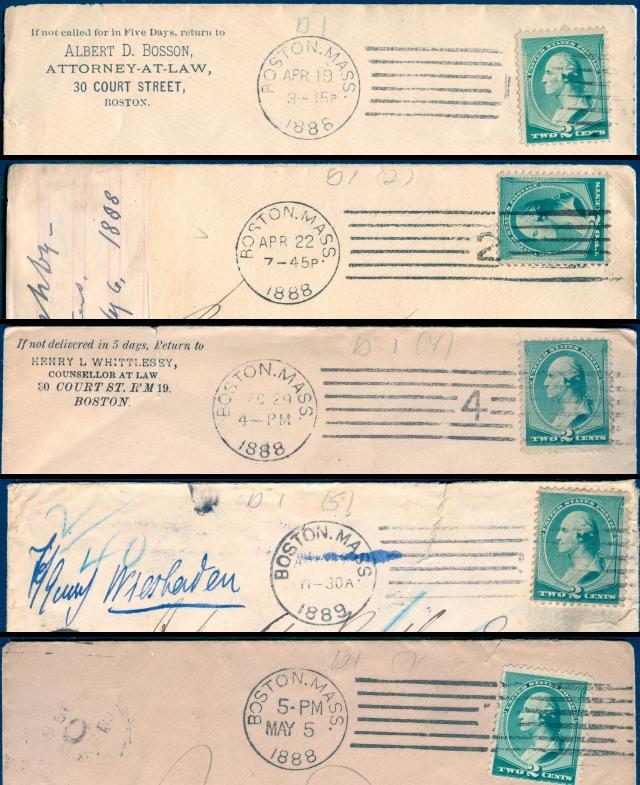 As I was preparing the covers for scanning I noticed that the May 5, 1888 cover had something inside of it. Imagine my surprise when I pulled this from the cover:  Wikipedia provides the following background on the Louisiana State Lottery Company: Quote:
The Louisiana State Lottery Company was a private corporation that in the mid-19th century ran the Louisiana lottery. It was for a time the only legal lottery in the United States, and for much of that time had a very foul reputation as a swindle of the state and citizens and a repository of corruption.
The company, initially a syndicate from New York, was chartered on August 11, 1868 by the Louisiana General Assembly with a 25-year charter and exchange gave the State $40,000 a year. With the passage of the charter, all other organized gambling was made illegal. This start almost immediately gave it a bad reputation as having bribed the legislators into a corrupt deal, especially at a time when other states were viewing lotteries and gambling with suspicion. It was founded by John A. Morris and Charles T. Howard, the former owing a controlling interest and the latter serving as its nominal head.
Charles Howard served as the first president, having previously worked for the Alabama Lottery and Kentucky State Lottery. Former Confederate Generals P.G.T. Beauregard and Jubal Anderson Early held the drawings. They added credibility but according to the New York Times they were paid handsomely for the few days each month their services were needed. Most of the tickets were sent via special train (there was so much mail it required a special consideration) to agents in the U.S. and abroad who would sell them in their respective areas.
In 1890, three years before the charter's expiration, the company bribed the legislature into passing an act to write them into the constitution (thus requiring a successful supermajority of both houses of the Louisiana State Legislature and referendum) by offering to give the state $500,000 per year.
While the lottery was always opposed on vice and morality grounds, the renewal of the charter and constitutional amendment began the serious, organized opposition that would kill the company. The Anti-Lottery League and its newspaper, the "New Delta" were the main proponents of ending the drawings. The League was backed by many prominent activists of the time, such as Edward Douglass White, who argued against it in the Louisiana Supreme Court and Anthony Comstock. The prominent Presbyterian minister of First Presbyterian Church, Benjamin M. Palmer, delivered an anti-lottery speech on June 25, 1891 at one of the League's largest meetings at the Grand Opera House in New Orleans. Many believed this was the final blow to the lottery.
In 1890 the United States Congress banned the interstate transportation of lottery tickets and lottery advertisements, which composed 90% of the company's revenue. The Supreme Court of the United States upheld this statute in 1892.
In March of that year the constitutional amendment to renew the charter (which had passed the legislature, but needed voter approval) was defeated. Murphy Foster, an anti-lottery gubernatorial candidate, was elected, as were a majority of anti-lottery legislators. During that year all lottery operations were banned, the company excepted until its charter expired in December 1893.
Backed by John A. Morris, it then moved its de jure headquarters to Honduras and illegally issued lottery tickets in the United States. In 1907 its Delaware printing press was found out by federals and shut down.
So far, the most interesting of the five covers is the one addressed to Dresden, Germany. It appears that the cover left Boston with insufficient postage on August 27th, 1889, arrived in Dresden on September 7th and was forwarded to Weisbaden, arriving on September 8th. Time permitting, I'll be trying to find information on each of the addressees. 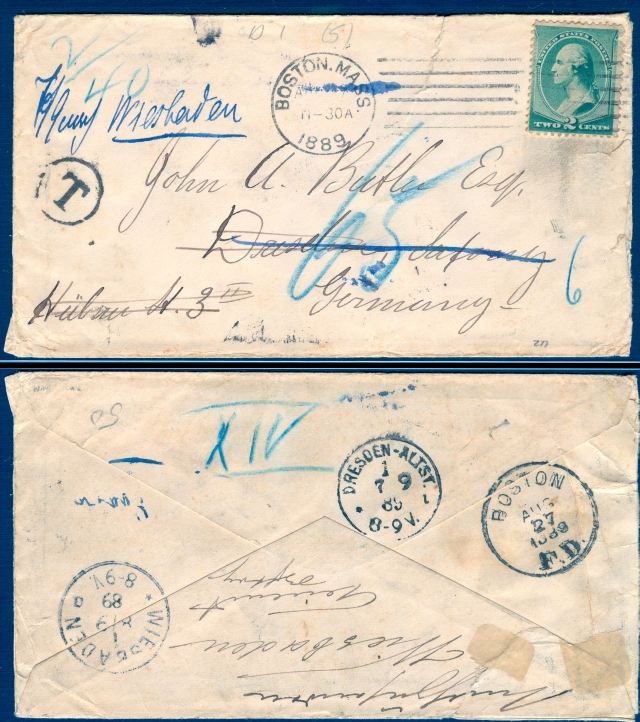 |
|
Send note to Staff
|
|
|
|
|
Moderator

United States
4788 Posts |
|
|
Pillar Of The Community
United States
2547 Posts |
|
|
Bedrock Of The Community
United States
12128 Posts |
|
|
As it relates to the return addressess of the covers #1 and #3, here are biographical sketches of the two attorneys named (bios are dated 1909). Interestingly, Albert D. Bosson, was Mayor of Chelsea, Massachusetts (1891) and both lawyers were at one point apparently in partnership with each other during the period in which these covers were postmarked: Quote:
BOSSON, Albert Davis, lawyer; b. Chelsea, Mass., Nov. 8. 1853; s. George C. and Mary Jane (Hood) B.; A.B., 1875, A.M., 1878. Brown Univ.; studied law In offices of Brooks, Ball & Storey. Boston, and in Boston Univ. Law Sch.; admitted to Suffolk bar, 1878; m. Chelsea, May 18, 1887, Alice Lavinia Campbell. Associated in practice with Charles E. Grinnell, 1878-91; sp'l Justice Police Court of Chelsea, 1882-92, Justice since 1892; mayor of Chelsea, 1891. Mem. Boston Bar Assn.. N. E. Historlc-Geneal. Soc., S.R. Clubs: University, Mass. Reform. Residence: Chelsea, Mass. Office: 722 Tremont Bldg., Boston.
WHITTLESEY, Henry Lincoln, lawyer; b. Chelsea, Mass., Nov. 30, 1862; s. Corydon M. and Maria L. (Ayer) W.; 7th In descent from John W., Saybrook, Conn.; grad. Yale, 1884; studied law with Richard H. Dana, Boston; LL.B., Harvard Law Sch., 1886; admitted to bar, 1886; m. Newton, Mass., July 6, 1889, Lillian Eddy, lineal descendant on mother's side of Edward Winslow, Mayflower pilgrim. Began practice in Boston, 1886; In partnership with Judge Albert D. Bosson, 1888-92, now Whittlesey & Wales; mem. Newton City Council. 1896; alderman, 1898, 1899; elk. Newton Police Court, 1890-1903. Cong'list. Club: Boston City. Residence: Newton, Mass. Office: 743 Tremont St., Boston.
ALBERT D. BOSSON (Image and Bio related to his term as Mayor of Chelsea, Massachusetts): 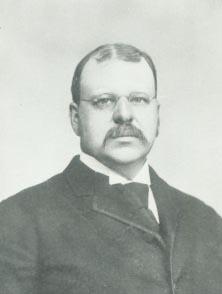 Quote:
ALBERT D. BOSSON, seventeenth mayor, born in Chelsea, November 8, 1853, he is decended from a long line of patriotic New England ancestry. His four great grandfathers served in the Revolution and his grandfather, John D. Bosson, was one of the early settlers of Winnisimmet village took an active part in the War of 1812. At age fifteen he graduated from Chelsea High School and entered Philips-Exerter Academy. He was a graduate of Brown University in 1875 and Boston University in 1877. In 1882 he was appointed associate justice of the Chelsea Court. He was elected the first democratic mayor in the year 1891. While mayor he advocated and was instrumental securing the abolishment of grade crossings between Chelsea and Charlestown. He was the first to advocate the overhead bridge to Charlestown. He was the first to recommend improvements to Winnisimmet Square and an advocate of the Metropolitan Park system. Governor Russell appointed him judge of the Chelsea Court in 1893.
In 1887 he married Alice Campbell the daughter of C. A. Campbell. They had two children, Campbell Bosson, born November 18,1888 and Pauline Arland Bosson, born February 24, 1894. Albert Bosson died on April 6, 1926. |
Send note to Staff 
|
| Edited by wt1 - 06/10/2011 9:36 pm |
|
|
Pillar Of The Community
United States
2480 Posts |
|
|
Quote:
both lawyers were at one point apparently in partnership with each other during the period in which these covers were postmarked: Both of their letters originate from the 30 Court Street address and the addressee on each of those covers is a Mrs. Lydia C. Farley, 2 Central Avenue, Chelsea, MA. |
|
Send note to Staff
|
|
|
Rest in Peace
United States
7097 Posts |
|
|
Pillar Of The Community
2361 Posts |
|
|
There is at least one similar 1888 Louisiana lottery ticket on ebay now, offered for $14.95 buy-it-now. http://www.ebay.com/itm/Louisianna-...140747041577This listing illustrates another point recently discussed. The seller spells "Louisiana" wrong in the title, so it does not show up in the usual "Search" -- that's how you sometimes find screaming bargains. |
|
Send note to Staff
|
|
|
Pillar Of The Community
United States
977 Posts |
|
|
Surprise!
That was a nice find.
Think about the fact that $1 was a great deal of money at that time.
To spend that much on just a chance wasn't childs play.
But then neither was $10 if you won. It was akin to buying a $100 ticket
today, with the chance of winning $1000. If they were selling as far away
as Boston, the chances of winning may have been slim. I doubt there were
any laws at the time where they had to print odds on the ticket.
As a side note, when I saw the picture later in the post, the first person
I saw was the comedy actor that played in Step-Brothers, or Dewy Cox, Walk Hard.
I don't know the actor's name, but that guy looks like his twin. I just got
a chuckle out of it, and thought I would share. |
|
Send note to Staff
|
| Edited by ratio411 - 06/26/2012 10:50 am |
|
| |
Replies: 0 / Views: 2,746 |
|
|
To participate in the forum you must log in or register. | |
 Transvaal Postal History Help Earliest Stamp With In-Design Date? My First Stamps Help Newbie.help With Stamp Identification (J29) Inherited These Stamps, Are They Genuine? APS Membership Discount Metropex Stamp Show: Roseville, Minnesota October 23-24 Weird Covers, 1885,1886, And 1982 For Users Of Two-Post Blue International Albums What Is Your Experience With Binders. New Member Posting Image Of Avatar, Front And Back Of U2 Cut Square, Market Value Or References? Working On An Offline Collection George Washington 3 Cent 1861 With Print On The Back Hello From The Netherlands - New Member Then And Now, From Old Postcards New Member Wanting To Add An Avatar Sparks Auction Fees? 163 VF Nyfm Vertically Ribbed 163 XF Quartered Cork, Labeled Jumbo 136 VF Quadruple Split H Grill Nashville Philatelic Society-Your Invitation To Our Auction Night Meeting Monday, October 26, 2026 Nashville Philatelic Society-Your Invitation To Our Meeting Monday, October 19, 2026 Christmas Around The World 2026 C.e. In The Large Queen Cancel A More Condensed Album Page Experiment. US Scott #3 Postmarked Or Fake? Transvaal Postal History Help Earliest Stamp With In-Design Date? My First Stamps Help Newbie.help With Stamp Identification (J29) Inherited These Stamps, Are They Genuine? APS Membership Discount Metropex Stamp Show: Roseville, Minnesota October 23-24 Weird Covers, 1885,1886, And 1982 For Users Of Two-Post Blue International Albums What Is Your Experience With Binders. New Member Posting Image Of Avatar, Front And Back Of U2 Cut Square, Market Value Or References? Working On An Offline Collection George Washington 3 Cent 1861 With Print On The Back Hello From The Netherlands - New Member Then And Now, From Old Postcards New Member Wanting To Add An Avatar Sparks Auction Fees? 163 VF Nyfm Vertically Ribbed 163 XF Quartered Cork, Labeled Jumbo 136 VF Quadruple Split H Grill Nashville Philatelic Society-Your Invitation To Our Auction Night Meeting Monday, October 26, 2026 Nashville Philatelic Society-Your Invitation To Our Meeting Monday, October 19, 2026 Christmas Around The World 2026 C.e. In The Large Queen Cancel A More Condensed Album Page Experiment. US Scott #3 Postmarked Or Fake?
Disclaimer: While a tremendous amount of effort goes into ensuring the accuracy of the information contained in this site, Stamp Community assumes no liability for errors. Copyright 2005 - 2026 Stamp Community Family - All rights reserved worldwide. Use of any images or content on this website without prior written permission of Stamp Community or the original lender is strictly prohibited.
Privacy Policy / Terms of Use Advertise Here |
| Stamp Community Forum |
© 2007 - 2026 Stamp Community Forums |
| It took 0.22 seconds to lick this stamp. |
 |
|
|
|


 Posted 06/10/2011 8:52 pm


