Quote:
Rileysan, no I didn't buy the 69 as a reperf.
How can you tell that it is a reperf?
It's tough to tell from a photo, thus my observations are not gospel. Be thorough in examining this stamp before assuming I'm correct. I tend to trust my instincts, but that doesn't mean I'm right all the time.
There are a couple of things I look for when looking for a reperf from a photo.
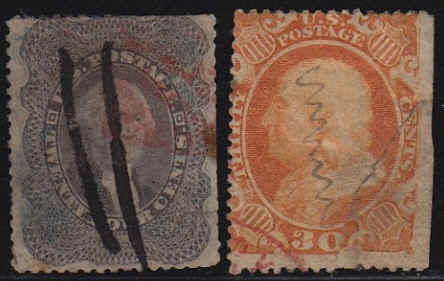
1) Perf spacing. Most attempts at reperfing are pretty poor and the perf spacing is usually way off. The bottom and right-side perfs look a little uneven in the spacing and should be checked with a perf guage.
2) Outside edges of perfs. Unless a stamp is scissor cut, the perfs will almost never be the same length. The top of your #69 is a good example of what I'd expect to see. The perfs are several different lengths due to uneven tearing when pulling the stamps apart.
3) Depth of the perf holes in relation to the design. This is not always possible measure as the perfs are not always square to the design. The best way to check is to put a straight edge on the inside edge of the perf holes to see if they make a straight line.
Finally, you cannot put a perf guage to a picture. But what you can do is look on all 4 sides of a stamp and visually compare in your mind. If you come to a side of a stamp with perfs that look different than the rest, there might be a problem. Since there weren't a lot of perf varieties in 19th century US stamps, it's easy to recognize the real thing.





 Posted 06/23/2011 7:39 pm