| Author |
 Replies: 7 / Views: 1,253 Replies: 7 / Views: 1,253 |
|
|
Valued Member
United States
491 Posts |
|
|
|
I am awaiting the Specialized Scott and my old, small one does not list a booklet form for either of these. Could someone check for me please. Then I'll know if my current catalog is missing some of this info. and also I can file these particular ones away. Cheers.
|
|
Send note to Staff
|
|
|
|
|
Bedrock Of The Community
United States
12128 Posts |
|
|
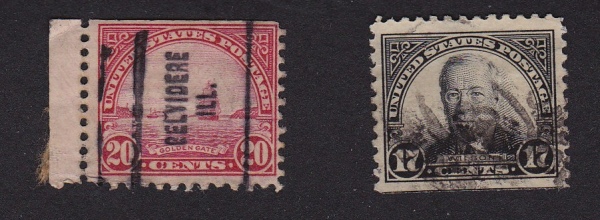
Neither 697 (17-cent) nor 698 (20-cent) came in booklet form. Stamps with straight edges for these issues are very common, though, as they typically came from the beginning or end or top or bottom of the row of a sheet of stamps. |
Send note to Staff 
|
|
|
Pillar Of The Community
United States
2547 Posts |
|
|
The 17 and 20 cent fourth bureau stamps were issued as flat plate (623 and 567) which were perf 11 and could have a straight edge. The rotary press (697 and 698) were perf 10.5x11 and would not have a natural straight edge. |
|
Send note to Staff
|
|
|
Valued Member
United States
491 Posts |
|
|
Bedrock Of The Community
United States
12128 Posts |
|
|
Quote:
the black has a definite black line just inside of and perfectly parallel to the straight edge Those are "guide lines". The stamps for the 1922 issues were printed in a 400-subject plate and were cut into sheets of 100. To quote from the Scott Catalog Introduction: Quote:
Horizontal or Vertical colored lines between the stamps, extending wholly or partially across the sheet. They serve as guides for the operators of perforating machines or to indicate the point of separation of the sheet into panes. |
|
Send note to Staff
|
|
|
Valued Member
United States
491 Posts |
|
|
OK, so basically I must be misreading the perfs?
I just took my 20th look at them and armed with this new knowledge I have to say that since the perfs on them aren't perfectly straight and flat, it is possible to interpret them as 10.75 quite easily. Also, 11 is very possible on the 17c. On the other hand, 11 is a real stretch on the 20c.
I have a number of US stamps put aside right now, because the perfs. don't match the number in the book -- for example, I have several where the catalog says 11 but they are really more like 10.8. Or it says 10 and they appear more like 9.8.
Is this type of minimal variation normal / expected or are the perf sizes actually always on the nail? i.e. Is the variation really all just the fault of my eyes? If so, that is rather scary -- but better forewarned I guess. Thanks. |
|
Send note to Staff
|
|
|
Pillar Of The Community
United States
2547 Posts |
|
|
Jan, there is variance in the perfs. The catalog perf descrptors are the number of perfs in 2cm. The U.S. used a "perf 12" from 1861 until 1912 however they had different spacing. The actual perfs being 12-65.51 (perf 12.020) 1861-73, 12-66.22 (perf 11.891) 1875-1898, 12-66.02 (perf 11.927) 1901-07, 12-66.25 (perf 11.885) 1908-12.
|
|
Send note to Staff
|
|
|
Valued Member
United States
491 Posts |
|
|
Thanks, Russ and wt1.
Looks like the 1861-1912 12 perfs were still pretty close to 12 even with the variations, though - greatest variance being .115 after 1908. Whereas the ones I am struggling with vary by up to 0.5 (10.5 instead of 11).
I found a note in my Scott materials that in the 1920s "various" perforations were used before they started to favor 11. I wonder if that means that variations can be found within a single issue, or if they just mean that different issues had differing perfs? I suspect the latter, otherwise surely there would be known varieties (eg "567a perf. 10.75x11").
Meantime, I have found several other 567/698 and one 623 in my shoebox that do not have a straight edge and whose perforations are easy to read.
I am left with:
a) the black 17c above has a straight edge and guideline therefore it must be 623 even though its perfs are in no man's land --probably closest to 10.75, but definitely not quite 11
b) the red 20c above is a beautiful precise 10.5 but must nevertheless be 567 (and an 11) because of the straight edge. The only alternative I can see is that someone has messed with it and created the straight edge. But given the humble provenance I can't see that at all.
c) Finally, I have one other 20c (no straight edge) that defies categorization -- it comes out at precisely 10.75. I am grouping it with the 567 crowd for now on the grounds that in my limited experience the 567s seem to show more variance than the 698s.
Can I ask one more question: how come the rotaries could not have a straight edge? Were they always manufactured so that each stamp had four perf'd sides, even at the sheet edges? So then maybe they had a plain (plate number) margin beyond the perfs at all four sheet edges? Were they cut down with guidelines beyond the margin? Or was each sheet just printed separately?
Thanks again for the assistance and information.
|
|
Send note to Staff
|
|
| |
Replies: 7 / Views: 1,253 |
|




 Posted 07/05/2011 1:47 pm