| Author |
 Replies: 9 / Views: 2,008 Replies: 9 / Views: 2,008 |
|
|
Valued Member
23 Posts |
|
|
Hi! I came across this 3cent albino, with printing on the inside of the cover and it looks like the ink was on the back side of the imprint. The envelope looks to be a #9, wmk 40, looks to be a U437 (?) can't tell if it's dark violet or purple. Can anyone verify what this particular envelope is and what the value might be? I can't find anything for the error in nay of my books. Any help would be appreciated. Thank you, Lee 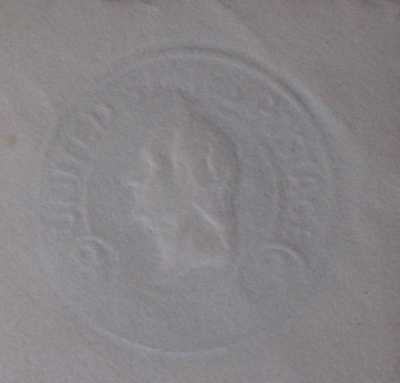 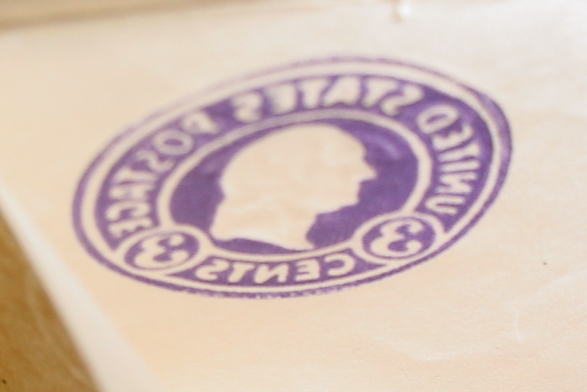 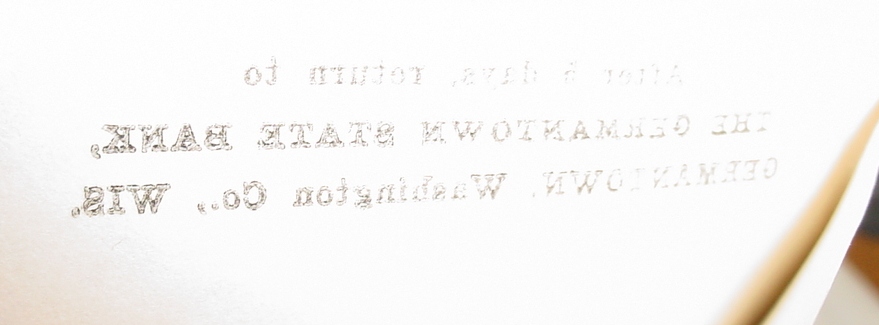 |
|
Send note to Staff
|
|
|
|
|
Rest in Peace
United States
1225 Posts |
|
|
Sorry, I can't help you. but, that is a fantastic find! |
Send note to Staff 
|
A well regulated Militia, being necessary to the security of a free State, the right of the people to keep and bear Arms, shall not be infringed. (The exact & entire wording of the 2nd Amendment to the U.S. Constitution) |
|
|
Pillar Of The Community
621 Posts |
|
|
You have a typical albino envelope. Your envelope was processed with another envelope blank on top of it during the embossing/printing. So, no ink was able to get to your envelope. This is essentially the definition of an albino.
Your envelope has the additional feature of an offset image on the back of the envelope blank (and therefore on the inside of the envelope) that resulted from a printing cycle prior to your envelope where there was no envelope in the press and the inked image was therefore deposited on the platen, soon to be transferred to the back of your envelope on the ensuing printing cycle.
A common attribute among albinos, which retail for $1 to $3 for typical examples.
They are not yet covered in a catalog. |
|
Send note to Staff
|
|
|
Valued Member
23 Posts |
|
|
Thanks Thomas! Appreciate the details as always. :) I thought it was pretty neat in that it also has the return address on the inside; backwards, but it's there. |
|
Send note to Staff
|
|
|
Pillar Of The Community
621 Posts |
|
|
During the time when your envelope was manufactured, one could order a quantity of stamped envelopes with a return address of your choosing (simple text, no graphics). These envelopes were produced in the normal manner with a Linotype-like plate being installed on the printing cylinder (or similarly with a flat plate printing mechanism) to provide the return address (envelope buffs call them corner cards in the manner they were called in earlier days) on your envelopes. So, the embossed stamp and the corner card were placed on the envelope blank at the same time. It is therefore easy to see why the corner card was also offset on the platen and printed in reverse on the inside of your envelope. |
|
Send note to Staff
|
|
|
Bedrock Of The Community
Australia
38679 Posts |
|
|
Pillar Of The Community
621 Posts |
|
|
I claim this is not an albino. Can anyone provide a logical reason why my statement could be true? 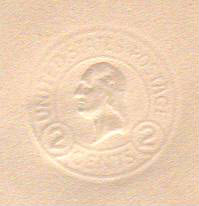 |
|
Send note to Staff
|
|
|
Valued Member
23 Posts |
|
|
WOW! nice impression - almost looks embossed. Since I'm so new to this I'll take a wild guess that it is too clean of an impression. It doesn't look like it had anything over it when getting run through the platen - nothing to "blur the lines" or soften the edges, which a second layer of paper might do, I guess would be one way to put it. |
|
Send note to Staff
|
|
|
Pillar Of The Community
621 Posts |
|
|
Well, you're on the right track, but not specific enough as to why this embossing-only envelope and not others. Half credit.
You are right that nothing got in the way of the printing/embossing. But, why? There is no ink on the stamp. Of course, the answer is that there was no ink on the die when the impression was made. For a normal albino that is because another envelope blank was fed into the press at the same time and (being on top) received the ink.
This envelope was produced on the web-fed Kenney press that was used (experimentally) in the early 20th century. With a web-fed press (i.e., a press that is fed by a really big roll of paper), there is no possibility of the traditional albino, as there is no way for two envelope blanks to be fed at the same time. This error should correctly be classified as a missing color error. Much rarer. Very much so.
So, how to know which envelopes were produced on the Kenney press? All explained in the front matter of the UPSS Stamped Envelope catalog. Basically, you tell by the knife type. The Kenney press had its own set of knives, with peculiar attributes.
Most collectors/dealers would still call my envelope an albino. Sometimes its hard to promote a specialist point of view.
You could also ask, "well, even on a non-Kenney press, couldn't the darn thing run out of ink and we'd have a missing color error?" The answer is yes, but how to prove it?
In 1965 the manufacture of stamped envelopes was changed (new contractor) to all web-fed presses. From that point on there were no true albinos, just missing color errors. That is why you will not see the Scott Specialized Catalog refer to an envelope with all colors missing as "albino". They simply list all the colors that are missing in describing the error.
However, he said dramatically, things have changed of late. The envelope contractors have started producing envelopes (with web-fed presses), and then feeding them thru another press to add the stamps. Albinos are back! |
|
Send note to Staff
|
|
|
Valued Member
23 Posts |
|
|
I hope you can get a book published and include things like this for folks like me :) Great explanation of the why's - of course I had no clue, but now have some more info for my referencing. Thanks! |
|
Send note to Staff
|
|
| |
Replies: 9 / Views: 2,008 |
|



 Posted 07/14/2011 8:22 pm


