| Author |
 Replies: 15 / Views: 1,949 Replies: 15 / Views: 1,949 |
|
|
Bedrock Of The Community
Australia
38679 Posts |
|
|
Stanley Gibbons have these as appendix and I cannot determine which are which, religious paintings? famous men? or what. Does anyone have a Michel catalogue to give an idea on the year and heading they are under please? Gainsborough Ingres Rembrandt durer raphael velasquez 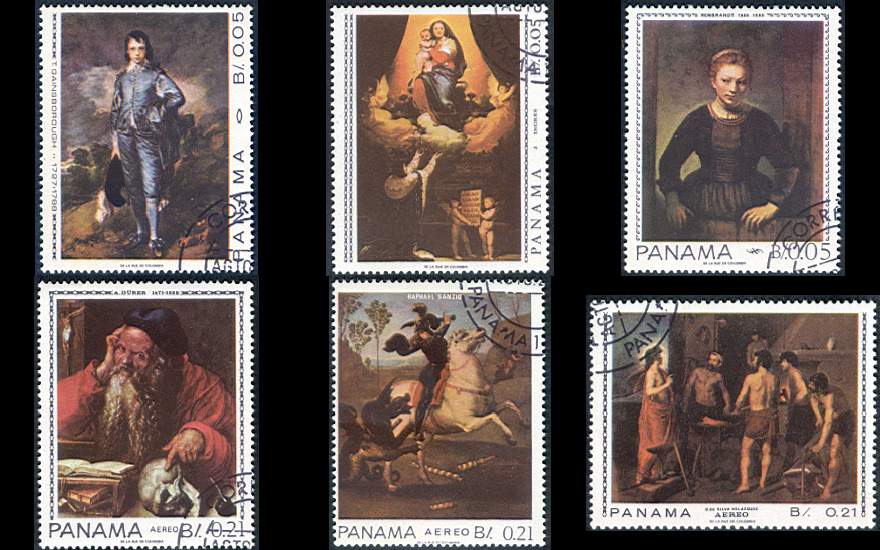 |
|
Send note to Staff
|
| Edited by rod222 - 07/19/2011 05:38 am |
|
|
|
|
Bedrock Of The Community
Australia
38679 Posts |
|
|
A subsidiary question,
under raphael's St George and the Dragon
there is a barbers pole with red and white banded colours
which I presume to be the colours of st george.
Anyone have an idea what this pole represents and the colours?
The genesis of this iconography?
thanks.
answering my own question partly,
but still lost on what Raphael was trying to say?
Bloodletting? the death of the dragon?
HISTORY OF THE BARBER POLE
In the Middle Ages, hair was not the only thing that barbers cut. They also performed surgery, tooth
extractions, and bloodletting. French authorities drew a fine distinction between academic surgeons
(surgeons of the long robe) and barber surgeons (surgeons of the short robe), but the latter were
sufficiently accepted by the fourteenth century to have their own guild, and in 1505 they were admitted to
the faculty of the University of Paris. As an indication of their medical importance, Harry Perelman points
out that Ambroise Pare, "The father of modern surgery and the greatest surgeon of the Renaissance,"
began as a barber surgeon.
The barber pole as a symbol of the profession is a legacy of bloodletting. The barber surgeon's necessities
for that curious custom were a staff for the patient to grasp (so the veins on the arm would stand out
sharply), a basin to hold leeches and catch blood, and a copious supply of linen bandages. After the
operation was completed, the bandages would be hung on the staff and sometimes placed outside as
advertisement. Twirled by the wind, they would form a red white spiral pattern that was later adopted for
painted poles. The earliest poles were surmounted by a leech basin, which in time was transformed into a
ball.
One Interpretation of the colors of the barber pole was that Red represented the blood, Blue the veins, and
White the bandages. Which has been retained by the modern Barber-Stylist.
|
Send note to Staff 
|
| Edited by rod222 - 07/19/2011 05:50 am |
|
|
Pillar Of The Community
United States
2480 Posts |
|
|
Rod,
Scott characterizes the set as "Works of Famous Artists" with an issue date of August 23, 1967.
Steve |
|
Send note to Staff
|
|
|
Pillar Of The Community
United Kingdom
1356 Posts |
|
|
Rod - no definitive answer, but some suggestions to follow up -
St George, depending on the version of the legend, used both a sword and a lance in his attack on the dragon, so I'm following a line of reasoning that the pole is his broken lance. His lance was sometimes known as "Ascalon", which is another name for the "Holy Lance". The Holy Lance refers to the lance used to pierce the side of Jesus during the crucifixion. Perhaps then the red and white stripes is a reference to the blood of Christ? |
|
Send note to Staff
|
|
|
Moderator

United States
4788 Posts |
|
|
Well, I recognize the "Blue Boy" at top left, but that's about the extent of my knowledge. I guess I better take an Art Appreciation refresher course. Maybe you should try the new Google Image search. Drag and drop a single image into this website: http://www.google.com/imghp?hl=en&tab=iiGood Luck, KirkS |
|
Send note to Staff
|
|
|
Moderator
United States
4788 Posts |
|
|
FORGIVE ME, Rod... You're obviously asking about the stamps catalog numbers -- I've got Google on the brain this morning ... plus I just finished looking at the topical thread about ART on stamps. I got all discombobulated there for a minute, but I'm OK now.  |
|
Send note to Staff
|
|
|
Rest in Peace
United States
7097 Posts |
|
|
It is a lance and they were usually highly decorated to be visible through the visor. Design was usually second to performance. I like stamgal's hypothesis too. |
|
Send note to Staff
|
|
|
Bedrock Of The Community
Australia
38679 Posts |
|
|
Thanks everyone, Thanks Steve for the Catalogue ref
I am surprised they are in Scott.
So thanks to Mr Scott.
Some interesting intrpretations, yes, broken lance
seems to fit, I'll chase up info on the ascalon.
Knowledgeable people we have here,
and good to know I am not the only one to get
discombobulated on occaisions. :)
|
|
Send note to Staff
|
|
|
Bedrock Of The Community
Australia
38679 Posts |
|
|
On looking at a wiki picture, I can see part of the lance still embedded in the dragon which supports stampgals theory..great stuff! The original painting is only approx 12 inches square. 1 of 2 by Raphael. 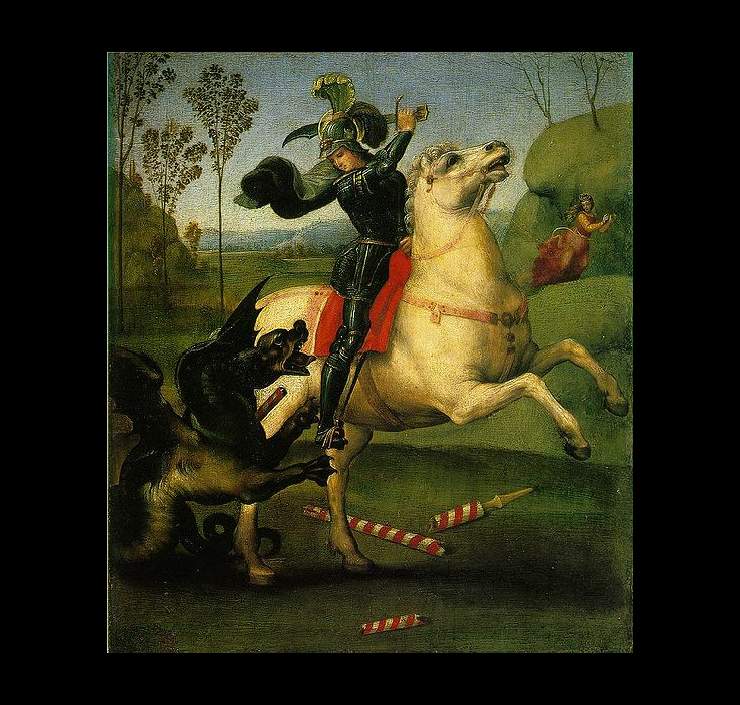 |
|
Send note to Staff
|
|
|
Pillar Of The Community
United States
2480 Posts |
|
|
Quote:
I am surprised they are in Scott. So thanks to Mr Scott.
Rod, I'm not familiar with the term "appendix" stamps but assumed it was similar to "back of book" -- was I even close? Scott assigns catalog number 479 to the Rembrandt, 479A Gainsborough, 479B Ingres, 479C Raphael, 479D Velazquez, and 479E Durer. Numbers 479F through 479K are assigned to the souvenir sheets of Gainsborough, Rembrandt, Ingres, Raphael, Velazquez and Durer, respectively. The catalog also notes that 479C-479K are airmail stamps. Steve |
|
Send note to Staff
|
|
|
Bedrock Of The Community
Australia
38679 Posts |
|
|
Steve, thanks, this is what stanley gibbons users have to deal with, a listing that is not a listing, guess your own catalogue numbers. This is Panama 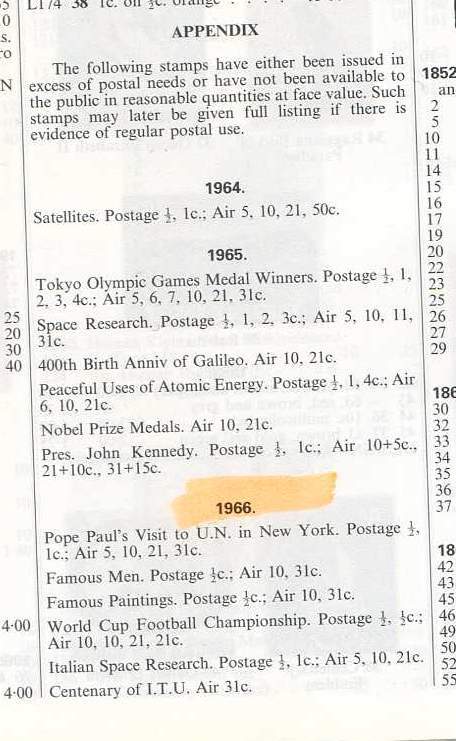 |
|
Send note to Staff
|
|
|
Pillar Of The Community
United States
2480 Posts |
|
|
That's interesting. It looks like all of those shown in the listing have been assigned catalog numbers by Scott. |
|
Send note to Staff
|
|
|
Pillar Of The Community
Canada
2574 Posts |
|
|
Rod
i just read the legend of St-George on a french site and there is no mention of a broken lance. There is a picture with St George darding the lance on the dragon. You have to understand that an artist dealing with a legend can paint it different ways. There is no solid facts to be based on. Daniel |
|
Send note to Staff
|
|
|
Bedrock Of The Community
Australia
38679 Posts |
|
|
Also interesting, is the way we get into a "zone" when
stamping.
It just dawned on me, I have the Scott specialised
(courtesy of a fine generous gift from Mr. Kirk S)
and also an old Scott CDRom
I hadn't considered employing either of them,
I'll dust them off immediately.
as for Stanley Gibbons numbers,
I'll put them into an Panama "Appendix" subfolder
with Scott numbers
|
|
Send note to Staff
|
|
|
Bedrock Of The Community
Australia
38679 Posts |
|
|
Cheers Daniel,
yes I understood that from what I learnt from Wiki.
In fact, I always took it as an icon of "good over evil"
I was surprised to read there was an actual St George
who died a very horrible death apparently.
|
|
Send note to Staff
|
|
|
Bedrock Of The Community
Australia
38679 Posts |
|
|
I wonder why the British Guiana magenta is not considered an "appendix" stamp ? That was never available to the public in reasonable quantities.  |
|
Send note to Staff
|
|
| |
Replies: 15 / Views: 1,949 |
|




 Posted 07/19/2011 05:35 am


