| Author |
 Replies: 9 / Views: 3,339 Replies: 9 / Views: 3,339 |
|
|
Pillar Of The Community
United States
6467 Posts |
|
|
One of the most extreme examples of a dry print I've seen. On a fairly decent stamp too... 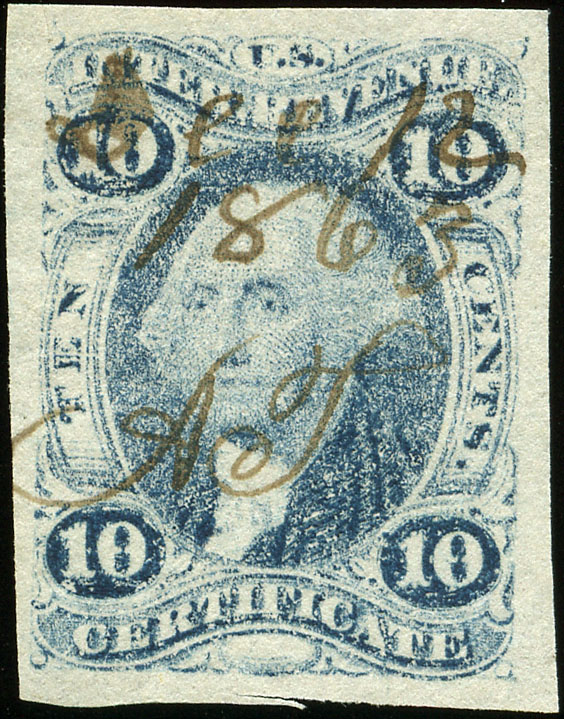 |
|
Send note to Staff
|
|
|
|
|
|
Pillar Of The Community
Canada
5821 Posts |
|
|
rev, I think that stamp needs a bit more ink.  But I guess there was a shortage during the war. |
Send note to Staff 
|
|
|
Pillar Of The Community
United States
1721 Posts |
|
|
WOW! I think that is the lowest inked print I have ever seen on a 1st Series! |
|
Send note to Staff
|
|
|
Bedrock Of The Community
Australia
38679 Posts |
|
|
Pillar Of The Community
United States
6467 Posts |
|
|
The "mottled" appearance is the giveaway. A washed/faded stamp would have the same impression as a fully-inked stamp, whereas this impression is much more coarse and there are ink omissions. It's hard to put into words, but it falls into the category of "I know it when I see it". |
|
Send note to Staff
|
|
|
|
Bedrock Of The Community
Australia
38679 Posts |
|
|
Thanks,
yes, I know what you mean.
However, being ignorant of early US stamps,
I would have passed over that thinking it was faded
especially with the India ink being faded.
It's a new tangent for me.
|
|
Send note to Staff
|
|
|
Pillar Of The Community
United States
6467 Posts |
|
|
I don't know that the stamp is worth any premium due to it being a dry plate. In fact, many collectors might avoid it simply because the impression is not as crisp as normally found.
I find it to be a good example of all of the quality control issues of the period, as well as an extreme example of a dry plate, so I felt it was worth picking up.
It's a curiosity, although EFO collectors might find it desirable as well. |
|
Send note to Staff
|
|
|
|
Pillar Of The Community
United States
517 Posts |
|
|
Bedrock Of The Community
United States
10838 Posts |
|
|
A dry print such as this one will be worth considerably less than a well printed example.
"I find it to be a good example of all of the quality control issues of the period, as well as an extreme example of a dry plate, so I felt it was worth picking up."
This was not caused by a "dry plate". The term "dry print" as used here is in reference to the moisture content of the PAPER during printing, not the amount of ink used on the plate. The moisture content had to be just right to get a fine sharp impression. If the paper is too dry, the ink will not stick and you get a print like this. If the paper is too wet, you get a very muddy, smeared impression. Given that this was the 1860's level of quality control (which was actually pretty good most of the time if not under intense pressure), and there was a war on and the government needed the money badly (the intense pressure), the overall quality of this issue is highly variable, especially in the lower values. Too wet and too dry prints are very common on the cent values, fairly common in the $1 and $1.50 and to a lesser extent the $10 values, and less common to non existent on the others. Great care was generally taken with the higher values, they represented a lot of money at the time.
|
|
Send note to Staff
|
|
|
Pillar Of The Community
United States
2555 Posts |
|
|
Dry prints are also very good plating aids because they almost always occurred around the edges of the sheet. While the wetted sheets sat in a stack to be used, the outside edges dried more than the interior of the stack. |
|
Send note to Staff
|
|
| |
Replies: 9 / Views: 3,339 |
|




 Posted 08/08/2011 9:40 pm





