| Author |
 Replies: 9 / Views: 1,639 Replies: 9 / Views: 1,639 |
|
|
Pillar Of The Community
Australia
2156 Posts |
|
|
This stamp seems pretty scruffy in the area to the back of the king's head and behind. Is this what people mean when they talk about 'rusted cliche'? I really have no idea what this term refers to, but the impression I've gained from online research is something along these lines. Regardless, clarification of the 'rusted cliche' matter would be greatly appreciated, particularly as I have a big lot of these due to arrive hopefully this week! 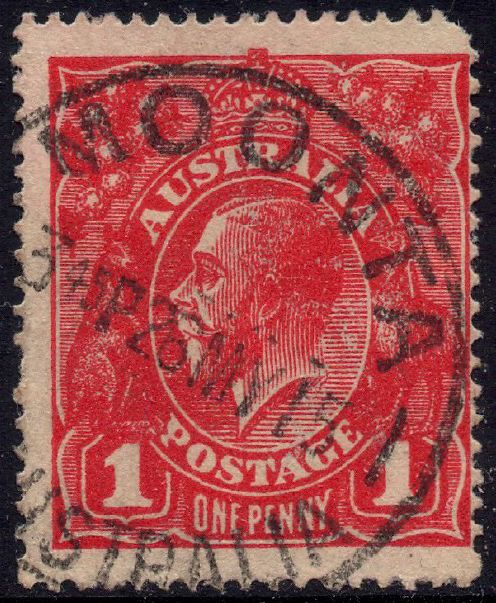 Thanks for looking! |
|
Send note to Staff
|
| Edited by jimjamtwo - 08/28/2011 07:46 am |
|
|
|
|
Pillar Of The Community
Australia
578 Posts |
|
|
"Tin shed" flaws? Although possibly a bit too early. I can say, however, that it definitely isn't a rusted cliché. Sorry to disappoint you. I don't have an adequate picture to post. Hopefully someone else has the real thing!  |
Send note to Staff 
|
| Edited by Plateflaw - 08/28/2011 08:38 am |
|
|
Bedrock Of The Community
Australia
38679 Posts |
|
|
The rusted cliches refer to two adjoining cliches
that became damaged due to rat urine, in storage.
(It's powerful stuff, I have seen it eat through a stainless steel wash trough)
The printing plates were cleaned and used
and indicate spotting behind the kings head,
and lightly down the left frame.
Rather more advanced than your stamp.
|
|
Send note to Staff
|
|
|
Pillar Of The Community
Australia
2156 Posts |
|
|
So what kind of damage are we seeing here?
I note that many KGVs have this scruffy look in parts and I'm wondering what causes it. |
|
Send note to Staff
|
|
|
Pillar Of The Community
Australia
578 Posts |
|
|
The so-called "Tin Shed" flaws were caused by the adherence of gum to the upper surface of the paper. The design was then printed over the gum, and after the stamps were used and soaked, the gum dissolved. This results in irregular patches of the design disappearing.
They are called "Tin Shed" because of the primitive conditions in which they were printed. |
|
Send note to Staff
|
|
|
Pillar Of The Community
Australia
2156 Posts |
|
|
Thanks for the info, Plateflaw.
I wonder if any photos exist showing the stamps being printed. |
|
Send note to Staff
|
|
|
Pillar Of The Community
United States
7106 Posts |
|
|
The "splotching" appears to affect the cancel, too, in the leg of the T and the left leg of the A, especially. Assuming something hasn't adhered to the face of the stamp, would that support a tin-shed theory? |
|
Send note to Staff
|
|
|
Bedrock Of The Community
Australia
38679 Posts |
|
|
That's a tough call, the quote in the specialists cat,
says they "vary in size up to areas covering one sixth of the stamp"
and "small patches" |
|
Send note to Staff
|
|
|
Pillar Of The Community
United States
7106 Posts |
|
|
Looking at it some more, and looking particularly at the rest of the ring outside the area behind George's head, the cancel isn't covering many of the whitish areas too completely (i.e., there is a lot of show-through).
To put it another way, I no longer think the T and A areas of the cancel have lifted off. |
|
Send note to Staff
|
|
|
Bedrock Of The Community
Australia
38679 Posts |
|
|
Yes, I share your opinion, but with dabbling
in the Georgian heads, it is a very exacting study,
and I don't know enough about them to be sure.
I would have expected KG5 to join the discussion
Nice "Moonta" pmk, we used to holiday there in the 1960's
as a family, beautiful aqua blue seas of the Spencer Gulf
In 1915 it would have been a hive of activity with Copper Mining
(pop 12,000)
They called it "little Cornwall" and I remember tucking
into some fabulous Cornish Pasties.
|
|
Send note to Staff
|
|
| |
Replies: 9 / Views: 1,639 |
|




 Posted 08/28/2011 07:45 am


