|
This page may contain links that result in small commissions to keep this free site up and running.

Welcome Guest! Registering and/or logging in will remove the anchor (bottom) ads. It's Free!
To participate in the forum you must log in or register.
| Author |
 Replies: 11 / Views: 4,815 Replies: 11 / Views: 4,815 |
|
|
Pillar Of The Community
Australia
3547 Posts |
|
|
Don't even contemplate collecting Poonch State complete, even on a simplified basis, but a small representative showing can be a lot of fun. Poonch was ruled by a junior branch of the ruling family of Jammu & Kashmir, in the extreme north of India, bounded by the Hindu Kush, Karakoram and Himalayan Mountains. Picturesque country, but not easy to get the mails around in. Poonch itself now lies on the dividing line between Indian- and Pakistani-controlled Kashmir. Poonch Town is in Indian Kashmir, but much of the territory of the old Poonch State, to the west, is in the Pakistani part. As the old Indian States go, it was a fairly large place, with a population of around 300,000. However, Poonch stamps were valid only within the borders of the State, and - as with Bhor - only a minority of the population could read and write in the first place, so demand for its postal services wasn't huge. Poonch produced its first stamp in 1876:  You'll have to go to the catalogues for a view of the stamp without the rather intimidating cancellation. Gibbons prices this unused at £16,000, which is a little out of my league. Poonch produced two similar looking. but smaller, stamps in 1877 and 1879. But they're also well outside my price bracket. (£8500 and £5500 used, and worse - much worse - mint  ) However, in 1880, Poonch produced one of the finest sets of all the Indian States, handstamped one by one, in red ink on white paper: The ½ Anna:  The 1 Anna:  The 2 Annas:  and the great masterpiece, the 4 Annas:  In 1884, Poonch added a 1 Pice (or ¼ Anna) value:  These come in a nice selection of types of paper: wove, wove bâtonné, laid, laid bâtonné and ribbed bâtonné. Which just goes to show how sadly unimaginative modern postal administrations are in their choices of papers to print on  |
|
Send note to Staff
|
|
|
|
|
Pillar Of The Community
Australia
3547 Posts |
|
|
Having worked through the variations on white papers, Poonch decided yellow papers might be nice, and proceeded to print the five values on yellow wove bâtonné, orange-buff wove bâtonné, yellow laid and buff laid and buff ribbed bâtonné papers Here is the 4 Anna on yellow wove bâtonné paper  One of my very favourite stamps ... By about 1887, though, Poonch had grown bored with yellow papers, and decided to give blue a try, so you have blue-green laid, blue-green wove bâtonné, lavender wove bâtonné, blue wove bâtonné, grey-blue laid and lilac laid papers. Here is a block of SG 50,  the 1 Anna on blue-green wove bâtonnéIf you look closely at the block, you can see that the spaces for the stamps were ruled in pencil. Then, in 1888, these newfangled aniline inks appeared in the Poonch marketplace, and were used for various values on all sorts of papers:  This is the 1 Pice on blue wove bâtonné paper. (You can usually tell the aniline inks because they're much more lurid colours, and the colour tends to show through strongly on the back of the stamps.) I can't be sure if this 1 Pice stamp, with the anti-theft pen strokes tieing it to the postcard, is an aniline ink printing,  but the date (1889) is right. |
Send note to Staff 
|
|
|
Pillar Of The Community
1448 Posts |
|
|
Fantastic!  I cracked open my new arrived 2012 SG 1840-1970 which immediately opened to Poonch, as a heavy Sandafayre cardboard insert lay there. A sign?  The SG lists different papers from (a) to (m) for the 1884-87 issue- which has 63 SG numbers - all with huge swings in prices. So Tony, how easy is it to differentiate paper types with these issues?  |
|
Send note to Staff
|
|
|
Pillar Of The Community
Australia
3547 Posts |
|
|
Poonch also printed all five values in grey to black, for government use. While the printers took some pains over printing the stamps for the general public  (the 1 Anna on white laid bâtonné paper) they didn't always make the same effort for the civil servants 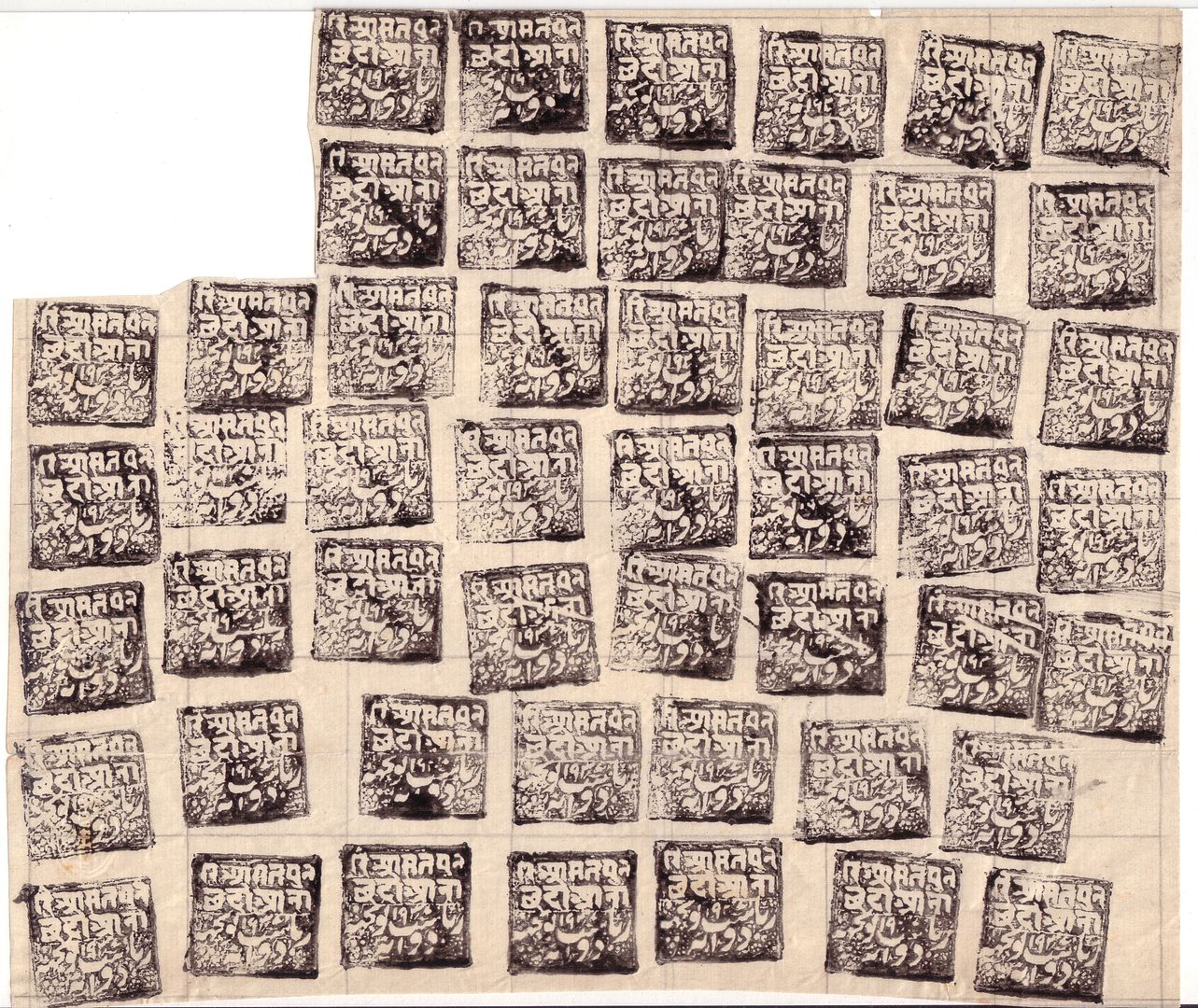 (the 2 Anna on white laid bâtonné paper) And to conclude the show-&-tell, here is an example of the Poonch Public Service at its brightest:   This government letter was sent from Poonch to Rawalpindi (now in Pakistan). As usual, it passed from the Poonch postal system to the British Indian system at the border town of Kahuta (now the centre of Pakistan's nuclear research effort) where it received the Indian postmark, before being forwarded on to Rawalpindi. Now, as Poonch stamps were only valid within Poonch, mail going to British India had to have British Indian stamps as well, to cover that leg of the journey. Single rate letters at this time cost ½ Anna in both Poonch and India. The Poonch mastermind should have added an Indian ½ Anna stamp, or used an Indian ½ Anna postal stationery envelope. However, he decided to pay the extra ½ Anna by applying a Poonch 1 Anna stamp. Hence the stamp on the front of the cover: POSTAGE DUE/ONE ANNA. I'll bet the recipient was delighted  So that's Poonch. Great fun, but don't let it suck you in too deeply. That way madness and poverty lie. If you want to see more of Poonch, there is an excellent Web site on the subject: http://www.poonchstamps.com/ |
|
Send note to Staff
|
| Edited by tonymacg - 10/15/2011 04:06 am |
|
|
Bedrock Of The Community
Australia
38679 Posts |
|
|
Nice yarn, interesting reading.
It begs the question, what were the lads doing,
the ones who could read and write, doing in Poonch
to warrant their sending mail to the outside world?
Were they traders?
Surely you would be from an outside labour force.
A shame we cannot read the postcards to 'flesh out" the times.
|
|
Send note to Staff
|
|
|
Pillar Of The Community
Australia
3547 Posts |
|
|
Yes, Rod, from the destinations of most of the non-philatelic mail from Poonch, it appears to be mostly correspondence by traders.
Actually, there are two main sources of mail from 19th century India: traders and lawyers. Without these two, our resources would be very thin indeed. As the papers used for Poonch stamps were almost certainly bought as required in the Poonch Town market, we can see that there must have been quite extensive trade with the outside world. In those days, of course that meant letters back and forth. |
|
Send note to Staff
|
|
|
Bedrock Of The Community
Australia
38679 Posts |
|
|
So what do you think Poonch had to offer
the rest of the world as trade?
I can see goods arriving, in pots and pans and
perhaps modern clothes, soap etc etc.
But what was going the other way?
I can only imagine fine wool and perhaps cottage industries.
Hmm, maybe
The chief occupation of the people of the district is agriculture. 23 percent of the total land area is devoted in the cultivation of maize, wheat and paddy. The orchards occupy 285 hectares of land in the district of Poonch.
|
|
Send note to Staff
|
| Edited by rod222 - 10/15/2011 06:26 am |
|
|
Pillar Of The Community
Australia
3547 Posts |
|
|
You probably have it: agricultural products of various sorts. I don't know of anything else in particular that Poonch produced. |
|
Send note to Staff
|
|
|
Pillar Of The Community
United States
5894 Posts |
|
|
Thanks for Poonching up this lovely post, Tony.
I love that partial sheet of official stamps. I can only imagine they got whatever papers that were available when they needed to print up some more stamps.
I remember being completely amazed when I learned (from you) how "primitively" the early Indian stamps were produced. The penciled-in grid on that block is a lovely item! |
|
Send note to Staff
|
|
|
Bedrock Of The Community
Australia
38679 Posts |
|
|
Pillar Of The Community
Australia
3547 Posts |
|
|
Quote:
I cracked open my new arrived 2012 SG 1840-1970 which immediately opened to Poonch, as a heavy Sandafayre cardboard insert lay there. A sign?
The SG lists different papers from (a) to (m) for the 1884-87 issue- which has 63 SG numbers - all with huge swings in prices.
So Tony, how easy is it to differentiate paper types with these issues? I do apologise for missing this, Jkjblue. Once I get onto my hobby horse, I forget to look around me until I've finished my ride. I ripped out that Sandafayre ad as soon as I saw it. But on the other hand, if it lures other collectors to their destruction, er, destiny in Poonch, it can't be an entirely bad thing And there's a Bundi Sacred Cow, down there in the front cover. This must be the Year of the Uglies. On my entirely unscientific survey of price rises in Poonch (what's in my collection), Poonch prices are up about 12% this year. That was after an 11% rise last year, and brings rises over the last 10 years to about 80%. All very gratifying But if Poonch tickles your fancy, it would be wise to plunge in now, before the prices leave the stratosphere. Most of the papers are pretty easy to tell apart, once you master the intricacies of ribbed and batonné. The only serious problem tends to be picking the 'blue-green' papers: they look rather blue, until you place them up against a true 'blue' paper. Forgeries are more of a problem. There are some pretty shoddy ones  and some more difficult ones  If in doubt, I strongly recommend the Poonchstamps Web site. |
|
Send note to Staff
|
|
|
Pillar Of The Community
Australia
3547 Posts |
|
| |
Replies: 11 / Views: 4,815 |
|
|
To participate in the forum you must log in or register. | |
 Transvaal Postal History Help Earliest Stamp With In-Design Date? My First Stamps Help Newbie.help With Stamp Identification (J29) Inherited These Stamps, Are They Genuine? APS Membership Discount Metropex Stamp Show: Roseville, Minnesota October 23-24 Weird Covers, 1885,1886, And 1982 For Users Of Two-Post Blue International Albums What Is Your Experience With Binders. New Member Posting Image Of Avatar, Front And Back Of U2 Cut Square, Market Value Or References? Working On An Offline Collection George Washington 3 Cent 1861 With Print On The Back Hello From The Netherlands - New Member Then And Now, From Old Postcards New Member Wanting To Add An Avatar Sparks Auction Fees? 163 VF Nyfm Vertically Ribbed 163 XF Quartered Cork, Labeled Jumbo 136 VF Quadruple Split H Grill Nashville Philatelic Society-Your Invitation To Our Auction Night Meeting Monday, October 26, 2026 Nashville Philatelic Society-Your Invitation To Our Meeting Monday, October 19, 2026 Christmas Around The World 2026 C.e. In The Large Queen Cancel A More Condensed Album Page Experiment. US Scott #3 Postmarked Or Fake? Transvaal Postal History Help Earliest Stamp With In-Design Date? My First Stamps Help Newbie.help With Stamp Identification (J29) Inherited These Stamps, Are They Genuine? APS Membership Discount Metropex Stamp Show: Roseville, Minnesota October 23-24 Weird Covers, 1885,1886, And 1982 For Users Of Two-Post Blue International Albums What Is Your Experience With Binders. New Member Posting Image Of Avatar, Front And Back Of U2 Cut Square, Market Value Or References? Working On An Offline Collection George Washington 3 Cent 1861 With Print On The Back Hello From The Netherlands - New Member Then And Now, From Old Postcards New Member Wanting To Add An Avatar Sparks Auction Fees? 163 VF Nyfm Vertically Ribbed 163 XF Quartered Cork, Labeled Jumbo 136 VF Quadruple Split H Grill Nashville Philatelic Society-Your Invitation To Our Auction Night Meeting Monday, October 26, 2026 Nashville Philatelic Society-Your Invitation To Our Meeting Monday, October 19, 2026 Christmas Around The World 2026 C.e. In The Large Queen Cancel A More Condensed Album Page Experiment. US Scott #3 Postmarked Or Fake?
Disclaimer: While a tremendous amount of effort goes into ensuring the accuracy of the information contained in this site, Stamp Community assumes no liability for errors. Copyright 2005 - 2026 Stamp Community Family - All rights reserved worldwide. Use of any images or content on this website without prior written permission of Stamp Community or the original lender is strictly prohibited.
Privacy Policy / Terms of Use Advertise Here |
| Stamp Community Forum |
© 2007 - 2026 Stamp Community Forums |
| It took 0.34 seconds to lick this stamp. |
 |
|
|
|


 Posted 10/15/2011 12:38 am


