| Author |
 Replies: 12 / Views: 1,904 Replies: 12 / Views: 1,904 |
|
|
Valued Member
49 Posts |
|
|
Well, I spent my first evening sorting through the packet of Washington Franklins I've had stashed away in an envelope since I was 10 years old -- about 25 years ago. Wow! What a lot of work! I've definitely gained considerable skill in just one evening but I have one I really can't identify. First of all, I've attached an image of the stamps I've been working to ID to Scott number. They are all green 1 cent Washingtons. I've been using the key on 1847usa dot com. When determining flat vs rotary printing, I tried using a "template" of a known plate printing as suggested on the web site. This seemed a bit troubling as the different printings all vary in size just a little bit. So, instead, I've been measuring the width and height of the field and comparing my measurements to the key on the site. OK, the one I'm having trouble with... An image of the stamp in question next to a ruler is attached. It's a perf 11 offest stamp with no watermark. Following the key on the site that takes me to Sc 525. However, the site lists the dimensions of the field as 19x22mm. As can be seen in the attached image, the stamp I have has a field width of slightly less than 18.5mm and a height of 21mm. What's the deal? Any thoughts? 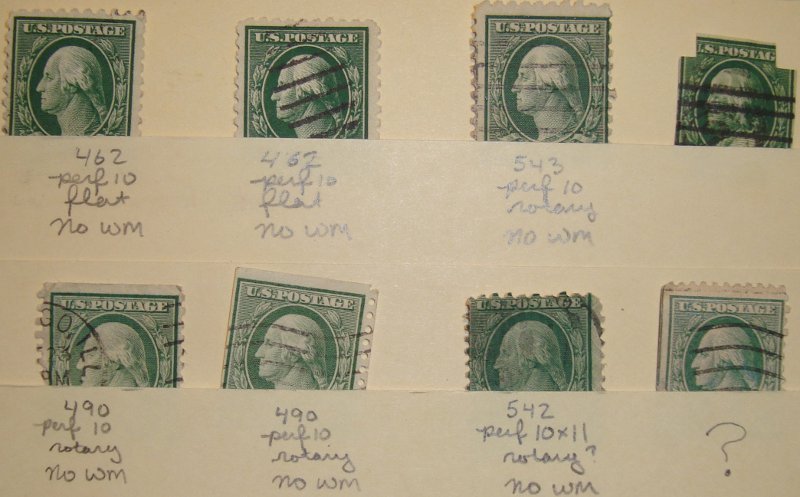 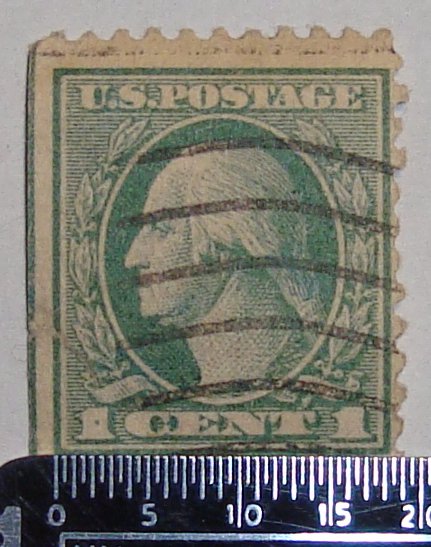 |
|
Send note to Staff
|
|
|
|
|
Pillar Of The Community
United States
2547 Posts |
|
|
The offset stamps show more variance is size than the engraved stamps due to the differences in pressures between the plate cylinder, blanket cylinder and impression cylinder. The easiest way to determine if the stamp is offset is by the surface of the impression.
The impression on engraved printings (flat plate and rotary press) have distinctively raised ink features while the impression on offset printings are much flatter. Additionally, the impression on offset printings is not a crisp and sharp as the impression on engraved printings.
|
Send note to Staff 
|
|
|
Valued Member
United States
262 Posts |
|
|
I have a few of these I've been working on but making very little progress. I have given myself a major headache though! |
|
Send note to Staff
|
|
|
Valued Member
49 Posts |
|
|
Quote:
The offset stamps show more variance is size than the engraved stamps due to the differences in pressures between the plate cylinder, blanket cylinder and impression cylinder. OK, so I really shouldn't pay too much attention to the fiend dimensions of the offset printed issues? Is the use of field dimensions on flat and rotary printed issues a reliable method of differentiating between the two methods or is there some other technique I should use? As for separating out the offset prints, that's generally not a problem for me. I really appreciate a good intaglio print so the offsets usually stand out like a sore thumb on less worn stamps. When worn, it's still fairly easy for me to feel the difference in my hands and have been using aluminum foil to confirm my initial impressions without fail so far. Clintd, it sounds like you are feeling my frustration! It's a good frustration, though, as I'm learning quite a bit. Are you familiar with the foil method for determining between the intaglio type flat/rotary versus offsest printing? It's more time consuming than simply looking at them but it's very accurate. |
|
Send note to Staff
|
|
|
Pillar Of The Community
United States
2480 Posts |
|
|
Pillar Of The Community
United States
2963 Posts |
|
|
You're still sane after spending an evening with these stamps? I commend you! |
|
Send note to Staff
|
|
|
Pillar Of The Community
United States
1497 Posts |
|
|
Valued Member
49 Posts |
|
|
tomiseksj, thanks for the link to the askphil site. On several pages it shows the dimensions for flat vs. rotary printed issues so it seems size is a valid way to determine the difference. Can someone confirm this or does someone know differently?
Trainwreck, the foil method for determining whether a given stamp was printed using an intaglio technique (flat-plate or rotary-plate) versus offset is quite cool! There is a detailed description on the 1847usa web site. I'd post the link but it would just get deleted as I'm a new member. The overview is that you take a piece of aluminum foil and place it over the stamp in question. Gently rub the foil with the stamp underneath it. If an intaglio process was used, the foil will conform to the surfaces and an image of the stamp can be seen through the foil. I find that using the dull side of the aluminum foil UP is easiest. It also helps if you look at the foil from a low angle while it is back lit. If offset printing was used you'll be able to see the edge of the physical stamp in the foil (the perferations) but the actual image on the stamp will not form in the foil. Try it on a perf 12 Washington Franklin. None of these were printed offset so you'll be sure to see what the result looks like with an intaglio stamp. |
|
Send note to Staff
|
|
|
Pillar Of The Community
United States
2547 Posts |
|
|
The dimensions on the intaglio printings normally show very little variation and can be used to distinguish between the flat plate and rotary press. In the intaglio printings the impression is taken directly from the plate. With the offset printings the image is transfered from the plate (on the plate cylinder) to the rubber surface of the blanket cylinder and then to the paper. The rubber surface of the blanket cylinder is subject to slight deformation which can cause both dimensional variation and loss of impression quality. |
|
Send note to Staff
|
|
|
Pillar Of The Community
United States
1497 Posts |
|
|
Rest in Peace
United States
7097 Posts |
|
|
What a wonderful post this is! I'm just getting my feet wet with these issues and I was posed with almost the exact same dilemmas as Xquercus, and this post and accompanying links are of immense help! THANK YOU! |
|
Send note to Staff
|
|
|
Valued Member
49 Posts |
|
|
Quote:
The dimensions on the intaglio printings normally show very little variation and can be used to distinguish between the flat plate and rotary press. Fantastic! Thanks, Russ. I was sort of assuming this was the case but hadn't seen it stated definitively anywhere. Thank you for doing so. I'm much more confident in my identifications now. I'll be sorting through a bunch more this evening. Let's see, in all the hours I spent yesterday, I managed to identify seven very common stamps. Let's see if I can double that rate tonight!  |
|
Send note to Staff
|
|
|
Rest in Peace
United States
7097 Posts |
|
|
Isn't there a way to tell by ink on the reverse side? I forget exactly which one it is though? (ink on the reverse of them) |
|
Send note to Staff
|
|
| |
Replies: 12 / Views: 1,904 |
|



 Posted 10/19/2011 12:33 am


