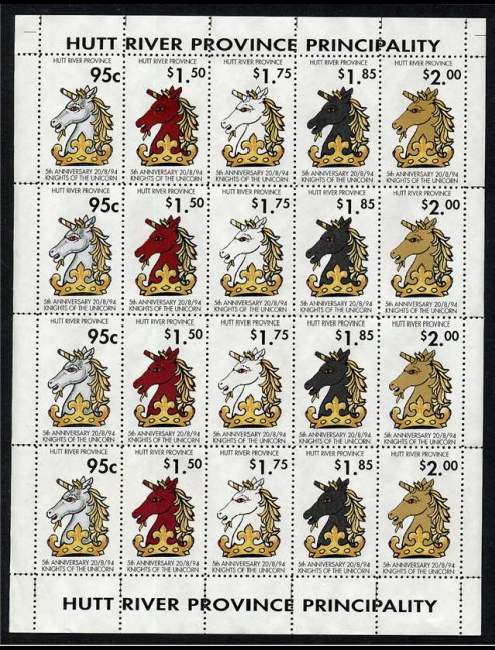
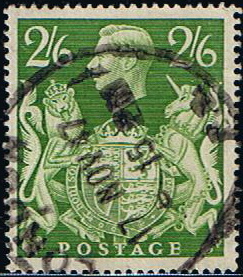
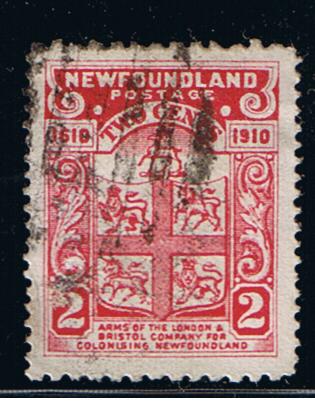
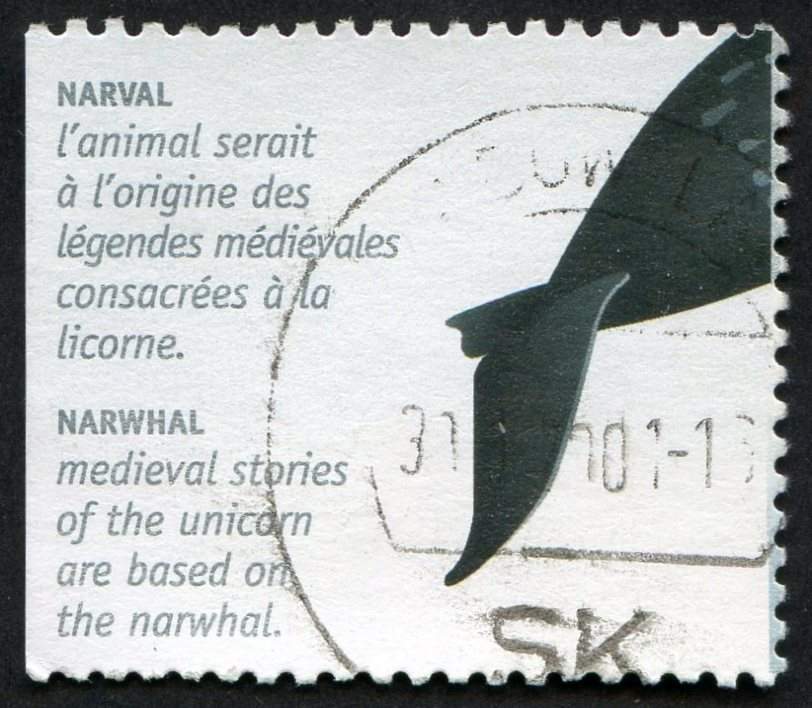
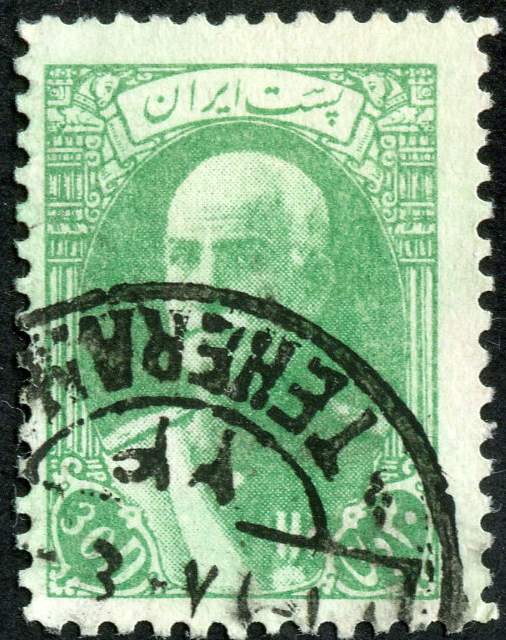
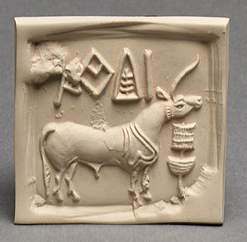
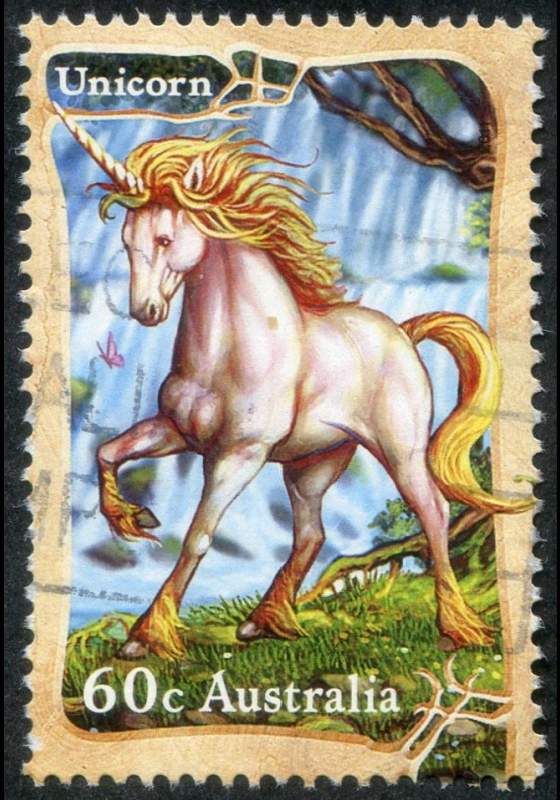
Australia has just issued a Unicorn on stamp,
which had me reflecting on a discussion on an old
newsgroup with the late Danish Stamp Collector Mette Heindorff and others back in 2004
So I thought it would be nice to re submit a few ramblings
Some links will not work due to the passage of time
Please submit any images you wish :)
From: amesh \(Mette\) (nobody@popx.dk)
Subject: The Unicorn in the Canadian Arms
View: Original Format
Newsgroups: rec.collecting.stamps.discuss
Date: 2004-12-10 11:15:31 PST
Does anyone know why Canada has chosen a Unicorn in
the country's arms? It is most easily visible on Scott E8.
http://kortlink.dk/archives/fs8 Eventually click
on the stamp to enlarge.
I have searched the net for the mythical stories of
the Unicorn, and found this one of particular interest:
http://members.shaw.ca/unicornhaven...History.htmlThe site does mention the Unicorn in the arms
of various countries within the Commonwealth,
but not Canada in particular, although the
site is written by a Canadian.
Hope someone can help :-)
--
Best regards
Ann Mette Heindorff (Mette)
=================================================
Hello Mette:
Here you go. I hope it is helpful to you.
Blair (TC)
----------------------
Coat of Arms - Canada
Canada's coat of arms was proclaimed by King George V
on April 30, 1921. They are at times referred to as
the "royal arms of Canada" or the "arms of Her Majesty
in Right of Canada."
http://en.wikipedia.org/upload/d/d2/Bigcancoat.gif Shield
The shield contains five parts, consisting of four
quarters at the top that represent European nations
that contributed to Canada's founding and a portion
at the bottom with a sprig of three maple leaves
representing Canadians of all origins.
The first quarter at the viewer's top left (in
heraldic terms the top right of the shield) contains
the three golden lions of England that have for
centuries been a symbol of that country. The second
quarter bears the Scottish lion and double border
with fleurs-de-lis, while the third quarter shows
the Irish harp of Tara. Legend states that this
golden harp with silver strings was used in royal
banquets at Tara, a capital of ancient Ireland,
and was later given to Henry VIII by the pope
during his attempt to succeed to the Irish throne.
The gold fleurs-de-lis of royal France, the first
European emblem raised in Canada by Jacques Cartier
during his landing at Gaspé, fills the fourth quadrant.
The sprig of red maple leaves at the bottom is
a distinctly Canadian symbol that became gradually
identified with the country throughout the 19th century.
Initially, the leaves were coloured green on
the coat of arms because it was thought to
represent youth, as opposed to the red colour
of dying leaves in autumn. The leaves were later
redrawn with the current colour to be in line with
the official colours of Canada.
Ribbon
The ribbon in the centre of the arms is marked
"desiderantes meliorem patriam", meaning "they
desire a better country." It is the motto of the
Order of Canada. This component of the arms was
added in 1994 by The Queen on the advice of then
Prime Minister Jean Chrétien.
Note: The current official artistic rendition
of the arms of Canada was made by Cathy
Bursey-Sabourin, Fraser Herald and Principal
Artist of the Canadian Heraldic Authority.
[She worked with my brother-in-law at the time.]
This design shows, around the shield, the
motto circlet of the Order of Canada. This
version was approved in 1994, and it replaced
the previous rendition, created in 1957 by
Commander Alan Beddoe.
A 1987 stamp showing the coat of arms:
http://data2.collectionscanada.ca/e...00008290.jpgHelm
The barred gold helm facing forward represents royal
sovereignty and is draped in a mantle of Canada's
official colours, red and white.
Crest and Crown
The crest consists of a twisted wreath or ring in red
and white on which is standing a crowned gold lion
holding a maple leaf in its right paw. This symbol
is used by the Governor-General, The Queen's
representative in Canada. At the top is
St Edward's Crown, the style of imperial crown
preferred by Her Majesty.
Supporters <==================
Supporting the shield on either side are the English
lion and Scottish unicorn, which are also the
supporters of the UK coat of arms. The lion stands
on the viewer's left (heraldically right) and holds
a gold-pointed silver lance flying the Union Jack.
The unicorn has a gold horn, a gold mane, gold hooves,
and around its neck a gold, chained coronet of crosses
and fleurs-de-lis; it holds a lance flying the three
gold fleurs-de-lis of royal France on a blue background.
Unlike the British version, neither supporter is crowned.
The history of the Unicorn on the UK arms.
King James VI of Scotland succeeded Elizabeth I when
she died childless in 1603, effectively uniting Scotland
and England beneath one rule. The Scottish Royal Arms
had up to that point used two unicorns as shield supporters.
The English Arms had used a variety of supporters,
but most frequently had included a lion. In a tactful
gesture then, he placed a lion upon the left of the new Arms,
and a unicorn upon the right. This was a potent bit
of symbolism, for both the lion and the unicorn had
long been thought to be deadly enemies: both regarded
as king of the beasts, the unicorn rules through harmony
while the lion rules through might, It came to symbolise
a reconciliation between the Scottish unicorn and the
English lion that the two should share the rule.
=====
"Go not to thy Elvises for counsel, for they will say both "Don't you
step on my blue suede shoes," and "Viva, Las Vegas!"
=====





 Posted 11/18/2011 02:07 am