It appears that no one has yet covered your question about the "Revalued to 15c" cover shown in your fourth scan, so let me explain.
That cover was created by the US Postal Service as a means to avoid having to reprint embossed stationery when a postage change came about. In fact, I believe in your example, the USPS was anticipating a rate increase to 16 cents and only 15 cents was approved, which resulted in a mass quantity of the 16c embossed envelopes, which had to be revalued as in your example.
It appears to be a Scott #U586, black surcharge on a 16c "USA" embossed envelope, that was revalued to 15 cents as issued on July 28, 1978. Assuming it's an entire cover and not just a corner cut square, it has a catalog value of $1. If it were unusued the value would only be 55 cents. The reason being that these envelopes showing proper postal usage (not a first day cover) are relatively hard to find, as most people were just using stamps and few elected to pay a premium for the embossed envelopes.
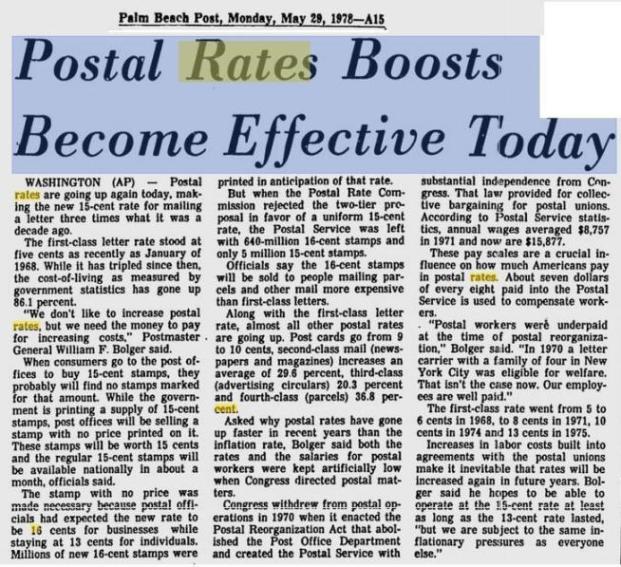
[edit] Came up with this newspaper article that recites the reason why stamps and postal stationery was printed anticipating a 16-cent "business" rate but later changed [or in the case of your postal stationery item, "revalued"] as a result of an across-the-board 15-cent rate approved in 1978. I had forgotten some of the details surrounding the event, which was quite a debacle for the USPS at the time and, in fact, resulted in the appearance of the "A"-Stamp as one of the first non-denominated postage stamps at the time:





 Posted 12/13/2011 1:21 pm