| Author |
 Replies: 12 / Views: 2,143 Replies: 12 / Views: 2,143 |
|
|
Valued Member
United Kingdom
462 Posts |
|
|
hi can anyone shed some light on this for me? was wondering about the date thanks in advance 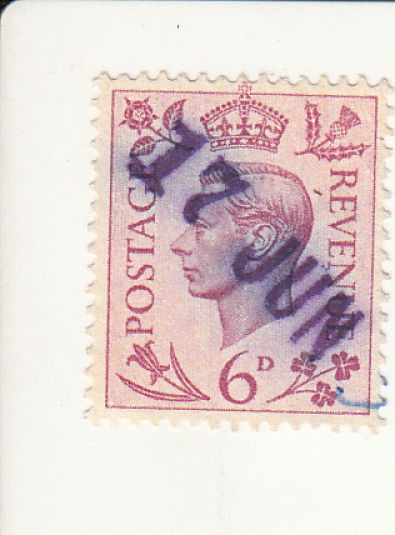 |
|
Send note to Staff
|
|
|
|
|
Pillar Of The Community
United States
7105 Posts |
|
|
I'm just guessing, but it has the look of a revenue cancel. Beyond "June 17" I don't know any way to discern a year. |
Send note to Staff 
|
|
|
Valued Member
United Kingdom
462 Posts |
|
|
thanks for the reply,can you tell me what in simple terms is a revenue cancel?
|
|
Send note to Staff
|
|
|
Pillar Of The Community
United States
7105 Posts |
|
|
Starting in the late 19th century, stamps of Great Britain (and much of the commonwealth) were valid for both postage and revenue purposes. (There were still dedicated revenue stamps for certain purposes, such as consular service stamps.)
Anyway, stamp collectors have traditionally wanted postal cancels on stamps that were valid for postage and revenue purposes. A revenue cancel is just a cancel used as a part of the stamp performing a revenue function.
On high value stamps, a stamp with a postal cancellation might sell for (hypothetically) $600, but a revenue cancel might sell for $20, or less. In years past, dealers usually sorted all of this out, but with the advent of online selling, and/or the decline in established, long-term relationships with dealers, it seems that revenue cancels are pointed out less and less frequently these days.
If you can't positively i.d. the cancel, then some spotting features that would be a rough rule of thumb would be straightline date cancels, purple cancels, oval cancels, manuscript cancels, and others. Any of those could also appear in a true postal cancel somewhere in the world, so you can't automatically assume "revenue" for a purple oval, for instance. But you should be careful with it.
More can be said, so I'll kick it off with this. |
|
Send note to Staff
|
|
|
Valued Member
United Kingdom
462 Posts |
|
|
Bedrock Of The Community
Australia
38679 Posts |
|
|
I would support Collins advice. I could not find an example, but I have included an Australian revenue that has the "cash register" imprint similar to yours. Your stamps would have been on some sort of sales receipt I should imagine. 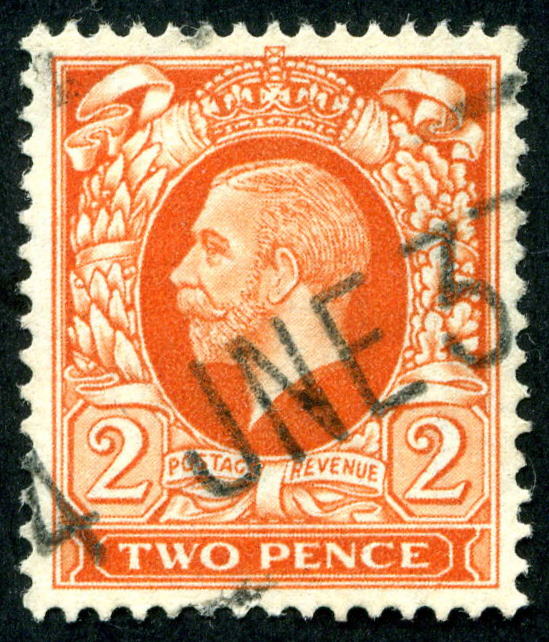 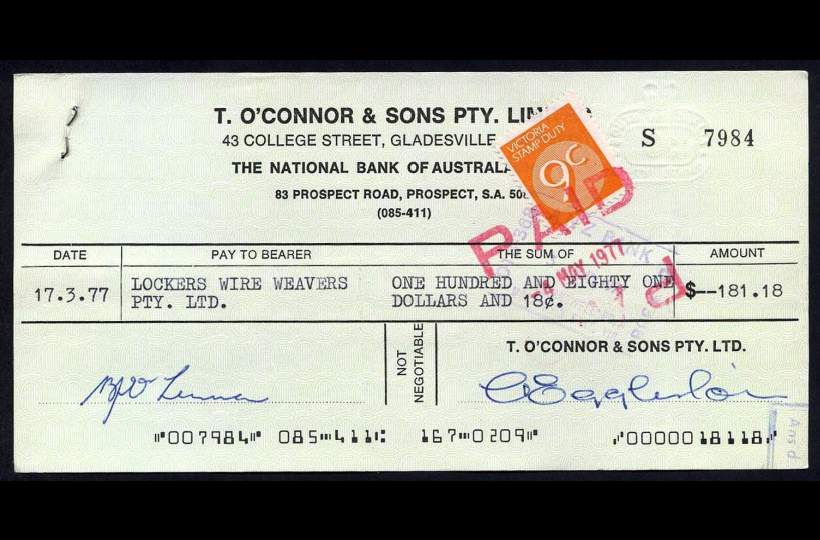 |
|
Send note to Staff
|
|
|
Pillar Of The Community
Australia
2156 Posts |
|
|
British stamps were often used as receipts. I have several KGV stamps on which have been written phrases such as 'Received with thanks, J. Smith. 1/3/30' |
|
Send note to Staff
|
| Edited by jimjamtwo - 12/16/2011 01:42 am |
|
|
Pillar Of The Community
Canada
669 Posts |
|
|
Here is something I have that is an example of what could have been the source of the O/P's stamp.  Have a good one, Skilo54 |
|
Send note to Staff
|
|
|
Bedrock Of The Community
Australia
38679 Posts |
|
|
Pillar Of The Community
Canada
6525 Posts |
|
|
Same here on the other side of the world. Here's a Newfie stamp with a bank cancel. 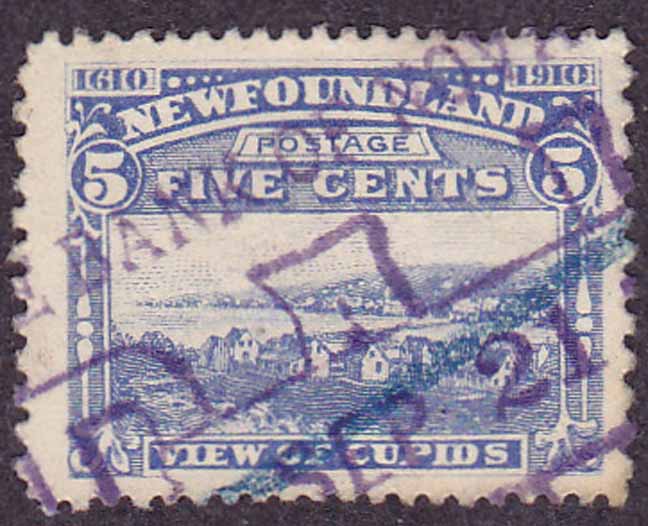 |
|
Send note to Staff
|
|
|
Pillar Of The Community
Canada
6525 Posts |
|
|
And here's a cheque from a Canadian bank with a 1942-43 War series George VI. 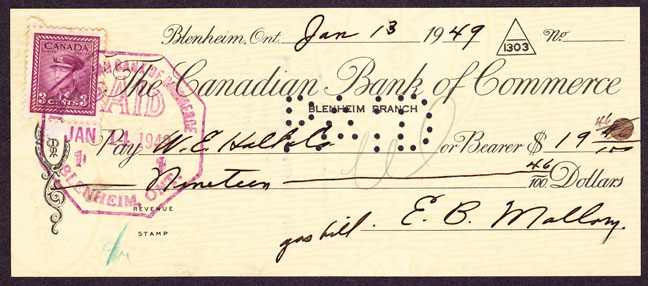 |
|
Send note to Staff
|
|
|
Bedrock Of The Community
Australia
38679 Posts |
|
|
New Zealand pen cancel revenue 30th March 1928 I wonder what the excise rate was, 1d per 10 pounds or part thereof 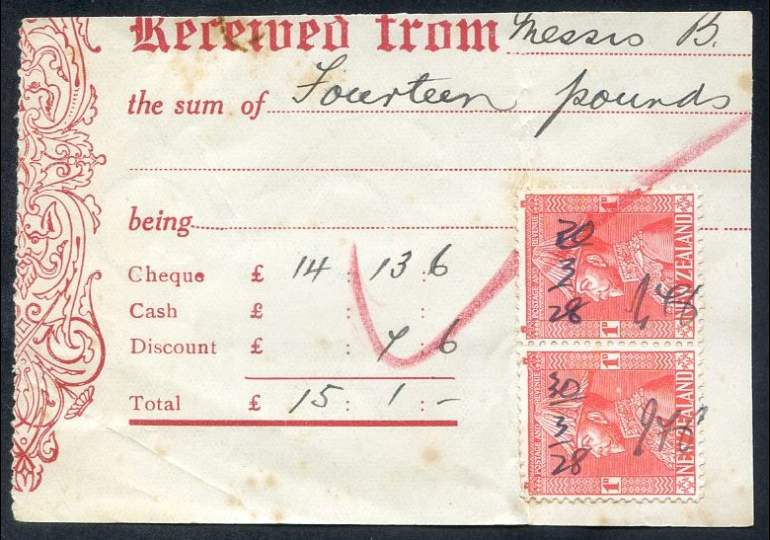 |
|
Send note to Staff
|
|
|
Pillar Of The Community
United States
7105 Posts |
|
|
Two additional clarifications from my earlier post.
Ovals are often seen as cancels on registered mail, and while some people don't like them, they are perfectly acceptable postal usages.
And what I meant by "revenue cancels aren't pointed out as often" is that old-line dealers wouldn't have wanted to show revenue cancels in their regular stock, at catalogue prices, because everyone knew that they just weren't worth much. Bad for the reputation, and all.
These days, it is very common to see stamps with revenue cancels just listed as "used" and whether that means the seller doesn't know, or doesn't disclose, probably depends on the seller. A strange quirk of this development is that more people are more often paying higher prices for revenue cancels than ever before (intentionally or unwittingly?)...does this mean that the catalogue value should start to rise? (And yes, stamps with a high CV sometimes have a specific additional listing as "revenue cancel" in Scott.) Don't know. |
|
Send note to Staff
|
|
| |
Replies: 12 / Views: 2,143 |
|



 Posted 12/15/2011 11:28 am


