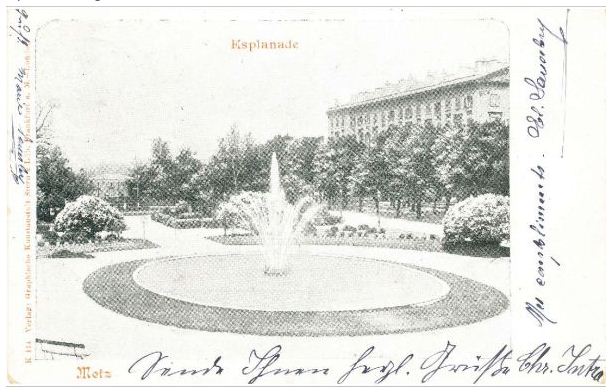
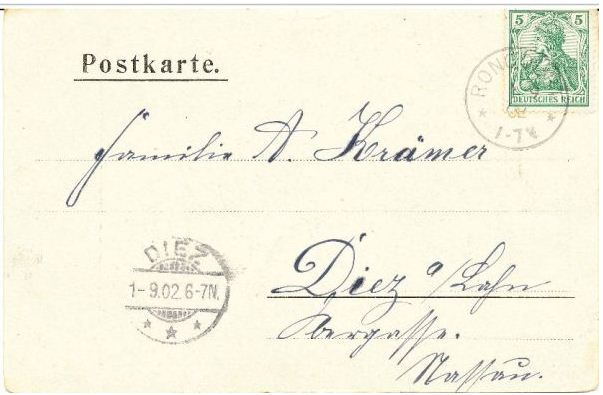
Found a box with old postcards. Now I wished I could read the old German hand writings.
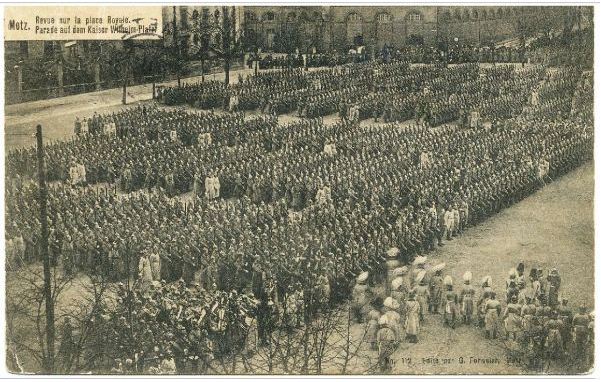
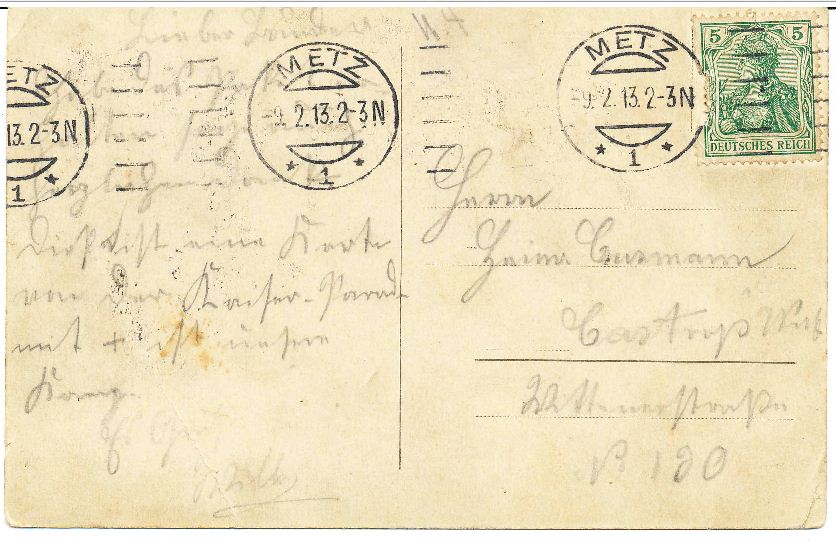
The card's cancellation is February 9, 1913. The card's title:
Parade on Kaiser Wilhelm Square. These soldiers are getting ready for the first world war.
Metz and the Franco-Prussian War During the Franco-Prussian War of 1870–71, Metz was the headquarters of the Third French Army Corps under the command of General Bazaine. Through the operations of the German army, Bazaine, after the battles of Colombey, Mars-la-Tour, and Gravelotte was besieged in Metz. The besieging German army was commanded by Prince Friedrich Karl of Prussia; as the few sorties of the garrison were unable to break the German lines, Metz was forced to surrender (27 October 1870), with the result that 6,000 French officers and 170,000 men were taken prisoner.
The philosopher Friedrich Nietzsche took part in the siege of Metz as a German soldier. By the Treaty of Frankfurt of 1871, Metz became a German city, and was made a most important garrison and a strong fortress. The German army decided to build a second and a third fortified line around Metz. The former fortifications on the south and east were levelled in 1898, thus securing space for growth and development.
20th century and modern day Metz Following the armistice with Germany ending the First World War, the French army entered Metz in November 1918 and the city was returned to France under the Treaty of Versailles in 1919. But after the Battle of France in 1940 during the Second World War, the city was immediately annexed by the German Third Reich. Most of the Nazi dignitaries assumed it was obvious that the city of Metz, where so many German army officers were born, was a German city. In 1944, the attack on the city by the U.S. Third Army faced heavy resistance from the defending German forces, and resulted in heavy casualties on both sides. The Battle of Metz lasted for several weeks and the heavily fortified city of Metz was captured by the U.S. Army under the command of General George S. Patton before the end of November 1944. Metz reverted to France after the war.





 Posted 01/18/2012 3:05 pm