Quote:
What caused the move away from plate block collecting?
The US Postal Service (in their greed) killed it! How? The collecting of plate blocks was very popular through the 1960s and 1970s, however, that was back in the day when virtually all stamps were issued in sheets of 50 or 100 stamps. It was too expensive for many collectors to buy and retain the whole sheet, so the plate block was considered the most desirable piece for a collection.
However, when new printing presses were used, a plate block often consisted of strips of 6, 8, 10 or even 20 stamps. This became unaffordable for many collectors (especially young people or those on limited incomes) and then you had the problem of storing those oddly shaped blocks that would not fit into a conventional album or stamp storage device.
Not only did plate block collecting dwindle at that point, but it was about the same time when stamp collecting values dropped considerably and collectors found themselves stuck with hundreds of plate blocks that had virtually little to no value, prompting many collectors to just use them as postage and abandon further collecting of them.
Then the USPS began contracting with outside firms to produce stamps and it was decided that, with few exceptions, only one plate number was needed with a "1" digit representing the different colors used on the stamp. In addition to the various printers, plate numbers then began appearing on coil stamps and even booklet panes, and the collecting discipline became too great and too expensive for many to continue to bother with given the number of stamps being issued today.
Furthermore, we have a great number of modern issues that have varied designs on each stamp in a pane, making it impossible to collect only a plate block representative of one example of each stamp, as oftentimes every stamp in the pane is different, making it necessary to collect the entire pane to get an example of each representative stamp.
One case in point is today's announcement of the "Just Move" stamp. Look at the scan below. A plate number is in each of the four corners, yet there are only 15 stamps to the pane and each stamp is of a different design. The USPS will demand that collectors only buy these in full panes of 15 (not singles or blocks) and if a plate block collector really wanted a block of 4 from all four positions, you'd have to purchase multiple panes of stamps to do it. Then, even with four plate blocks from each corner, you'd still be missing some representative stamps from that series. So plate block collecting in this case is virtually meaningless:
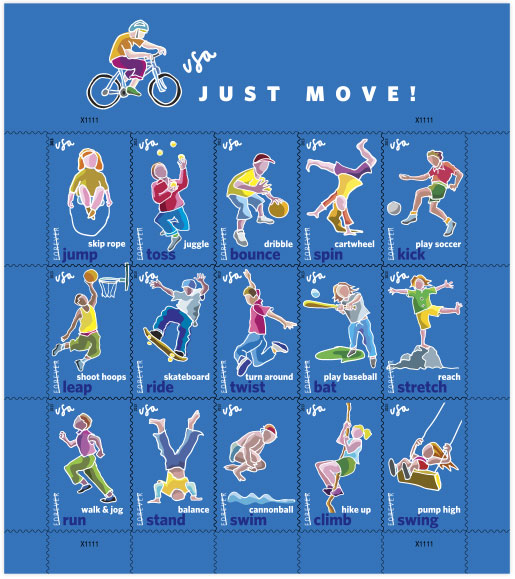
There is, however, a trend toward collecting plate number singles, which may be a modern day equivalent of identifying the various plates and numbering systems used for modern day stamps, but it has never risen to the popularity that plate block collecting once did.





 Posted 01/31/2013 11:28 am


