Quote:
I have a full sheet of the Scott 1552, and did not realize until now that it was the first US self-adhesive.
Actually, it was the first US self adhesive stamp FAILURE.
The 1974 Christmas self-adhesive stamp was prepared using the wrong self-adhesive properties (rubber based and traces its origin to a patent issued in 1845. This is the traditional adhesive of original Scotch brand cellophane tape) which rendered many of the stamps discolored. In fact, that was the very reason why it was an "experimental" self adhesive and regularly issued self adhesives didn't show up for awhile thereafter because of the desire to perfect the adhesive for long term storage without discoloration.
This summarizes one of the better (although lengthy) papers on the subject, the link for which is provided below the quote:
Quote:
Fifteen years after the initial unsuccessful experiment with pressure-sensitive postage stamps, the U.S. Postal Service tried again. In 1989, the 25-cent Eagle and Shield stamp was issued as a so-called EXTRAordinary product, in flat panes of 18 stamps that sold for $5, a premium of 50 cents over face value. The format was the now familiar "convertible booklet," with removable strips of paper between blocks of stamps that facilitated folding into a convenient protective carrier. A limited additional quantity was issued in coil format for philatelic purposes. Distribution of the panes was limited to 15 cities for 30 days as a test. The stamps were not well received by the public, probably because of the premium price. They did get a reprieve briefly during the war in the Persian Gulf, where humid conditions caused problems for ordinary stamps, until Congress authorized free postage for active-duty military personnel.
Experimental self-stick stamps for use in banks' automatic teller machines were issued in 1990, employing a 25-cent stylized Flag design, in panes of 12 stamps, printed on plastic. They were tested by Seafirst bank for a period of six months, at 22 ATMs in 10 Seattle, Washington, locations. Although these panes, exactly the size and shape of U.S. currency, were trademarked EXTRAordinary, they sold at face value to the public. A non-denominated F-rate (29-cent) version of the plastic ATM stamp was issued for the 1991 increase in the domestic letter rate.
Over all, the ATM experiment was deemed a success, and distribution was extended next to Equibank ATMs in the Pittsburgh, Pennsylvania, area and later to other banks across the land. But the plastic on which the first two ATM stamps were printed proved a bane to paper recyclers, so the next ATM issue, the 29-cent Liberty Torch stamp of 1991, while retaining the self-stick feature, was printed on stamp paper, as are all subsequent issues.
The switch from water-activated to pressure-sensitive adhesive meant that each category of postage stamp would change over in due course. The 29-cent Toy Train ATM stamp of 1992 became the first self-stick Christmas stamp since 1974, introducing what has since become an annual tradition. Stamps for valentines and wedding announcements went self-adhesive with the 29-cent Sunrise Love issue of 1994; commemoratives, with the 32-cent Tennessee Statehood stamp of 1996; post card rate stamps, with the 20-cent Blue Jay booklet and coil stamps of 1996; and low-value stamps, with the non denominated (5-cent) Butte nonprofit rate coil. Serpentine die cuts, simulating perforations, superseded straight edges as manufacturing techniques improved.
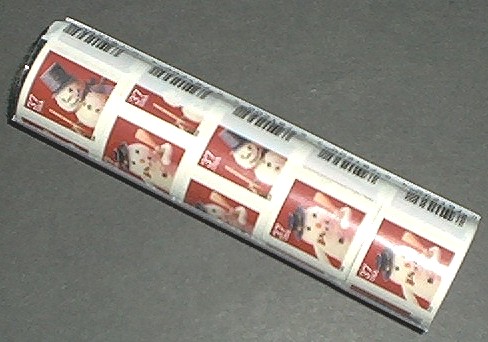
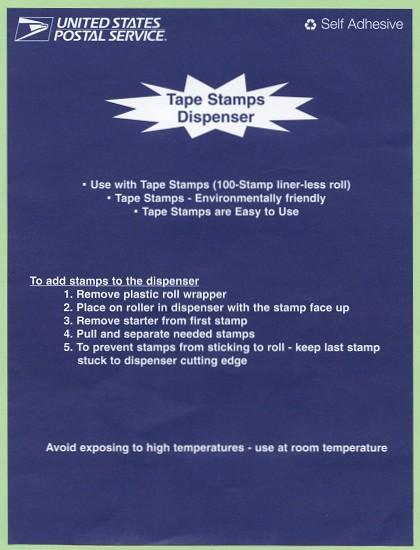
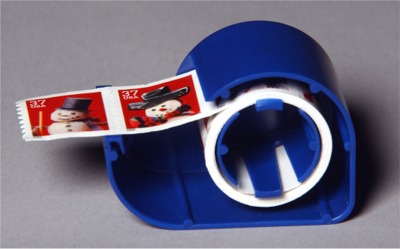
Meanwhile, self-adhesive technology paved the way to other innovations. Linerless coil stamps, issued like rolls of tape without backing paper, arrived in both retail and wholesale formats in 1997 the 32-cent Flag over Porch coil in 100-stamp plastic dispensers for individual users, and the imperforate non-denominated (10-cent) Juke Box bulk rate stamp in rolls of 10,000 and 30,000 for mass mailers.
In several instances, USPS has issued matching self-stick and lick-and-stick stamps. When the self-adhesives all had straight edges, it was easy to tell them apart. Now that many have serpentine die cuts that resemble perforations, close examination is sometimes necessary to tell one type from the other. On self-sticks, the die cut is clean and shaped like a wave; on stamps with traditional gum, the edge between the perforation holes usually is ragged and fluffed or chopped straight if affixed by a mailing machine.
Removing Self-Stick Stamps from Envelopes: Chastened by their experience with the 1974 Christmas stamp, Postal Service officials resolved to overcome problems experienced with that original pressure-sensitive adhesive issue. When the 1989 stamps were announced, news releases and reports in the philatelic press stated that the adhesive on the 29-cent Eagle and Shield stamp would not migrate, would not stain, and would be soluble in water.
These claims were not precisely true, but as a practical matter they may meet the specifications that USPS officials established. The acrylic-based adhesive on those and subsequent self-stick issues does not migrate through paper as the old rubber-based adhesive did, and it doesn't stain. But over time it can cause paper to become translucent. To prevent that, self-stick U.S. stamps issued since 1989 have a protective primer layer between the stamp paper and the adhesive.
Contrary to published announcements, the adhesive is not soluble in water, but Postal Service specifications required that the stamps be removable from paper by soaking them in water for up to 30 minutes. This works because the primer layer between the adhesive and the paper is water soluble. Even so, soaking in water doesn't always work. The majority of samples tested by the Salm Foundation's scientific laboratory did not float free of attached paper after soaking for 30 minutes in hot water; the lab recommends soaking for up to 45 minutes.
Many factors affect the soakability of self-stick stamps. Although most of them have not been tested in a controlled environment, the following factors have been reliably reported and confirmed: First, the longer the adhesive is allowed to set up, the firmer its bond. Other factors probably accelerate or retard the bonding also, such as ambient temperature and humidity, but time is crucial. Therefore, a stamp should be soaked off as soon as possible. The longer it stays on the envelope paper, the more difficult it becomes to soak it off.
When a stamp fails to separate from the attached paper during a lengthy soak, that is a sign that the adhesive may have penetrated the soluble primer layer and bonded directly to the stamp paper. In that case, it is frequently possible to free the stamp by soaking it in an organic solvent such as naphtha or turpentine. Such a solvent cannot dissolve the acrylic adhesive, but it does cause the sticky substance to soften and swell, after which it usually can be rubbed off the stamp.
Another factor that affects the strength of bonding is the type of paper on which the stamp is fastened. Stamps usually float free from coarse paper more readily than from coated or highly calendered stock. Acidic paper tends to form a weaker bond than alkaline paper, according to laboratory tests. But these are relative distinctions, of less importance than the time given to set up the adhesive.
Some self-sticks have a tendency to curl after soaking, if dried in open air. Collectors who experience this problem are advised to place the wet stamps between two layers of blotter paper, and place a weight on top while they dry.
Autopost and PVI strips lack the water-soluble primer layer between adhesive and stamp paper. They are not soakable in water, and attempts to separate them from envelope paper after treatment in organic solvents are usually disappointing. To collect them off cover in used condition, it is best to leave them undisturbed, and to trim away most of the envelope leaving just neat narrow borders around the stamps, as the 1974 Christmas stamps are normally collected.
Storage and Preservation: In 1996, a U.S. Postal Service authority was quoted as having predicted that the adhesive on self-stick stamps "is likely to turn to powder as it ages," perhaps in 80 to 150 years. Interviewed for this report, the official stated he had been misquoted, and had merely speculated that this transformation might occur, but that no tests had verified it.
A National Archives conservator who specializes in adhesives wrote in response to our questions, "The newer stamps [issued after the 1974 Christmas stamp that had rubber-based adhesive] employ the acrylic based adhesives. These do not yellow, they don't lose their adhesive strength appreciably over time, and they don't dry out and become brittle. They do suffer cold flow which makes for the dreaded 'edge ooze' and also may affect the appearance of the stamp by sinking into the paper. I believe that the difference between these two types of adhesives should be made clear to collectors. The newer stamps definitely do not await the same fate as their 1974 predecessor."
Conservators favor removal of such adhesives whenever possible, but the archives conservator acknowledged that "there are different levels of collecting, and that adhesive removal is not always acceptable when one collects rare or pristine stamps."
Besides potential effects on the stamps themselves, pressure-sensitive adhesive may pose other problems, particularly for cover collectors. Acrylic gums have a tendency to cause certain inks to run, and may cause envelopes to discolor or become translucent. Combined with virtually inevitable cold flow around the edges, these stamps on cover may end up with sticky or otherwise distasteful borders.
Not all preservation problems are caused by the adhesive. In many respects, self-stick U.S. stamps are more stable than other contemporary stamps when artificially aged and when subjected to rub tests. Unlike some recent postage stamps, the printed image on all self-adhesives tested by the Salm Foundation's laboratory proved to be stable. None of the ink rubbed or soaked off in standard tests, even at elevated temperatures designed to simulate five years of aging. However, the ink on some stamps can be removed with a normal eraser, according to reports from collectors.
Hot extraction laboratory tests revealed that nearly all the self-adhesives are alkaline or about pH neutral. The only ones that showed a significant level of acidity were the two plastic ATM issues. There is no reason to believe that acidity is worrisome for plastic stamps as it would be for paper stamps, but care should be taken not to store the plastic stamps in close proximity to others.
These observations on preservation apply only to regularly issued U.S. postage stamps, and probably also to self-stick federal Duck stamps. They do not apply to foreign self-adhesives, Autopost and PVI strips, state revenue stamps, Christmas seals, or miscellaneous postal labels. The problems associated with these are often more severe, and less predictable than those that face the stamps which are the subject of this report. For example, many Autopost stamp imprints have faded to near invisibility in the decade since they were issued, and their long-term prospects for preservation are probably bleak.
Collecting Mint Self-Adhesives: For those who want to keep their stamps in mint condition, certain precautions are advisable. They should not be lifted from their backing paper, which creates a more significant change in the pressure-sensitive gum than hinging causes to traditional water-activated gum. Instead, one should remove each adjacent stamp and use them as postage, then trim away all but a small border around the stamp to be saved. These can then be mounted in the usual way, but the mounts should be examined from time to time for evidence of cold flow sticking. If the stamp face clings to the mount, the mount should be discarded and replaced.
The exceptions to this advice are the linerless coils. For those stamps, USPS provides silicone-treated paper strips to use as backing, on which single stamps or strips may be attached before inserting into mounts.
There are two methods of saving the self-adhesives that are printed on both sides. For collectors who want to show the front-and-back feature itself, simply save the full pane as issued. Do not remove the stamps from the backing. This is what collectors do now if they want to show the printed design on the liner backing, or other special features such as the special die-cut Steamboats pane. Some collectors save two of each, so they can show both front and back, side by side.
For collectors who just want to keep mint singles or blocks of self-adhesives that are printed on both sides, peel away the other stamps, front and back, and use them for postage. Then trim a neat border around the ones to be saved while they are still adhered to the backing liner, and mount in the normal way.
A separate problem is storage of large uncut press sheets, which are shipped in cardboard tubes or large cardboard envelopes, neither of which is safe for long-term storage. The safest holders are sleeves made of inert archival materials such as Mylar D; next best are interleaved layers of glassine inside boxes or folders made of acid-free cardboard.
Collecting Used Self-Adhesives: For collectors of used U.S. stamps off cover, the techniques described above for removing the pressure-sensitive adhesive are essential to master. Once the gum is gone, these can be stored like any other used stamps, although the plastic ATM stamps should not be kept in contact with paper stamps. The most important point to remember is to remove the adhesive as quickly as possible, because the longer it sets up, the tighter it clings to the stamp.
http://cool.conservation-us.org/byo...n23-605.html





 Posted 04/12/2013 07:45 am


 to the Community. Enjoy your stay!