| Author |
 Replies: 0 / Views: 1,588 Replies: 0 / Views: 1,588 |
|
|
Valued Member
United States
77 Posts |
|
|
I'm trying to figure out if this is an early-use 114. It appears to be a one cent over payment - I believe the 2 cent rate would apply. I looks like it has the "New York City P.O. Received" postmark (which I believe was only used for mail staying within the city - usually a different postmark with just "New York" was used for mail going outside the city), with a date of March 20, 28, or 29. It is not clear if it is from 1869 or 1870 (or later). Any thoughts on the year? Maybe based on the cancellation - any idea what years/months this cancellation was used? Also, why would this Mott Co., based in NYC, who has pre-printed envelopes with "New York City" at the bottom, overpay? - or am I incorrect on the 2-cent rate? 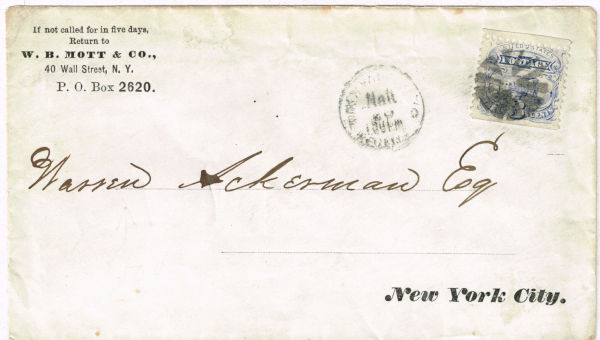 |
|
Send note to Staff
|
|
|
|
|
Bedrock Of The Community
United States
12128 Posts |
|
|
According to the Scott Specialized Catalog, the EKU of the #114 was March 27, 1869.
As to rates, from July 1, 1851 through September 30, 1883, the postage rate was three (3) cents. The distances changed a few times throughout that period, but the "local" rate was still three (3) cents for up to 1/2 oz. It wasn't until October 1, 1883 that the letter rate was reduced by one-third to two (2) cents. |
Send note to Staff 
|
|
|
Pillar Of The Community
2361 Posts |
|
|
Scott contains two full pages of rate data. As of July 1, 1863, the distance differential was eliminated, and the rate became a flat 3c per ½ ounce. The rate did not change again until October 1, 1883, when it was reduced from 3c to 2c, so your letter has the correct postage. |
|
Send note to Staff
|
|
|
Pillar Of The Community
2361 Posts |
|
|
Bedrock Of The Community
United States
12128 Posts |
|
|
Valued Member
United States
77 Posts |
|
|
I'm trying to understand the rates. There was some type of two cent rate for letters staying within the same city. Was there something else special about that rate during 1869-1870? Maybe these had to be delivered to the post office? It has never been clear to me when (starting what date) the post office went from all mail having to be delivered/picked up at the post office to the post office picking-up/delivering it to addresses. Also, any thoughts if this is from 1869 or 1870? 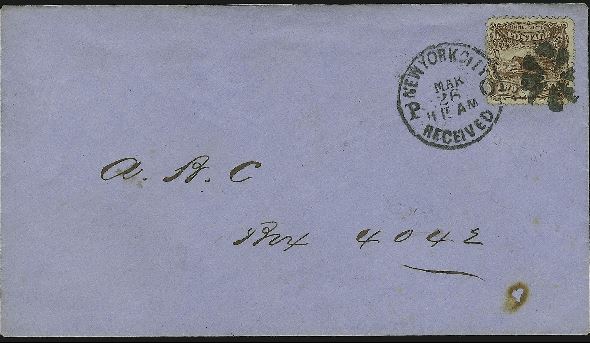 |
|
Send note to Staff
|
|
|
Valued Member
United States
77 Posts |
|
|
Also, thanks for all the information! I'm looking for the year date for the 3 cent cover - I included the two cent image to show that there was a 2 cent rate. |
|
Send note to Staff
|
|
|
Bedrock Of The Community
United States
12128 Posts |
|
|
I don't think anyone can identify with absolute certainty the date on any cover that shows only a month and day in the postmark, especially without a return address to identify the distance the cover may have traveled. One would have to relay on the postage stamp used and the rates that were in effect during that period. Remember, there would have been nothing to stop someone from having used the stamp in later years either, as long as the denomination used was correct for the mail piece. |
|
Send note to Staff
|
|
|
Valued Member
United States
77 Posts |
|
|
I was hoping someone who specializes in New York postmarks and cancellations might be able to tell. Sometimes there are changes to the postmark over time, and we know when they were first used and last used. The same is true for the fancy postmarks. If this cover (the three cent cover) is from 1869 (as opposed to 1870 or later), it would be a very early use, which would add to its value.
My experience with the 3 cent locomotive is that less than 5% of them have postmarks with a year in the date. It was quite rare in 1869-1870.
I'm sorry I side-tracked the discussion with the 2 cent vs. 3 cent - I'm really more interested in the year question! |
|
Send note to Staff
|
|
|
Valued Member
United States
77 Posts |
|
|
Valued Member
11 Posts |
|
|
The 2cent rate of your cover is the "drop letter rate" for a letter brought to a Post Office for pick up by the addressee from his post office box. When home delivery started I assume a drop letter would also be delivered to an addressee at his home if the letter was addressed to his home. This rate started on July 1,1845. I know there was a drop rate into the 1940's (and beyond?)but I cannot say for sure what the drop rate would be when rates fell to 2cents for all letters in 1883. You can see that the writer did not bother to show the name of the city. |
|
Send note to Staff
|
|
| |
Replies: 0 / Views: 1,588 |
|



 Posted 05/05/2013 11:44 am


