| Author |
 Replies: 30 / Views: 5,232 Replies: 30 / Views: 5,232 |
|
Pillar Of The Community
New Zealand
731 Posts |
|
|
I have over 300 covers, and access to many books and resources. But one bunch of general questions about value have stumped me for years. Here is hoping that someone out there knows, has an opinion or best a resource to point me too. These are the questions I have: 1. Does the value of a cover increase if it has been opened by a WWII censor, and if so how much? What about the markings, some have code are they valuable or unique? 2. If a cover with a stamp issue and mailed on the first day of issue (ie a First Day Cover), does it have an increased value from catalog of just that stamp on a cover? 3.Does a cover with registration markings add value and what of their unique variant cachets and the like? what does the numbers mean? See the attached example 4. I have ludlow's railway catalog, but how can I tell the value from the unique RPOs once I find them? RPOs must increase the value but how much? 5. Same with covers canceled / mailed on a ship? how much more valuable to catalog or is there nothing more for it? 6. What about a cover that has a hand cancel on the stamp with ink? does this make it rarer or not? more valuable and how much? Any help would be greatly appreciated 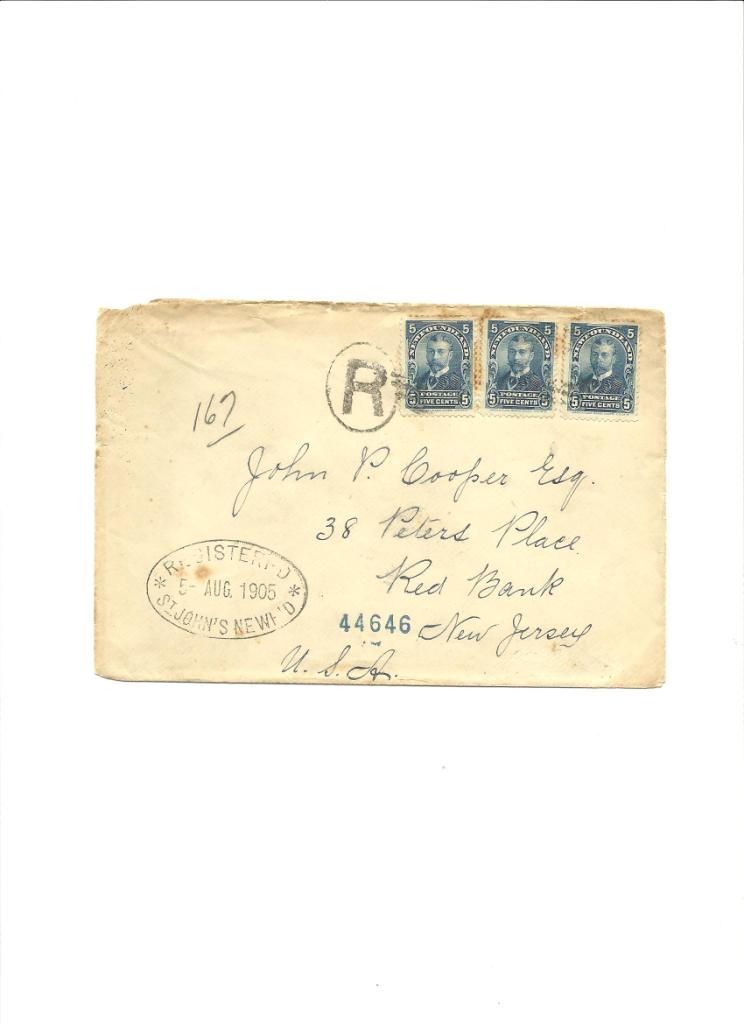 |
|
Send note to Staff
|
|
|
|
|
Pillar Of The Community
United States
6667 Posts |
|
|
Some good questions that will have different answers depending who you ask.
1. Yes censored covers can increase the value of a cover, how much ? Depends on markings, routing, and Stamps. The cover might be worth $2 to one collector and $50 to another if there are personal ties.
2. First Day covers basically the older the better. Many will say that a solo stamp paying the proper rate or multiple Stamps on cover paying the correct rate (Commercial cover) will almost always be valued higher.
3 - 5. Generally speaking the more auxiliary markings the better. RPO's, Ship Postings (Paquebots) are very collectible but usually don't turn a basic cover into a Siegel auction item but they can increase the value slightly.
Hope some of this helps. |
Send note to Staff 
|
|
|
Pillar Of The Community
New Zealand
731 Posts |
|
|
Thanks Stallzer.
And what do you all think the number "44646" signifies?
Is it like a counter? or is it the unique number assigned to the registration? |
|
Send note to Staff
|
| Edited by tommy - 05/24/2013 4:07 pm |
|
|
Bedrock Of The Community
United States
12128 Posts |
|
|
Bedrock Of The Community
United States
12128 Posts |
|
|
By the way, the addressee of the scanned cover, John P. Cooper, Esq., of Red Bank, NJ was a stamp collector and dealer in his day. He was a member of the APS and often had ads such as this in stamp publications from the period: 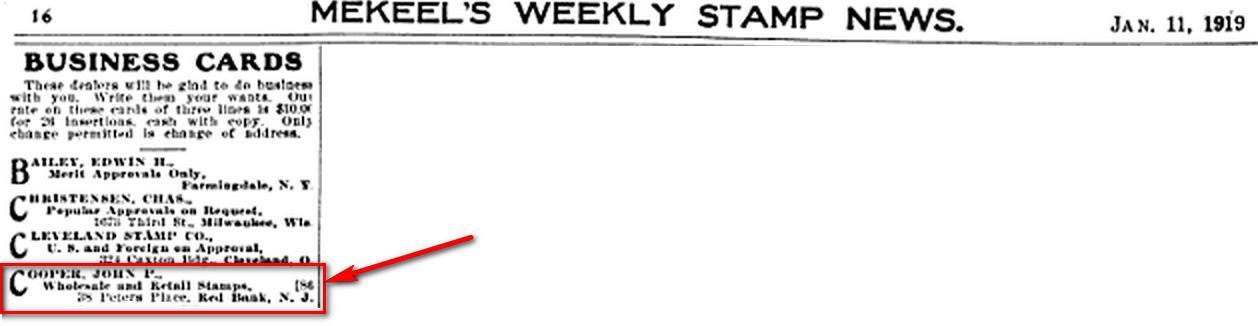 |
|
Send note to Staff
|
| Edited by wt1 - 05/24/2013 4:27 pm |
|
|
Valued Member
392 Posts |
|
|
It is impossible to answer your questions about covers. There are too many variables to consider. Are you interested in the covers or are you simply interested in selling then to make a profit? Your resources will probably be of little use. If you will be selling I suggest you spend some time looking at covers sold on ebay. This will give you an idea of price ranges for different kinds of covers. Spend time at stamp bourses and shows looking through cover dealer boxes. You can rely on advice from others but do so with a grain of salt. There is a tendency for stamp dealers to suggest unrealistically high prices. Stamp and covers are different beasts |
|
Send note to Staff
|
| Edited by lorddenning - 05/24/2013 6:06 pm |
|
|
Bedrock Of The Community
United States
12128 Posts |
|
|
Quote:
Stamp and covers are different beasts Agreed! Likewise, buying or selling are different beasts. For example, the initial post mentioned censored mail covers from World War II. They are very common for that period, as virtually all military personnel stationed overseas and writing back home would have their mail subject to military censors. So in this case, some may not be worth much as an individual cover, but specialists in World War II history items would often pay more. First Day Covers are another situation altogether. Typically US first day covers after 1940 are so plentiful they have flooded the market and as a result there is little value to the individual cover, so most are valued at $1 or so on the secondary market -- sometimes much, much less, depending on condition or cachet -- and clean, unaddressed covers with cachets will command a premium over addressed ones. On the other hand, pre-1940s first day covers can command a significant premium as will those with scarcer cachets. Even when talking about RPOs, although collectible, there are many examples for sale at relatively low prices. Premiums are typically added for especially nice covers, scarce RPO routes and/or special postal markings. Just because it's an RPO doesn't make it significantly valuable. RPO covers are quite common as they were generated by the US Mails for decades up until the middle of the 20th century. (NOTE: In the original post, the Ludlow RPO Catalog was referred to, which I believe covers primarily Canadian RPOs. If that is your area of collecting, there could be a different market and value, as my previous comments were based on US RPO's.) |
|
Send note to Staff
|
| Edited by wt1 - 05/24/2013 7:57 pm |
|
|
Pillar Of The Community
United States
821 Posts |
|
|
So Far I have found the most influential aspect of covers that affects pricing is the topic. Most covers value in at about 75 cents but A sports figure can jack the price up significantly. |
|
Send note to Staff
|
Member of the Central Oregon Stamp Club.
Redmond, OR 97756 Mailer's Postmark Permit #1
APS 239403 |
|
|
Pillar Of The Community
New Zealand
731 Posts |
|
|
Many thanks to the posts, all helpful.
I am only a buyer, not a seller and only of Newfoundland: so my question was more of interest in being better educated. for example, if I have a cover with a stamp from 1935 and the unitrade or NSSC value is $10.00, then how much more would it be if it were an FDC? I realize that this is subjective, impossible to answer--but was grasping to see if there was some resource out there that provided a guideline for higher value %. In the way that NH% premium is provided in the Unitrade.
Or in the way that Ludlow provides rarity factors for cancels.
I love learning, and when I stumbled onto some of my covers with RPO/TPO cancels, then I bought the Ludlow book and it casts some light or organization (and fun) on those aspects.
It seems to me that with the WWI censors covers, that there is a need for a special book or resource to organize those unique aspects--and their value (or rather their increased perceived value). Does anybody know of such a resource? For example, I found something recently in the NSSC book on special stamps from secret American bases in Newfoundland..and that was cool..but limited. It might also cut across Newfoundland and other countries too.
At the end of the day, its only worth what someone will pay.
|
|
Send note to Staff
|
| Edited by tommy - 05/31/2013 1:57 pm |
|
|
Pillar Of The Community
United States
6667 Posts |
|
|
Quote:
the unitrade or NSSC value is $10.00, then how much more would it be if it were an FDC? Or how much less would it be valued ? An FDC is a Philatelic item and should be valued less than a commercially used Cover. Also remember that valued at and priced at are 2 different things. |
|
Send note to Staff
|
|
|
Valued Member
392 Posts |
|
|
Quote:
f I have a cover with a stamp from 1935 and the unitrade or NSSC value is $10.00, then how much more would it be if it were an FDC? I have been buying covers for a long time. The Unitrade "values" are made up. If you really want to know what covers are worth you have to work at it! There is no simple way. You asked about first day covers. Collectors of FDCs are interested in specific cachets. Cachets produced by Rosecraft are not as expensive as those produced by Kolor Kover.  Rosecraft Rosecraft Kolor Kover Kolor KoverBut wait! Here is a general purpose Rosecraft FDC that is even more desirable.  This is explained in the following article: http://postalhistorycorner.blogspot...purpose.htmlSo, how are you supposed to know this? Study, study, study! It has never been easier to learn about the hobby. |
|
Send note to Staff
|
|
|
Pillar Of The Community
United States
6667 Posts |
|
|
But on the other hand, they might not be worth much to non FDC collectors. The mystery of covers and valuing them is that a cover could be worth $100 to one collector and $2 to another collector and I am now convinced that putting values on covers is merely a dart throw. Certain classic pre-1875 covers will almost always demand a premium but after 1900, anything goes. |
|
Send note to Staff
|
|
|
Pillar Of The Community
United States
611 Posts |
|
|
I'm going to hop in and comment on values of covers. To have a discussion though I think covers should be broken down into categories. I don't collect or sale FDC's so I'll limit my comments to usage covers. Most catalogs value stamps on covers very (like they do stamps) because it is a draw to the consumers to think they have a highly valued collection. The stamp has minimal impact on the value unless the stamp itself is scarce. What cover collectors desire changes all the time and so you see an item sale for one price this month and a different price the next. People jump in and out often. Learning the nuances of solo usage, types of cancelers, DPO's, RPO's, treaty ports and foreign destinations, censors and where they were performed, and postal markings (I'm sure I left out as many as I put in) make it a challenging field to study. Also the reference books that are actually needed to understand them can cost more than the accumulation of the covers. Once you undertake to understand a field and acquire or borrow the reference books then you will find out how little you knew. The last thing is condition. Keeping the covers in a place to keep them from having battered edges and spider webs and also keep attached notations is even harder.
|
|
Send note to Staff
|
|
|
Pillar Of The Community
United States
1128 Posts |
|
|
Greetings, tommy! As you can tell by the previous answers, your questions certainly are not dumb, but in fact, are thought provoking. The value of a cover is how much I enjoy having it whereas its' worth is what I would appraise that I, as the owner, would sell it as. I, as a buyer, have to determine if the value or enjoyment to me is worth the cost of what I would have to pay for it. (We tend to use "value", "worth", and "cost" interchangeably, but there are differences in their meaning.) My perspective on covers is that ALL covers have an important place in philately and most have a varying amount of appeal to different people. I think that FDC's, ship covers, FFC's, etc. have a very important niche in philately. There are many collectors who simply cannot afford "high cost" covers, but want the enjoyment associated with cover collecting. Two years ago, I sent approximately 500 fdc's to the disabled veteran's stamp club where they were well received. I also am of the opinion that a stamp on cover should not be viewed as having less worth than the stamp alone. It just doesn't make much sense to say if I remove a stamp from a certain type of cover will increase it's value and hence its cost. Bottom line is ... you have to do your homework. If you are interested in FDC's, know how the comparative worth of various cachet makes is, as lordenning indicated. If you have a topical collection, covers having a stamp, cachet or postmark related to the topic will probably have a higher value to you, hence you are willing to pay a little more for it. When considering an item for purchase, determine its value to you AND STICK TO IT. If you find yourself paying more than what you wanted to, then you did not do a decent job in determining its value to you. I will be creating a new post soon for sharing some of my recent purchases. I have over 5000 covers, by the way, some have very little, if any, value, but I just don't want to spend the time to go through them. My time has value, too!  |
|
Send note to Staff
|
| Edited by ncbuckeye - 06/01/2013 10:41 am |
|
|
Pillar Of The Community
New Zealand
731 Posts |
|
|
Stallzer, Now I am curious about your comment that "An FDC is a Philatelic item and should be valued less than a commercially used Cover." Is this always the case? I have quite a few Newfoundland first day covers from prior to 1940 that were simply the first day usage of a stamp, and my view is that they would be more expensive. For example, I have a cover from June 9, 1933 from St Johns to Washington DC using the C13 and C14 stamps on the first day possible of those stamps. would this cover be incrementally more valuable than say a cover on June 10 or one from 1934? Is it a "Philatelic" item and worth less even it was from a dealer to himself? I'll upload the scan tomorrow Great discussion and thanks 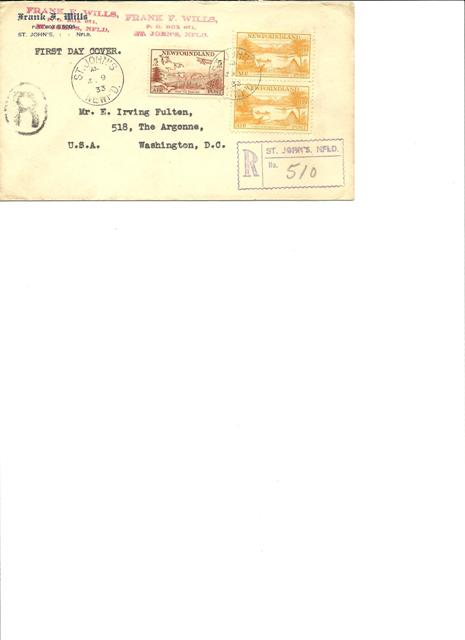 |
|
Send note to Staff
|
| Edited by tommy - 06/01/2013 5:25 pm |
|
|
Pillar Of The Community
United States
6667 Posts |
|
|
Quote:
"An FDC is a Philatelic item and should be valued less than a commercially used Cover." ,Is this always the case? Not always as some FDC's were printed in small quantities. The definition of a Philatelic cover is an envelope or post card prepared with a stamp(s) and address and sent through the mail delivery system for the purpose of creating a collectible item. So by definition all First day covers, First flight covers, commemorative covers etc, are Philatelic. But not all commercial covers are valued higher than all FDC's and some of the First flight covers can get spendy also. I don't know what the percentage is of cover collectors that prefer commercial vs philatelic but it would be interesting to know. Should be clear as mud now  |
|
Send note to Staff
|
| Edited by stallzer - 06/01/2013 4:07 pm |
|
|
Replies: 30 / Views: 5,232 |
|



 Posted 05/24/2013 12:44 am


