Stamp Community Family of Web Sites
Thousands of stamps, consistently graded, competitively priced and hundreds of in-depth blog posts to read


Stamp Community Forum
 
Username:
Password:
Save Password
Forgot your Password?

This page may contain links that result in small commissions to keep this free site up and running.

Welcome Guest! Registering and/or logging in will remove the anchor (bottom) ads. It's Free!

"Par Le Packet Anglais " - Which One Was That ?

 
To participate in the forum you must log in or register.
Author Previous TopicReplies: 3 / Views: 3,096Next Topic  
Valued Member
Romania
302 Posts
Posted 06/15/2013   10:04 am  Show Profile Bookmark this topic Add March to your friends list Get a Link to this Message


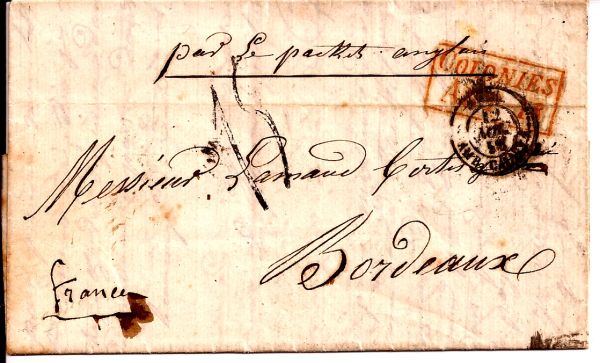
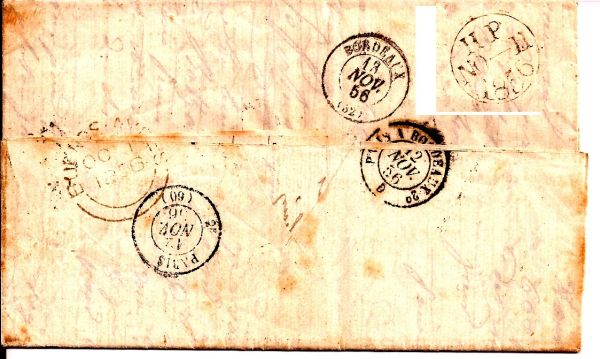
From my collection attached is a non-stamped ( without franking ) cover sent from Buenos Aires , Argentina to Bordeaux, France in 1856.
The itinerary ( route) of this envelope has two legs , one by ship :Buenos Aires - Calais and another one by railway: Calais-Paris-Bordeaux , which can be traced by the place & date postmarks as well as by the text on cover's front as follows :

On front of the cover :

- On top side the handwritten text " Par Le Packet anglais "

- An orange rectangular stamp with text : COLONIES /A.M. 13 ( or "18" as it is not fully readable)

- Double-circle postmark : "12 NOV 56 / AMB.CALAIS " in black colour

On back of the cover :

- Double-circle postmark : "BUENOS AYRES / OC 1 / 1856 " in greyish-black colour ( It seems to be postmark of B.A. port post office ? )

- Double-circle postmark : "2E PARIS (60) / 12 NOV. 56 " - black

- Double-circle postmark : " PARIS / BORDEAUX 2 G - 12 NOV 56 " - black

- Double-circle postmark : " " BORDEAUX (32) / 13 NOV 56 " - black

And the last but not least postmark is also on the back , single-circle in greyish-black with text : " H.P / NO - 11 / 1856 " .
So is this a maritime cancellation struck on board the English packet ( " Le Packet anglais " ) ?!? And which was this vessel doing the itinerary Buenos Aires - Calais in Oct/Nov. 1856 ?!?

Also what about the orange rectangular postmark (?) on the front cover ?!?

Thanks to everyone who can answer these questions
Send note to Staff
Edited by March - 06/15/2013 10:11 am

Pillar Of The Community
United States
5894 Posts
Posted 06/15/2013   11:40 am  Show Profile Bookmark this reply Add smauggie to your friends list  Get a Link to this Reply
Fascinating cover, thanks for sharing!

This website may be of some assistance.
http://www.theshipslist.com/ships/l...lmail.shtml" target="_blank" rel="nofollow"> br / http://www.theshipslist.com/ships/l...almail.shtml
Send note to Staff  Go to Top of Page
Valued Member
Romania
302 Posts
Posted 06/15/2013   2:24 pm  Show Profile Bookmark this reply Add March to your friends list  Get a Link to this Reply
@smauggie
Thanks for the link I have got few more but it will be a hard work to trace that vssl
Send note to Staff  Go to Top of Page
Valued Member
Romania
302 Posts
Posted 09/29/2013   06:49 am  Show Profile Bookmark this reply Add March to your friends list  Get a Link to this Reply
With the help of my buddies from another Forum ( http://www.stampboards.com/viewtopi...718#p3521718 ),several questions were clarified with regard to this mail/cover history . Here they are :

(1)


The front side cancel «Angl. / Amb. Calais» was applied on the Calais to Paris train and indicates the letter was coming from England (Angl. =Angleterre) Amb. is short for «Ambulant» a travelling Post Office. All letters originating from abroad were directed to Paris for distribution.

Hence, on the back side you have a Paris transit, I'm surprised to see a «2E» on the left side, this should be a «10E» for Bordeaux but these errors are quite common.

Then you have a «Paris to Bordeaux, 2nd night train» transit mark (I know it is a night train as the inside of the cancel is circular; a day train would have an octagonal inside) and, finally, a Bordeaux receiver.

The red rectangular cancel on the front reads «Colonies / Art. 18» It is an accountancy mark for letters having transited through England. The mark is unusual on letters as it was usually applied to lists of letters. Letters with this mark usually sell for sums in excess of 100 euros.

Lets not forget the «15» mark on the front which represents the postage due amount of 1 franc 50 centimes, it was applied in Paris.
I hope I have shed some light on your unusual letter.

MEMPHRE( Delcampe )


***

(2)


the HP is a London postmark.

From the Economist of 15 Nov 1856 , the name of the ship was Avon and she arrived at Southampton.

( see the link for document copy )

On another voyage Lisbon - Southampton is 4 days.

So Lisbon 7th Nov ... Southampton 11 Nov and thence London the same day.

ROSSI
***


(3)

Indeed most likely is the passenger ship "AVON ", of 2,069 tons, built in 1843 at Bristol by Patterson Shipyard , with registered owner Royal Mail SP Co ., and wrecked in Colon 21.11.63
( source : Miramar Ship Index )

March


****

(4)

The HP is an internal code used at the GPO of London.
I don't know its meaning for sure.
But just to give you an idea it could be the time of the day, example 7.30 - 8.00am, or it could be that hand stamp, or it could be a sequential letter changed every day, so the next day you could find HQ the next HR and so on.
Do not take literally what I said it was just to show some examples.
That postmark was used in black during 1845-1857

ROSSI


****


(5)


I try to give some additional info about the accountancy mark that memphre mentioned above .

The argument is very interesting.

Here it is:

( see the link for document copy )

It was applied in London.


With the help of the book Robertson Revisited by Colin Tabeart:

The cachet "Colonies &c Art" resulted from the 1843 Anglo-French Convention, and subsequent amendments thereto, and are known from the inception of that Convention on 1 Jun 1843.

They were applied to unpaid or insufficiently pre-paid letters passing through Britain to indicate to France the bulk rate being claimed by the British for sea and transit postage. The Act numbers refer to numbers in the letter bill, and not an article of the Convention: they changed in 1846 due to an amendment to the letter bill, and again in January 1856.

Those most commonly seen are:

COLONIES &c ART 12: Jun 1843 - Jan 1846 mail exchanged at the bulk rate of 3/4d per oz
COLONIES &c ART 13: Jan 1846 - Dec 1855 mail exchanged at the bulk rate of 3/4d per oz
COLONIES ART 18 Jan 1856 - Dec 1856 mail exchanged at the bulk rate of 3/4d per oz

Your "ART 18" is scarce because of the short period of use.

Mails exchanged at higher bulk rate of 4/- per oz, primarily from British North America and Jamaica, received markings as follows:

CANADA &c ART 11: Jun 1843 - Jan 1846
CANADA &c ART 12: Jan 1846 - Dec 1855
CANADA ART 19: Jan 1856 - Dec 1856

Here is a letter-bill of 1844 so that you can understand what I marked previously in bold about article numbers!

( see the link for document copy )

On 1 Jan 1857 the new Anglo-French Convention became effective and new accountancy markings were introduced.

Here they are:

( see the link for document copy )

So the accountancy mark "ART 18" stated the British claim of a bulk rate of 3/4d (40d or 40 decimes) per oz.

Why the letter was taxed in France for 15 decimes ?

Here it is:

( see the link for document copy )

I don't know how that 15 was computed, but in some collections I saw explained the "15" as:

10 decimes (British transit and sea postage) + 5 decimes (French inland postage)
BUT I'm not sure about that, I don't know French postal rates.

ROSSI


****

(6)

I just found the article with the missing part

( see the link for document copy )

The ship "Avon" departed from Buenos Ayres on October 2nd, the letter has a date-stamp of October 1st.

ROSSI


***

(7)

The ship Avon departed from Buenos Ayres on October 2nd, the letter has a date-stamp of October 1st.
I can confirm that the Buenos Ayres double circle datestamp was used in Buenos Aires, Argentina. This cancellation was issued by the British Postal Agency in Buenos Aires (and similar ones to Montevideo and Brazilian offices) in 1851.Looking in "South American Packets" by Rev. J.N.T. Howat, I see that your cover was carried on the Royal Mail Steam Packet Company vessel "Avon", which left Buenos Aires on 2nd October 1856, Montevideo on 5th and Rio on 15th, arriving in Southampton on 11th November. The mails reached London the same day, and this cover was then sent on to France as described by previous posters.

PAUL F.

Send note to Staff  Go to Top of Page
Edited by March - 09/29/2013 10:47 am
  Previous TopicReplies: 3 / Views: 3,096Next Topic  
 
To participate in the forum you must log in or register.

Go to Top of Page

Disclaimer: While a tremendous amount of effort goes into ensuring the accuracy of the information contained in this site, Stamp Community assumes no liability for errors. Copyright 2005 - 2026 Stamp Community Family - All rights reserved worldwide. Use of any images or content on this website without prior written permission of Stamp Community or the original lender is strictly prohibited.
Privacy Policy / Terms of Use    Advertise Here
Stamp Community Forum © 2007 - 2026 Stamp Community Forums
It took 0.14 seconds to lick this stamp. Powered By: Snitz Forums 2000 Version 3.4.05
