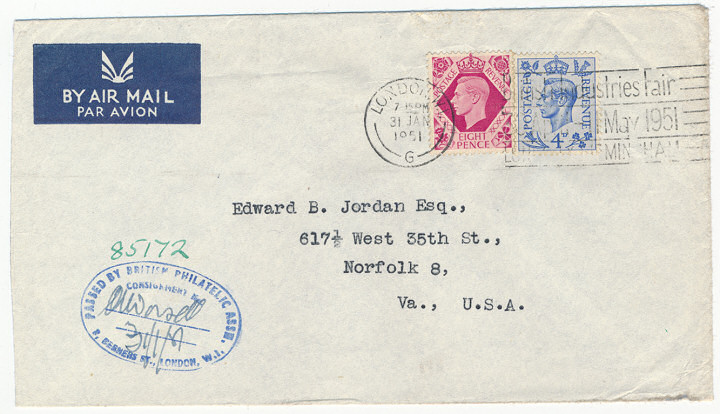
Here's your answer:
Quote:
Early in World War II, exchange controls on the export of capital and capital assets were set up by the Government to ensure that exports were paid for with hard currency or a barter agreement, and imports paid for via the proper currency channels. Valuable small items like stamps had potential for evading the controls by being sent out of the country in the post to be sold abroad. Although censors could be expected to realise the value of items such as jewels, spotting a rare stamp among a packet of common material took expertise.
In order to trade, permission from the Foreign Exchange Control Department of the Bank of England was required. When the "Phoney War" ended in May 1940 the rules were tightened up. From 1st July, export of stamps was prohibited except under licence. The stamp trade was hardly vital to the war effort, but as a net exporter it brought in valuable foreign currency.
A meeting of stamp dealers agreed that the British Philatelic Association (BPA) would operate a "Philatelic Import and Export Control", under a committee of leading figures in the trade. This proposal was readily accepted by the Government departments concerned, and full details were published in Stamp Collecting's July 20th issue. Anyone wishing to trade in stamps overseas had to obtain a permit from the BPA, who acted as agents for the Board of Trade and the censor, assuming responsibility for the bona fides of the sender and also for payment of the sum due.
Packages for export had to be sent to the Central Clearing House in the BPA offices at 3, Berners Street, W1, to be checked. Dealers had to inform overseas correspondents to address stamps sent to Britain c/o the BPA, who opened them to ensure that invoice and contents matched, recording the sender and value of all packets. An enclosed prepaid envelope addressed to the customer was required, normally for registered post -- although most dealers in Central London preferred to make their own arrangements for collection and delivery at Berners Street.
This self-regulatory system applied to all stamp sales and exchanges, by dealers, exchange clubs, and private collectors. There was no fee for the service, even for non-members of the BPA. Currency restrictions remained after the war, however, and although regulations were relaxed for the "sterling area" shortly after VE Day, the BPA continued to act as a middleman for other stamp imports and exports until 30th June 1953, having performed a crucial role in keeping the stamp trade going during difficult times.
http://www.gbps.org.uk/displays/passed-by-bpa/Here's a link to some differing handstamps from the BPA. The one shown on your cover seems to be the Type 2 that was in use through 11 February 1953. Also, the signature in the stamp is that of one Winifred Worsell.
http://www.gbps.org.uk/publications...d-by-bpa.php





 Posted 08/08/2013 1:08 pm