To participate in the forum you must log in or register.
| Author |
 Replies: 91 / Views: 23,235 Replies: 91 / Views: 23,235 |
|
|
|
Valued Member
42 Posts |
|
|
Essayk, this is quite startling and equally impressive. I want to talk more about this revelation, but first, let me show you and the community what Casilear's signature looked like during the period we are discussing (i.e. 1848-1851). I reproduce two signatures of his on letters dated May, 1848 (top) and July, 1850 (bottom, dark). As you can see, they are virtually identical, and clearly do not match the penciled in signature appearing above on the die essay credited to him by some unknown hand. 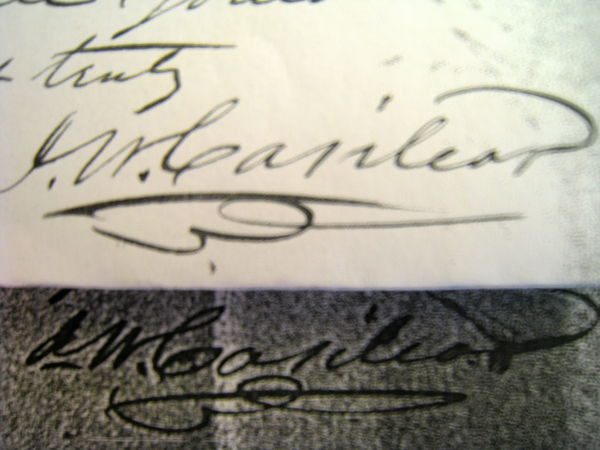 One more thing: after racking my brain for days trying to remember where I saw the reference to the Thomas Morris attribution of the 1851 stamp vignette engraving, I finally found it. Brazer raised the issue in the Collectors Club Philatelist, October, 1938, pp. 278-79. I don't have access to this issue, but, Chase, in his opus on the 3c Washington of 1851, refers to that article on page 33: "Unfortunately, practically nothing is known as to the identity of the man or men designing or engraving the 3c 1851 stamp. . .Thomas F. Morris, Sr., a designer trained by . . .the designers and engravers that he could credit with the work: in the center of the group of 1851 proofs, he wrote "Pease" and "Henry Earle". Since then, Edward Purcell has been given credit for the design of the 3c, largely, it seems, because he lists his address in the 1850-51 city directory as 29 Wall Street, the same as TC/TCC. Purcell was a talented designer, and he did partner earlier with Nathaniel Jocelyn, who also was at TC/TCC along with his brother Simeon - a talented engraver -at the time of the 1851 stamp issue. But, these attributions given to lesser men at the TCC firm at a time when it was openly competing for the post office contract against several others, seems badly misplaced. The firms had to submit examples of their stamp essays to the post office for preliminary judging prior to the contract being awarded. They would almost certainly have used their best men to work on these elements, if for no other reason than to impress the Post Office with their "heavyweight" status. A look at the philatelic literature will confirm this observation - it is explicitly stated in the 1851 Wagsal 2001 census of the Franklin 1c 7R1E, which is the most completely printed original frame of that issue. I concur with your naming of Cyrus Durand as the likely lathe engraver (not Earle or Spencer), particularly given the artful use of the rosettas. And, he was part of the firm in 1851. Durand was a genius and a control freak when it came to using his geometric lathe (in fact, he had a monopoly with that machine he invented that he exploited for decades). Then, returning to Pease, we know he was tied up with the prolonged effort art engraving of "Old '76 and Young '48" during this period. Pease certainly could have done the 1851 1c and 3c vignette engraving, but I don't think he did. The reasons behind this hypothesis have to do with the way TC & Co operated before and after the formation of ABN in 1858. When the seven bank note engraving firms joined together, TC & Co still had the stamp contract with the Post Office. Thus, that part of their work was hived off and left in Philadelphia and remained so until the contract expired in 1861. Morris, when he joined ABN in 1869 and thereafter, would not have had access to the TC & Co. stamp records which remained behind in Philadelphia (along with some of the earlier partners). When the firm later sold its stamp assets to the firm of Butler and Carpenter (or Joseph R. Carpenter, the record is unclear), all the stamp material would have transferred to this firm. Then, as history records, the Jayne Building housing all the machinery, inventory, etc. burned to the ground March 4, 1872, and with it any record of who did what on the 1851 issue (for historical interest that building is shown on the 1c, 2c and 4c private die proprietary stamps of D A Jayne & Son, listed in Scott S419-S424). Morris was a very talented engraver and administrator of the Bureau of Engraving, and maybe he was asked to do something that he really did not know the answer to, but, in any event, he did his best with probably as little information as we have today. He knew names and places and dates, and the attributions to Pease and Earle - probably done after their deaths - would not have aroused much curiosity, because nobody else had much information to go on either after the Jayne Building fire. I am speculating here, but, if someone else on this forum can provide any documentation whatsoever on this topic, it will be of great historical value. The comparison between the Casilear attributed die essay and the green trial proof is indeed quite close. There are some variations in the cuts in the toga around his neck, and, generally, the cuts are deeper in the green trial proof. I have spent some time trying to locate the engraved heads of Franklin and Washington used on obsolete bank note currency before the 1851 stamp issue, and have found none. Julian Blanchard made a study of this back in the early 40's, using Brazer's material, and could not find any either, as published in the Essay-Proof Journal. He also noted the slight variation in the engravings used on the stamps and on the bank notes. Lacking any more conclusive information (and I certainly do not have access to all the scholarly stamp articles written on the 1851 issue), I conclude, as I believe others have, that the engravings used on the 1851 1c and 3c issues were purpose done for that use only. I am keen to get feedback on this post, as well as to learn from Essayk if there is any further stylistic testing to be done, and what the feedback he has seen from others not on this forum. In closing this overly long, but I believe necessarily expanded reply, I would like to quote from Ashbrook's opus on the 1851 1c. Referring to the Franklin head on page 52 of Volume 1, he writes: "The engraver of the head is unknown, but if first engraved in 1849, it may be the work of the artist engraver John W. Casilear, who joined the firm of Toppan, Carpenter, Casilear & Co. that year. the engraving firms were then comparatively small and the members of the firm generally did separate parts of the work. William C. Smillie, a member of the firm, was a letter engraver, as was Charles Toppan, the senior member. Smillie probably executed the lettering and possibly the scroll work. Henry Engard Saulnier, another member of the firm, then devoted his time to transferring and he probably was the siderographer." Whether any of this is true or not, it comes from someone who spent most of his life studying this one stamp, and not someone asked to jot down on a proof what he may or may not have known happend forty years or so earlier and one year before his birth! |
Send note to Staff 
|
|
|
Pillar Of The Community
United States
1946 Posts |
|
|
Quote:
the Collectors Club Philatelist, October, 1938, pp. 278-79. I don't have access to this issue, Oddly enough, I have access to this series, but not to the book by Chase. Brazer ran his "Historical Catalog" serially in the CCP from 1938 into 1949, and gives updates/upgrades on the earlier notes as he goes. Several years ago I photocopied the entire series and put it in a binder for my personal use. Now I am about the task of scanning the journal pages. It's a great resource. BTW among the entries in that final installment, he includes a note regarding George Washington Casilear: "the nephew of John W. Casilear and the son of his brother Francis Casilear..." It is a worthwhile compendium, but in need of an edit job. [reflecting on earlier notes: In this same installment he has notes about Thomas F. Morris, including the date he started with ABNCo (4/20/69), the names of the men for whom he apprenticed, the year he was made Superintendent of the Designing Department, when he left for Homer Lee, when he started with the Bureau, and the dates of his retirement and death.] Quote:
Thus, that part of their work was hived off and left in Philadelphia and remained so until the contract expired in 1861. Morris, when he joined ABN in 1869 and thereafter, would not have had access to the TC & Co. stamp records which remained behind in Philadelphia (along with some of the earlier partners). When the firm later sold its stamp assets to the firm of Butler and Carpenter (or Joseph R. Carpenter, the record is unclear), all the stamp material would have transferred to this firm. Let's tweak this. Prior to the failure of the postage stamp contract, Joseph R. Carpenter had become a partner in TCCo. By May 1861 John Butler had been newly elected to Congress, and TCCo sold him a 20% interest in their stamp contract hoping to gain an edge. So when the stamp contract ended for TCCo in June 1861, John Butler and Joseph Carpenter joined up to form the engraving firm that successfully contracted with the Treasury Department for the first issue of revenue stamps. Brazer notes, "It is, however, well known that many, if not all, of the old firm's valuable stock of dies and transfer rolls and some record proofs, etc., were left in the firm and taken by the old partner Joseph R. Carpenter into his new firm of "BUTLER & CARPENTER." The company was listed in the 1862 city directory with offices at 242 Chestnut St., and the margin imprints on their stamps identify the firm as "Butler and Carpenter" until John Butler died in 1868 at which point it becomes "Joseph R Carpenter" alone. Brazer reports that some of the TCCo dies were used by the new company for private revenues, and "Others, especially for the 1861 postage essays, which were the 1851-61 contract designs with numerals added, descended to the old firm's successors, the Philadelphia Bank Note Co." Carpenter was the founder and general manager of that company until his death in 1892. Quote:
Then, as history records, the Jayne Building housing all the machinery, inventory, etc. burned to the ground March 4, 1872, and with it any record of who did what on the 1851 issue Actually, the New York Times reported on that fire several times on the same day and followed its progress. The devastation was not total, inasmuch as the floors above the sixth were not affected except for smoke. Nor were the lowest stories much affected except for water damage, inasmuch as the fire started on the third floor. Unfortunately the only comment the report gives about damage to the tenant companies is this: The upper portion of the Carter-street front fell with a tremendous crash a few minutes ago, [sometime after 11:15 PM] but the side walls still remain as firm as ever, and if they continue so the Bank of Commerce and various brokers' offices on Chestnut-street will probably escape with the exception of damage from water." The building was finally demolished in 1957. Given the fact that a significant portion of the stock dies were still available for sale to Ernest Schernikow in 1900, and the fact that Joseph Carpenter relocated his production facility to 435 Chestnut street prior to 1876, suggests that not all was lost. Quote:
Morris was a very talented engraver and administrator of the Bureau of Engraving, and maybe he was asked to do something that he really did not know the answer to, but, in any event, he did his best with probably as little information as we have today. You're forgetting an important source of information to which Thomas F Morris had ready access, especially from the time he became superintendent of the design department at ABNCo. The people who were engaged in Securities engraving and printing were a pretty tight group of artists all. According to his son Thomas F Morris II, Morris personally knew these people and their families. He had access to more than the kind of information stored in company records, and not just for people in the immediate employ of ABNCo. Quote:
I have spent some time trying to locate the engraved heads of Franklin and Washington used on obsolete bank note currency before the 1851 stamp issue, and have found none. Julian Blanchard made a study of this back in the early 40's, using Brazer's material, and could not find any either, as published in the Essay-Proof Journal. He also noted the slight variation in the engravings used on the stamps and on the bank notes. Lacking any more conclusive information (and I certainly do not have access to all the scholarly stamp articles written on the 1851 issue), I conclude, as I believe others have, that the engravings used on the 1851 1c and 3c issues were purpose done for that use only.
Can you give me some specific EPJ references? I have a complete run of that and would like a leg up on digging in to what Blanchard had to say. Also could you give me a more specific reference for your final sentence? It completely dismisses without rebuttal the evidence I have put forward based on my detailed observations. I do not see how you can deny that the banknote Franklin vignette was used for the one cent, or that Casilear used the Washington vignette for his original essay design. The dots and dashes line up too well to ignore them. Quote:
Whether any of this is true or not, it comes from someone who spent most of his life studying this one stamp, and not someone asked to jot down on a proof what he may or may not have known happend forty years or so earlier and one year before his birth! No offense intended, but I do think that Morris deserves better than that. He was not an outsider to the field. |
|
Send note to Staff
|
|
|
Valued Member
42 Posts |
|
|
Essayk, again I must applaud your detailed response and genuine commitment to getting to the bottom of this issue. Trust me, we are on the same page.
As to specifics, the Blanchard information is contained in EPJ, Vol. 3, No's 2 &3, "Bank Note Dies Used for Stamps". I read the sections: 'Essays for US 1851 Stamps', and just after this, US 1c and 3c stamps', p.p. 5-10. There is good information on the heads of Franklin and Washington as worked up by other firms competing for the Post Office contract as well as those of TCC. I don't have the specific dates for when the stamp die essays and proofs for the 1851 TCC series were worked up, but does it not the possibility exist that they served as models for the bank notes rather than visa-versa? I wish I could present the forum with an engraver's sample sheet from TC, or TCC, showing their vignette wares. Unfortunately, I have never seen one cross in an auction, and the last one I am sure that crossed in an auction was in 1907.
The filled in information on the Jayne Building fire and subsequent use of some of the assets is very interesting, but, it doesn't change the fact that Morris, and Morris alone, seems to be able to identify who did what, and when viz. the 1851 issue. I do not dismiss his contribution at all; I merely point out that there were others who spent their whole lives practically, looking at the 1c and 3c issues, and they couldn't offer anything definitive on the topic as to who the engravers were. Pardon any implicit sarcasm directed to Morris.
Related directly to this issue, I ran across an interesting tidbit online you may be able to track down as I am very meagre in stamp literature at hand. In 1994 in The American Philatelist, Vol, 108, issues 1-6, p.508, there is a snippet of a quote that got my attention: "Toppan, Carpenter submitted reenegraved die proofs of the 1857 issue, with vignettes by Joseph Pease and lettering by Henry Earle." Could this be what Morris was referring to and not the 1851 issue? It boggles my mind to think that is the case, but it must be considered a possibility. I would like to know who wrote that article and what else it says.
As to the similarity of the Casilear die essay and the green trial color proof, I agree completely with your assessment. If we had something similar with the Franklins, that would really seal the case.
Over to you, and anyone else who want to offer their views. |
|
Send note to Staff
|
|
|
Pillar Of The Community
United States
1946 Posts |
|
|
I have read through the article by Julian Blanchard in the EPJ, and have come to a somewhat different conclusion than you about what Dr. Blanchard had to say. After discussing how a duplicate die may be made and altered for a new purpose from an eisting die in part one (whole #10, p. 85) he then reacts to the claim made by some collectors at the time that the vignettes on the stamps were printed from the dies used for the Bank Notes. Blanchard states, "A careful study of these bank note vignettes and comparison with those on the stamps now indicates that they are not from identical dies, although closely similar." That is the position I have taken as well for the one cent and the Casilear three cent die essay, especially insofar as cropping of the original images are concerned. You may refer to my notes above on that, where I illustrate my points with images. However, it has come to my attention that in the discussion of my hypothesis on the use of a pantograph, at the point where I compare proof images, I have not established the question of uniform original scale in a convincing way. So let me here tackle that problem, and hopefully lay that question to rest. Central to my procedure in that argument was the observation by direct measurement of the actual material that the vertical heights of the full stamp designs are equal for the Casilear three cent and the final three cent. On that basis I created images in photoshop in which the center height of the full designs was 1000 pixels for each. My claim was that this did establish a parity between the two, and from that all else followed. Now I will establish scalar parity by a completely different method. In order to establish that all the images I would use have exactly the same starting scale, I made a fresh set of scans of similar, or the same, items in my collection. For the Banknote vignettes I used an undated remainder $10 note TCCo did for the Canal Bank of New Orleans. 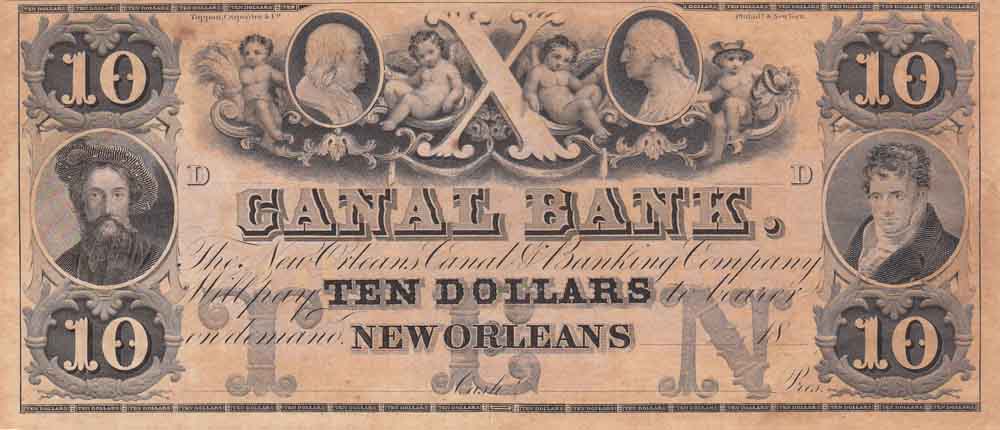 For uniformity I used the same small input box in the scanner software on each item I intended to compare. This first figure shows the unaltered original scans for the five vignettes I intend to compare, all against a blue field. Although the scan on the left appears to be wider than the others, this is merely an optical effect. As each scan was added to the composite I positioned one atop another for comparison, and observed that without alteration the scans are all the same size. 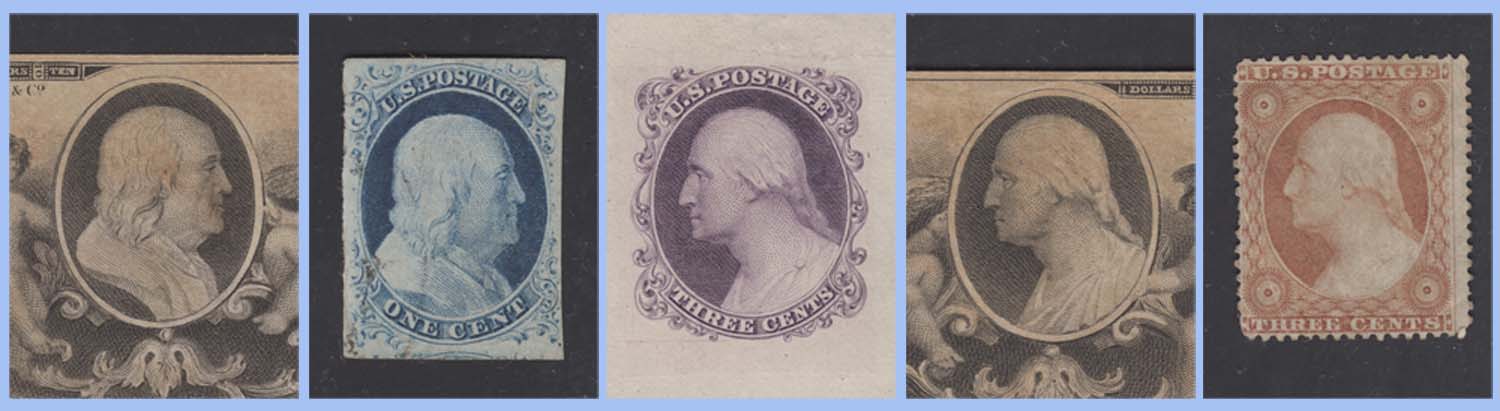 For each scan I then cropped the image to the tangents around the vignette frame. This gave the basis for comparing the actual vignette engravings, and for these comparisons no alteration of the images was allowed going into the composites. The composites of pairs of designs thus preserve the size relation between the two, based on the same original scale. In the first example, the Franklin image from the bank note is compared with a final stamp (I do not own a proof of this). It is clear that when viewed in scale the bank note vignette has been cropped for the stamp, but that the lines of engraving otherwise correspond in the main. The background shading on the stamp appears heavier than that on the bank note, but the horizontal wavy lines are still present with fewer vertical elements. Such details sometimes get murky in the final print of a stamp, as compared to a die or plate proof, so I am not entirely sure what that feature should look like in a clean reproduction. Nonetheless, the close correspondence of the lines of engraving suggest that the stamp die was derived from the bank note die. 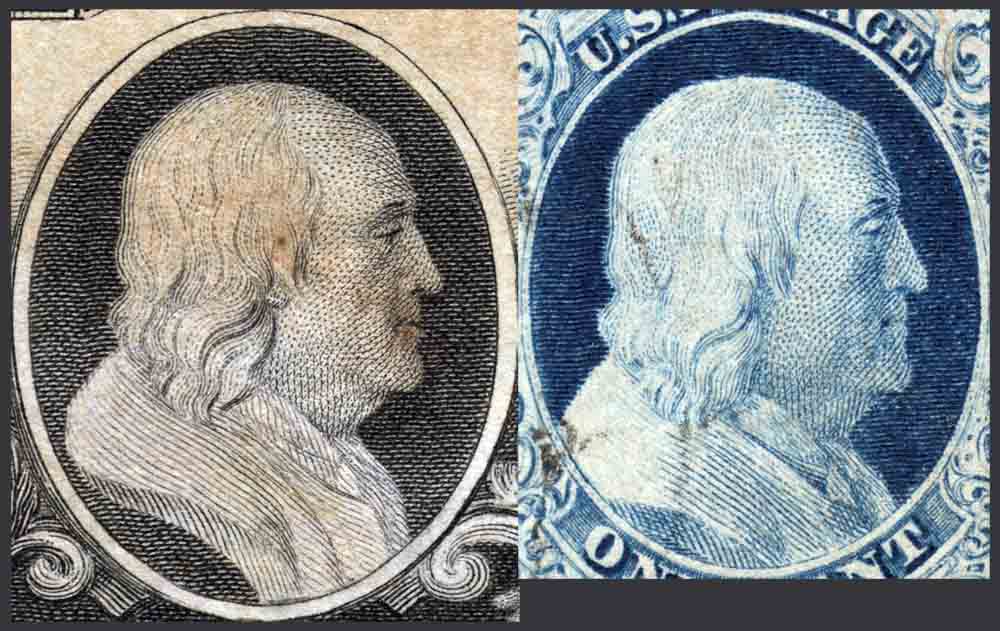 Why do I not think it went the other way? The Blanchard article in the EPJ illustrates a bank note with the Washington/Franklin pair on a note from the Piscataqua Exchange bank which bears the hand-stamped note (as did all examples known to Blanchard), "Printed previous to 1850." Assuming the authenticity of this claim, this note claims that the bank note vignettes were crafted first. While this is not incontestable evidence, a better interpretation of the meaning of such a notation is yet to be given. Next I present the Washington vignettes from the bank note, on left, and what I am calling the "Casilear three cent essay." The two are in scale with respect to one another, but the image limits here required me to reduce the composite slightly. 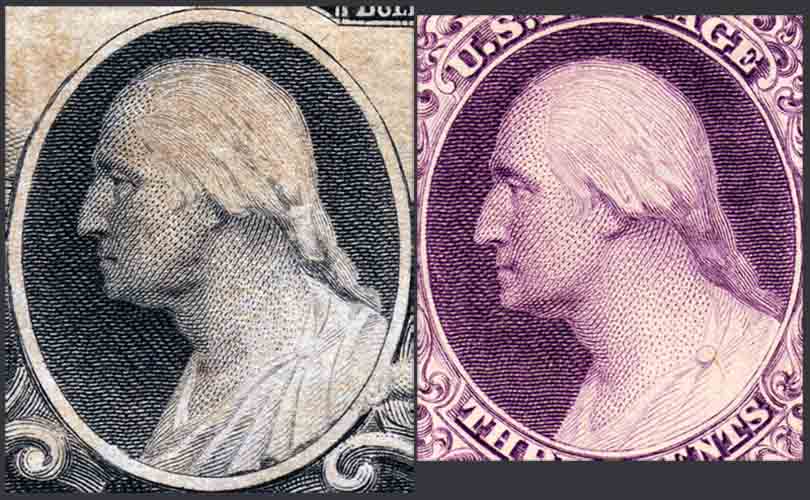 Here again it is obvious that the bank note image has been cropped and touched up in places like the nose, the strengthening of the toga button, and the softening of the shadow below the eye. But otherwise the engraving lines correspond. In this case the background shading lines more closely correspond than we saw with the Franklin vignettes. The stamp essay vignette appears to me to have been directly derived from the bank note vignette. For the next image pair I compare the Casilear vignette with one from the issued stamp. I apologize that I cannot use a nice clear proof image for the stamp, but an unused stamp is the best I can muster for an original scan (and not even a fresh one at that). 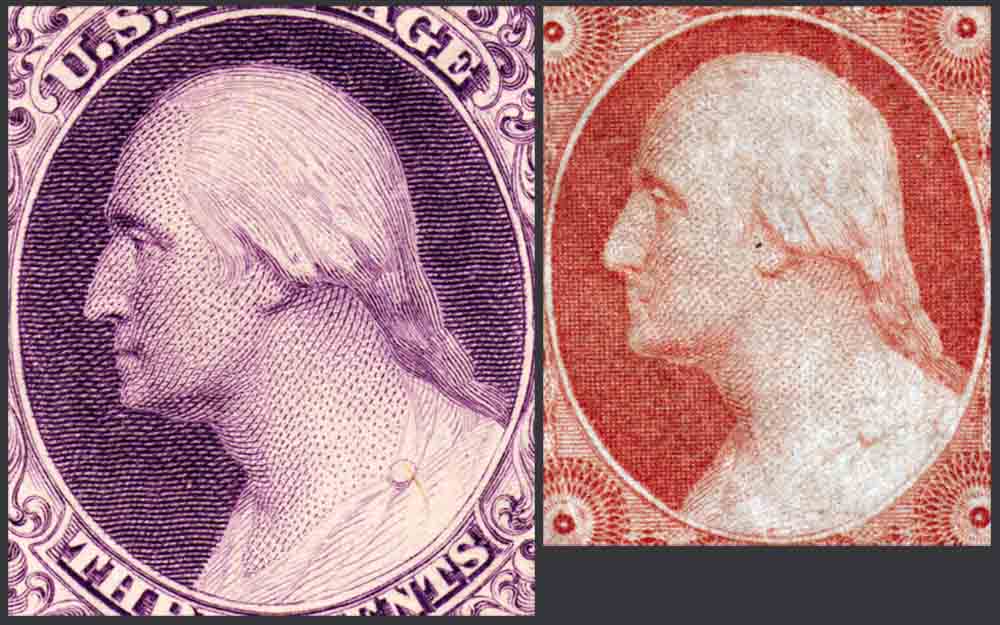 The size reduction is obvious in the direct scalar comparison, but things get more interesting when we bring these two vignettes into size conformity (in a way that Blanchard could not have done). As before I had to reduce the size of the composite because of the website size limit, but for the actual comparison the resizing of the stamp image was accomplished by placing its image over that of the essay, and stretching it until all sides matched. This, of course, broke scale for the stamp, but shows what the deisgn would have looked like if it had not been reduced. The essay vignette was not altered. 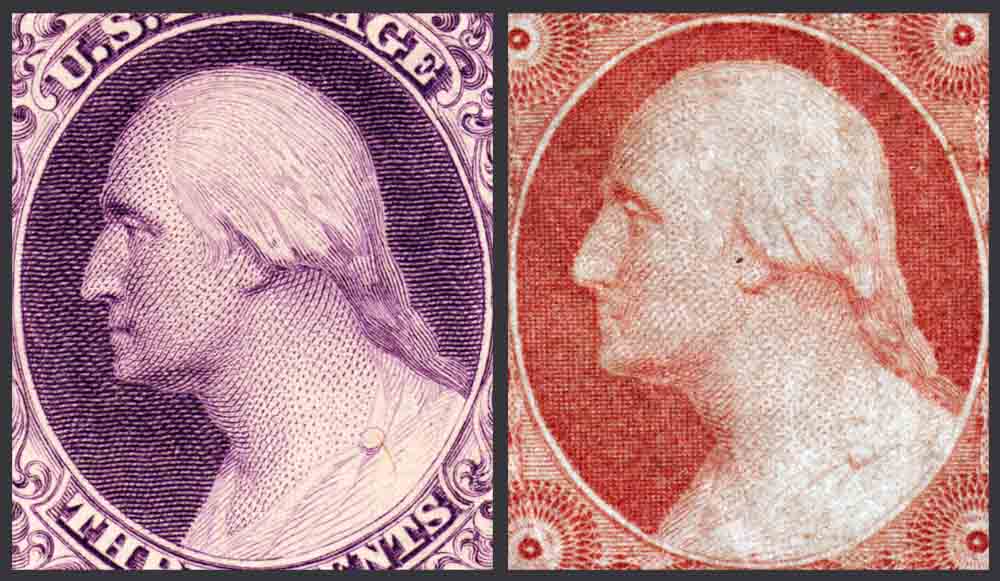 The degraded image of the stamp does not preserve detail as well as the trial color proof above, but the most prominent engraving lines appear where we would expect to find them based on their location in the Casilear vignette. I believe that if it showed its lines as clearly as the trial color does, we would find the same correspondence we saw before. When I attempted to create a composite of the stamp vignette adjusted to the size of the bank note vignette, I could not get it to resize without distortion. This suggests to me that the Casilear vignette was a necessary intermediate stage in the reduction of the Washington vignette from its earliest form on the bank note to what we see on the stamp. A curious feature of this progression is the relative prominence of an earlobe. The bank note original shows an earlobe that is entirely connected to the cheek. The Casilear version shows a bit of rounding, and the stamp (TC proof and issued stamp) shows a decided rounding to a lobe that protrudes below the point of connection to the cheek. We are fortunate to have better tools for making these kinds of comparisons at our disposal. We are permitted to see and show these patterns with a clarity that men like Blanchard and Brazer could only dream about. [Which reminds me, could you give us a better reproduction of Casilear's signature? I do not have an example, and would like to have one that is uniformly clear, without fuzziness.] |
|
Send note to Staff
|
|
|
Valued Member
42 Posts |
|
|
Great post, Essayk. To start with this post, let me give you and the forum a better Casilear signature, as requested. This is about as good as I can do with a tripod, digital camera, and enhancing/cropping tools. 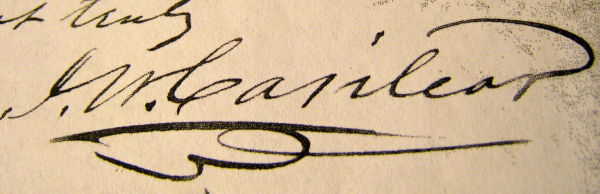 Now, to respond to your thoughts on the Blanchard post. Going back to the very beginning of this thread, I see where you talk about the bank note dies of Franklin/Washington going back as far as 1845, without providing any sourcing for this assertion. Blanchard, in his EPJ write-up, doesn't provide any definitive evidence either. To be fair, let me add his entire response on this on page 8 of his discussion of 'Bank Note Dies Used for Stamps': There is illustrated here another note containing these two portraits unsigned and undated with the imprint of Toppan, Carpenter & Co. It is a $10 note of the Piscataqua Exchange Bank of Portsmouth, New Hampshire. On most of the specimens of this relatively scarce note that we have seen, and on this one, there is overprinted or stamped the words "Printed previous to 1850". Of the history of this impression we know nothing, but if the statement made is true it would indicate that the dies existed before the stamps and could have served, therefore, as models. This bit of evidence is presented for what it is worth since we have not seen any of the Georgetown notes with dates as early as 1851 Taken on its face, there is nothing offered by Blanchard to prove that the bank note die existed before the stamp die. As with the Morris attribution, I want, and expect, more corroboration to be scholarly in pursuing this topic. So, I turned to outside experts to help me out. What is stated below may not be the final word on the subject, but it is enough to convert me to your earlier unsubstantiated assertion. Prior to presenting the experts information, and for those on this forum who may not follow the paper numismatic specialty, in the obsolete bank note field (i.e. paper money used by banks and other entities to conduct transactions during the period of our country's history when the federal government did not issue or back currency issued - roughly early 1780's to 1863- but no longer considered legal tender, hence 'obsolete', there are different types of notes that present themselves today to collectors of these. The main ones are issued, or used notes; remainder notes, which banks ordered and received, but never put into circulation; and proof notes, which were high quality engraving firm presentations on special paper to potential bank clients, to help them decide on purchase. The Piscataqua remainder bank note Blanchard refers to had an additional wrinkle, an overprint, or stamp. When the federal government decided to go into the bank note issuing business during the Civil War, they needed to get the state bank and other notes out of circulation, so they imposed a 10% tax on same under the National Banking Act of February, 1863, and this had the effect of getting thousands of issuing state banks and other issuing entities to redeem these and convert their issues to national bank notes. This history is not the same for the bank notes of the Confederate states and other private entities there, which continued to issue their own notes up to the time the Civil War ended. As one would expect, with thousands of issuing entities operating in an environment where communications between them and for the public generally, were very rudimentary, counterfeiting operators sprung up like weeds, so that today we see a good percentage of available issued and unissued bank notes that are fakes. Sorting all this out today is a real task for the serious bank note collector and researcher. With this extensive, but I feel necessary, background, I return to the Piscatagua Exchange Bank of New Hampshire, which today only has unissued, or remainder notes available to bank note collectors, the bank having successfully redeemed all (or nearly all) their outstanding issued notes during the 1860's. Even though it is known that the bank commenced operations in 1845, the lack of any issued bank notes made it difficult to determine when this bank commenced bank note issuing operations. However, the written history uncovered on this bank definitively establishes that it commenced operations on June 14, 1845, and issued their first currency on June 23, 1845, indicating that it had been ordered long before that time. The overprint "Printed previous to 1850" was added by a successor bank much later as part of the written bank history. Since these issued notes were not changed prior to the issue of the 1851 series stamps (as determined by the bible for obsolete bank note collectors, James Haxby's United States Obsolete Bank Notes, 1782-1866 ), we can confidently state that the $10 Piscataqua note with the Franklin/Washington engravings existed in circulation prior to 1851, even though we have no evidence of same today due to the redemption of these notes by the bank. This unpublished bank history is courtesy of Dave Bowers and Dave Sundland of the New Hampshire Currency Project. Since we also know, from Foster Wild Rice's Antecedents of the American Bank Note Company of 1858 as reprinted in the Essay-Proof Journal, Whole No's 71, 72, of Volume 18, 1961 that Toppan, Carpenter & Co. came into existence in 1844, we are fairly confident that no other state bank of that era had any issued or unissued notes with the two engravings of Franklin/Washington prior to those of the Piscataqua Exchange Bank. We still do not know who engraved these bank note used profile busts, or when, and that remains an issue to discuss. Also worth mentioning is the fact that the bank note engravings of the Franklin/Washington profile busts may themselves have been subject to some reworking/touch up over time, as they were used on obsolete currency by at least four state banks (issued and unissued) over a fairly long period, over 10 years. While I am on this issue of bank notes, I should disclose that, as yet, I can't be sure that Cyrus Durand was working for TCC during the period of the 1851 stamp series, and my earlier assertion is just that for now (i.e. without definitive proof or compelling evidence). However, the historical record indicates that his chief competitor in the geometric lathe machinery invention and operation business, Asa Spencer, died in 1847, so there is doubt as to who else could have done the lathe work for the 3c Washington as expertly as Durand. Getting back to Essayk's carefully revised and illustrated explanation of the successive engravings, I take note of his remarks about the correspondence of engraving lines between the bank note engravings, the intermediate Casilear attributed die essay, and the final 3c Washington 1851 issued stamp as well as the Franklin bank note engraving and issued Franklin 1851 stamp engraving. Maybe I am just dreaming here, but does not such correspondence suggest that it might have been Casilear himself who either designed and/or engraved the original bank notes? We know that he was made a partner at TC & Co. not only because of his talents and reputation, but because of his long association with the other TC partners. I can establish a relationship with Charles Toppan going back to 1832. It is very difficult to prove this, however, because Casilear didn't sign more than a few of his engraving vignettes. On stylist grounds though, it seems to be within the realm of possibility, if Essayk's careful work on this is given weight. Casilear certainly had the "chops" to do this kind of vignette engraving, and can provide information on this, if necessary. I really wish others on this forum could offer some views. Particularly, I mentioned in my last post an article in the American Philatelist discussing attribution of the 1857 stamp reengravings to Pease and Henry Earle. Can no one access this and present what was said? |
|
Send note to Staff
|
|
|
Pillar Of The Community
United States
2555 Posts |
|
|
Sojourner, I can likely provide a copy of the AP article but it is not on the page or in the volume you claim. Check your references.
Essayk, Thanks for the clarification. I would go as far as saying that all three vignettes that you have posted, which includes the one on the banknote, are all remarkably similar with only minor differences. I agree that it would probably be impossible to accomplish such a feat freehanded. I think you have a good theory in need of some proof. |
|
Send note to Staff
|
|
|
Valued Member
United States
101 Posts |
|
|
Regarding the comparison of the two Franklin images posted 9-4-13 at 5:09 PM...
It looks fairly obvious that the second image was copied from the first, if examined from an artistic point of view.
The modeler looked a the first image and asked himself "How can I copy this but still improve it?"
The first image needed more modeling of light and shadow.
Objects done in a light color and with more contrast appear to be nearer than darker objects. So highlights were added to the nearest hair features, bringing it forward thus creating more depth. This is also much more apparent where the clothing is modeled - the nearest part, the shoulder, is lightened and the source of light is much more defined, coming from the upper left so the clothing is lighter on the left and more shaded on the right.
This is done in a subtle manner throughout the whole image, so that the final result is not as "flat" as the original. These are artistic changes that would have been done intentionally, by critically examining the first image. |
|
Send note to Staff
|
|
|
Pillar Of The Community
United States
1946 Posts |
|
|
Let me commend you for a truly outstanding post, Sojourner. I have been getting a first class education from this thread, but that post wins the day for me. I am particularly pleased to learn of the distinctions in the classes of notes as obsolete versus remaindered, etc. I also want to thank you for posting the improved version of the Casilear signature. Given your syngraphic interest you might consider investing in a scanner. I use a Canon Canoscan LIDE210 unit that is just a scanner (not a combo job) that I got for about $100 new at an Office Depot (I think). It does everything I need for stamps and coins and I enthusiastically recommend it. You have seen some of what it can do when teamed up with Photoshop CS5. I really enjoyed reading about the Piscataqua note, since I had no clue about why that overprint was deemed necessary. The other info on the bank does I think help build the case for pre-1850 origin. On the matter of which came first the note vignettes or the stamp vignettes, there is a circumstantial point that I had intended to mention last time, but decided not to. This has to do with the fact that the size disparity in the bn vigs and those on the 1c stamp and 3c essay is a move from larger to smaller if we assume the priority of the bank note vignettes, but from smaller to larger if we assume the priority of the stamp vignettes. That seems like an uphill battle to me to argue the succession in that way. But all of that may be moot now in view of my latest piece of news, about which I am rather excited. Based on the note classification information you gave in your post, and knowing what we needed here, I went ahead and purchased the item pictured below which I am sure will help us nail this down with less guesswork. The scan is not mine, for I do not yet have it in hand, but when it arrives I will post some details. 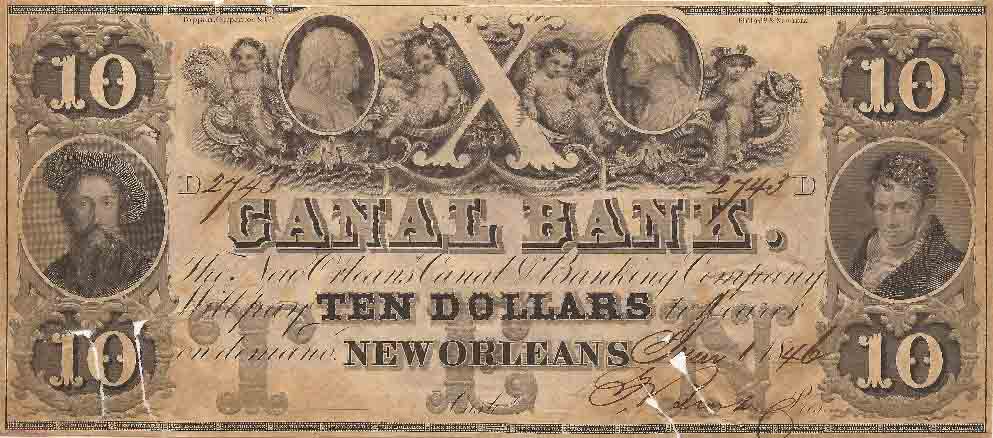 I have two examples of this note as a remaindered note, but this is the first I have that is an issued note, dated and "cancelled" with the cuts. I don't know how clearly the date shows, but it is June 1, 1846. For purposes of this discussion, I consider this a sort of smoking gun. Now in addition to the reconstructed data from the Piscataqua note, we have a dated corroborating note from the Canal Bank in New Orleans. Provided the usage can be verified. Here is where you can help me again. What is the most appropriate authenticating authority to whom I should send this? David Bowers at Bowers and Ruddy Galleries? I am out to sea on all of that. You are quite right that we still cannot be sure about the engraver for either of these vignettes. Before we got into this I had surmised that Charles Toppan himself may have done them when TCCo started up, but have since learned from Brazer, and you, that Toppan was mainly a letter engraver. Casilear is an alternative option, of course, but his work was primarily as designer, or modeler, and I cannot state definitively that he did portrait vignettes. Then again, his association with the company address is known at least by 1848, as I reported earlier. Now you say that he can be associated with Charles Toppan all the way back to 1832? Hmmm. He was born in 1811, and at age 15 was apprenticed to Peter Maverick. When Maverick died, Casilear continued to study under Asher B. Durand. In 1832 he would have been 22 years old, but it is not until 1848 that his association with TCCo can be documented, and that only by association of the address. Can you fill in the blanks? Brazer identified Casilear as a picture engraver, not specifically for portraits. Pease, on the other hand, who was in Philadelhia from 1835, is identified as a portrait and picture engraver. Who else do we have at TCCo for portraits, back about 1844 or 45? I think we can rule out Cyrus Durand as an employee of TCCCo, since he was in a partnership with George Baldwin from 1849-50, and a member of the firm Danforth, Wright, and Co from 1851-58, where he succeeded Asa Spencer as the lathe engraver for that company. If he had anything to do with the creation of the three cent of 1851, it would have been as a competitor for the contract. We still have some homework to do on the personnel at TCCCo, and I am going to try to find the text of the broadsheet announcing the incorporation of TCCCo to see what names it gives for the principal positions. Let's stay with this. |
|
Send note to Staff
|
|
|
Pillar Of The Community
United States
1946 Posts |
|
|
Duncan,
Thank you for your comments. I think they offer yet another reason to consider the stamp vignette as derivative from the bank note. Permit me a further probe on this. Do you think that these kinds of changes could have been made directly on a new laydown die made from a light impression from an altered transfer roll taken from the die of the earlier engraving? Hmmm. Let me clarify that:
The stages in die duplication/replication/design alteration are as follows: a relief is taken from the original die on a new unhardened transfer role, and modified by the removal or trimming of design elements no longer wanted. The roll is case hardened and used to impress an unhardened die block, at whatever depth desired, to form the laydown for a new die. A light transfer to the new die would impress the design in a way that would allow selective replication of the original lines, or not, as the re-engraver might choose, perhaps even alternating the use of burin and burnisher.
Do you think that an approach something like this might have been used to create the portrait vignette on the stamp die? Is there a way to establish that one way or the other? |
|
Send note to Staff
|
| Edited by essayk - 09/05/2013 4:47 pm |
|
|
Valued Member
42 Posts |
|
|
Just a quick reply to some of the items posted. Football season starts tonight!
First, Essayk, thanks for your kind words.
Second, I hate to bust your balloon, but the note you purchased is a remainder. Two things make it so: No cashier's signature on the bottom left; second, those white slashes at lower left and right are "cut cancels" indicating that the bank no longer was going to put them into the public's hand. The filled in information you see by the bank president was common back then. Think of the hundreds, even thousands of notes that had to be hand signed. What a lot of bank president's did was come in on a certain day, and just sign, sign, sign, so that the notes would be ready for issue to the public after sign-off by the cashier.
If this note was sold to you as an issued example, demand your money back. The remainder Canal Bank notes are plentiful and cheap. Just because this note wasn't pristine didn't mean it was issued. You know the old saying about a book . . .
Third, Sinclair 2010, I thought I copied the Google page reference correctly, but if not, will go back and resend the referenced item. Maybe its 1995, not 1994.
Fourth, I can send some items attesting to both the tie between Casilear and Toppan in 1832 and an example of Casilear's portrait engraving skills. But that, any other Casilear ties to the engraving firms I decide to send will take a day or two to put together. To share all the ties between Casilear and the engraving firms is well beyond the scope of this inquiry, and would take a long time to put together. I have trouble keeping it all together and reasonably organized, because there are so many cross-overs to the fine art side of his career and the individuals he knew and worked with there.
You are right, Essayk, I need to get a scanner. Just hate to give up my old reliable, but very antiquated printer. |
|
Send note to Staff
|
|
|
Pillar Of The Community
United States
1946 Posts |
|
|
Re. the non-issued signed remainder.
I am not as concerned about the status of issued versus non-issued as you would be, since my interests in this lie elsewhere. If as you say it was common for the Bank President to come in on a day and sign a herd of notes, wouldn't the date on the note still reference when the note was present and duly signed by him? Even if it was never issued, a properly signed note still gives documentary attestation to the existence of these vignettes prior to 1850. Or am I missing something? All that matters to me is that this note gives us a terminus ante quem for the vignettes at June 1, 1846.
If there is a question regarding the authenticity of the signature, then you understand why I asked about having it authenticated. Even if it is a signed remainder, I would still like to hear a recommendation on that, if that is okay.
As for the American Philatelist page reference. perhaps you could give us the url for where you found it. I am still looking for the correct issue too.
Casilear's skills as a portrait engraver for bank note work are not at question. What is at question is whether or not we can verify that he did these particular portraits. The data that connect him to Toppan in 1832 might be useful, and it would be good to have whatever those facts might be, if you care to share them.
I understand about the printer. I still have an old Epson dot matrix printer that did yeoman service for me in the 80s and still works. I would never get rid of it, and have kept a system that will drive it. But who says you have to send images to your printer from the scanner. Electronic images are what you need for the net, whether you ever print them or not. The scanner need not be a "threat" to the printer. And if you ever do need to print from a scanned image, supplement the printer with a cheapie that will support the scan. It sure beats doing without. My 2c on that.
Back to you.
|
|
Send note to Staff
|
|
|
Pillar Of The Community
United States
1946 Posts |
|
|
@sinclair2010
Thank you for the affirmation, Winston. We'll keep chipping away at this thing until it gives up its secrets or we hit bedrock. Who knows how long that will take, but the more hands the better. So if anything occurs to anyone along all these lines, this is the place to let it loose. Thanks again for giving it even this much attention. |
|
Send note to Staff
|
|
|
Valued Member
42 Posts |
|
|
Ok, back to the task at hand. Hopefully, I have been able to cut and paste the webpage taken from Google that talks about the 1857 "reengraving" with Pease and Henry Earle doing the work. The reference in Google is exactly the one I cited in an earlier post, no errors in typing. There is a mention of the "American Philatelic Association" in addition to the other data, and this appears to be an organization that had that name a long time ago. Also, the snippet of information that I saw on line appears to use a script that you might see in an older publication than 1994. Above the snippet is some reference to "denominations". Hopefully, this all comes out in the paste. Not sure what else I can do at this point. Google won't let me upload the page directly on the forum, or at least, I haven't figured out how to do it. http://books.google.com/books?id=PL...=0CC8Q6AEwAAEssayk, sorry I was so short with the post yesterday. I know what you were saying, and agree that this written information on the issue is indicative of a pre-1851 standing, but I was a little fatigued from the earlier postings and wanted to do something else for awhile. I should not post when I am tired. There are two online services that get the majority of bank note collectors business for grading their issues, but you have to be a member of each, and then pay according to the type of membership you have (if at all). They are grading services, primarily, to advise on the quality of the note viz. others of the same type. If you want authentication, that is extra, if the service if offered. Frankly, I think you should not need to do this, as the Canal Bank was said to have this $10 bank note prior to 1850, according to Haxby, even in in issued form, I believe (need to confirm), but have never seen one, only remainders, which are very common. Let me do a little more online checking and I may be able to assure you that what you have is completely authentic and avoid expensive alternatives. For your information, the two grading services are: www.pcgscurrency.com www.pmgnotes. com BTW, I did find a fifth state bank that also has the two profile Franklin/Washington engravings on it, that Blanchard apparently was unaware of. However, I believe its notes are all post the 1851 stamp series. Need to confirm this as well with Haxby. That's all for now. On the Casilear relationships to engraving firms, will put together a separate post, as it is a bit convoluted and requires some effort to present, but quite interesting, in my opinion. |
|
Send note to Staff
|
|
|
Pillar Of The Community
United States
1946 Posts |
|
|
AP Article. Thanks for the link. I was able to find the article in question, but not quite where the link referenced it. Here is a proper biblio reference for it: Calvet Hahn. "Stampless Provisionals Bracket Civil War." American Philatelist 108 (1994, 6) 514-517. Whole number 1121.
The late Calvet Hahn was a stalwart of the Collectors Club of New York and a noted philatelic author of long standing. I knew him personally, and he could be a stinker at times, but he generally knew his stuff and was careful in his research. He possessed a significant philatelic library, and most researchers do. His references to TCCo in this article touched on the bidding for the contract of 1861, for which they had submitted essays of their earlier designs altered by the addition of numerals of value. The word he uses for the nature of their effort is "perfunctory." (That is a better term than the one I use, which is "lame.") However, he does not discuss those designs and merely reports the names of the engravers, presumably on the Morris tradition. He gives no citations for his information, probably because it does not deviate from the usual scholarly tradition. Unfortunately, the Hahn article will not take us anyplace we have not already been.
Well that's not entirely true. One new thing I picked up from his article was the point that Joseph R. Carpenter was the son of Samuel H Carpenter the TCCo accountant. I had not known that relationship, but it answers a lot of questions for me. However, Hahn states that SHC had stayed with the old firm at the startup of the ABNCo, when it is reported elsewhere on better authority (Brazer, 1938) that he left with Toppan when the latter was elected president of the new company in 1858.
Regarding a fifth bank. Okay, from Blanchard we get Georgetown-$10, Canal Bank-$10, Piscataqua-$10 and Wabash River-$10. Of the canal Bank notes Blanchard says, "only undated remainders seen." Had you seen a dated remainder prior to the one I showed you? I get the impression that you don't consider it very important or useful for our inquiry.
What is the fifth bank? City Bank of New Haven, CT?
Thank you for the info and thoughts on authentication.
|
|
Send note to Staff
|
| Edited by essayk - 09/06/2013 4:17 pm |
|
|
Pillar Of The Community
United States
1946 Posts |
|
|
I almost forgot the most obvious indicator of age pre- or post-1851: the form of the company imprint. Do you know when they started to add Casilear's name to the imprint? Presumably not long after he started. So notes with the Toppan, Carpenter and Company imprint are presumably pre-1851 by default. Or did they tend not to update the imprints on their notes? |
|
Send note to Staff
|
|
|
Replies: 91 / Views: 23,235 |
|
|
To participate in the forum you must log in or register. | |
 Help With A 1 Cent Franklin From The Philippines Show Your US 1851-57 Imperforate Stamps Stamps On Stamps Optical Instruments: Microscopes, Binoculars, Sextans, Theodolits, Hand Scopes Cover Calendar For Month And Day -Pics Pushing 330,000 All Different Worldwide Stamps In One Collection . Postmarks.day By Day Experimenting With A Phone As Attached Scanner Turn On The Light! Candles, Lamps, Torches, Candelights, Bedside Lamps. Fan, Éventail, Abanico, Fächer, Leque Linn's To Return To Printed Issues Minkus Supreme Global Albums (The Big Red Thread) Soviet Union Stamp Engravers Czech Stamp Engravers Collecting By Engraver 1851-57 12c Washington Canada 742 Color Shift Error? Stamps Made Of Cloth, Polymer, Metal, Wood Etc Art & Paintings On Stamps Need Help With Swedish Stamp And Postmark Living Persons Portrayed On Stamps If You Have A Design You Like, Might As Well Stick With It! Newfoundland 82 Imperf Cover Please Identify - USSR Stamps US Half Cent Postage Dues On Cover Help With A 1 Cent Franklin From The Philippines Show Your US 1851-57 Imperforate Stamps Stamps On Stamps Optical Instruments: Microscopes, Binoculars, Sextans, Theodolits, Hand Scopes Cover Calendar For Month And Day -Pics Pushing 330,000 All Different Worldwide Stamps In One Collection . Postmarks.day By Day Experimenting With A Phone As Attached Scanner Turn On The Light! Candles, Lamps, Torches, Candelights, Bedside Lamps. Fan, Éventail, Abanico, Fächer, Leque Linn's To Return To Printed Issues Minkus Supreme Global Albums (The Big Red Thread) Soviet Union Stamp Engravers Czech Stamp Engravers Collecting By Engraver 1851-57 12c Washington Canada 742 Color Shift Error? Stamps Made Of Cloth, Polymer, Metal, Wood Etc Art & Paintings On Stamps Need Help With Swedish Stamp And Postmark Living Persons Portrayed On Stamps If You Have A Design You Like, Might As Well Stick With It! Newfoundland 82 Imperf Cover Please Identify - USSR Stamps US Half Cent Postage Dues On Cover
Disclaimer: While a tremendous amount of effort goes into ensuring the accuracy of the information contained in this site, Stamp Community assumes no liability for errors. Copyright 2005 - 2026 Stamp Community Family - All rights reserved worldwide. Use of any images or content on this website without prior written permission of Stamp Community or the original lender is strictly prohibited.
Privacy Policy / Terms of Use Advertise Here |
| Stamp Community Forum |
© 2007 - 2026 Stamp Community Forums |
| It took 0.43 seconds to lick this stamp. |
 |
|



 Posted 09/02/2013 10:25 pm


