|
This page may contain links that result in small commissions to keep this free site up and running.

Welcome Guest! Registering and/or logging in will remove the anchor (bottom) ads. It's Free!
To participate in the forum you must log in or register.
| Author |
 Replies: 91 / Views: 23,238 Replies: 91 / Views: 23,238 |
|
|
|
Valued Member
42 Posts |
|
|
Here are two images of the $10 note, one from the Canal Bank, the other from the Piscataqua Exchange Bank. The first shows the same handwriting characteristics as the note you showed before, Essayk. Even the date is the same. In fact, after examining several of these like notes, it is clear that all of them were signed the same date, June 1, 1846. Therefore, it seems likely that these are genuine cut cancelled, but unissued notes, since no descriptions of them indicate any counterfeiting or alteration. I checked Haxby, and the evidence presented is that there are no issued notes of this particular $10 note, only cancelled unissued, and uncancelled unissued.
Image of 1846 $10 Canal Bank, New Orleans, LA, Crisp Uncirculated. Two ... | Lot #22283 | Heritage A
This image of the Piscataqua bank is a good one, because of the freshness of the note, and because it is one that doesn't carry the overprint "Printed previous to 1850". The description indicates it was printed before the time of the overprinted notes, but how that is established is unclear. Nonetheless, the quality of the note makes it a good candidate to study the Franklin/Washington bust vignettes, since we are pretty certain the bank received the note before 1851.
Image of Portsmouth, NH- Piscataqua Exchange Bank $10 G10. This piece is | Lot #12818 | Heritage Auc
The other note I found with the two engravings, the Lafayette Bank of Cincinnati, Ohio, was never ordered by that bank and thus is only available as a proof, dated from the 1850's, thus later than the 1851 series stamps.
I hope the images will show up as I copied and pasted them. |
Send note to Staff 
|
|
|
Valued Member
42 Posts |
|
|
Images won't load because they are not the right type of file.
I suggest anyone interested go to Ha.com website, sign up for a free membership, then go to the currency history section, select the Obsolete sub-section, type in the respective notes one at a time at the top, and view them on the site. This website is very good for seeing the types of notes and values achieved at auction on Heritage. The images can be blown up to show great detail. Perhaps someone can figure out how to upload them to this site. |
|
Send note to Staff
|
|
|
Valued Member
42 Posts |
|
|
To answer the question about when the Toppan firm started adding "Casilear" to the nameplate on bank note engravings, I don't know. But, since the announcement of his joining as partner was made January 1, 1850, it is possible it appeared on bank notes before the 1851 series stamps, which I understand were issued July 1, 1851. |
|
Send note to Staff
|
|
|
Pillar Of The Community
United States
1946 Posts |
|
|
Here are the images you were after. Quote:
Image of 1846 $10 Canal Bank, New Orleans, LA, Crisp Uncirculated. Two ... | Lot #22283 | Heritage A 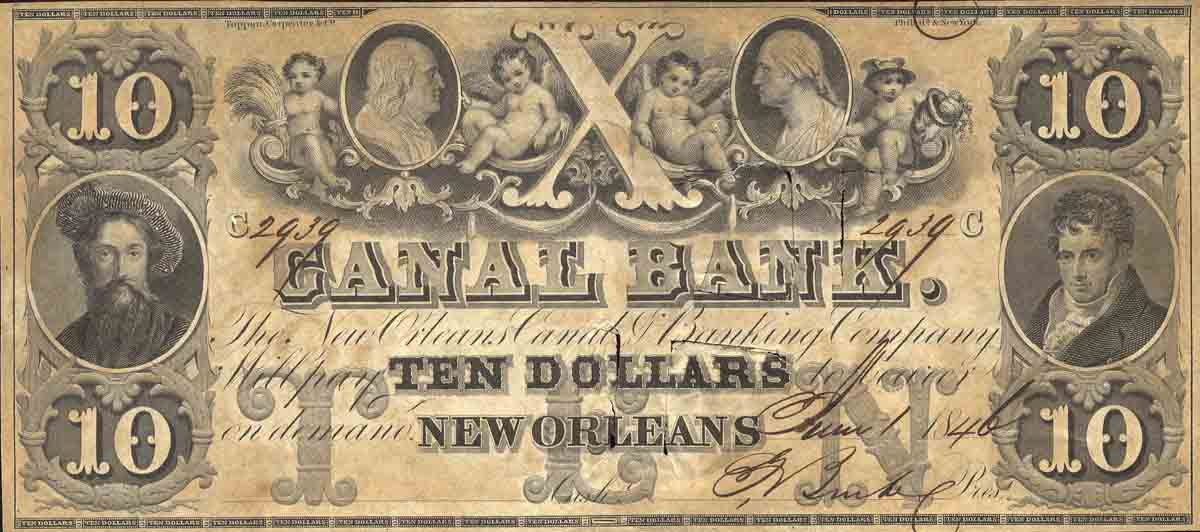 Quote:
Image of Portsmouth, NH- Piscataqua Exchange Bank $10 G10. This piece is | Lot #12818 | Heritage Auc 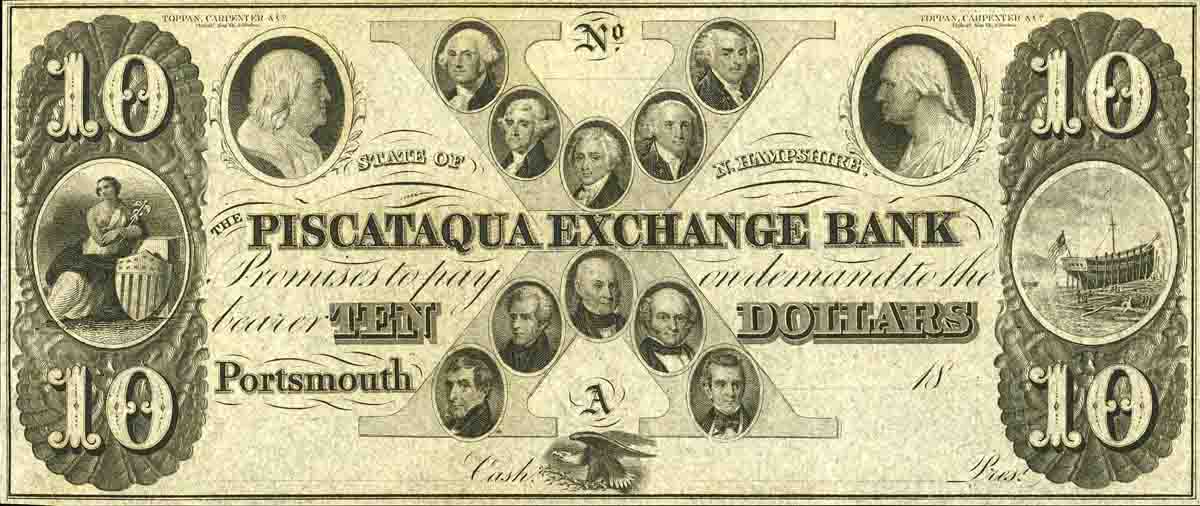 Here is an image from the Heritage site I found interesting for this study. The entire sheet of notes is signed and dated, but what caught my attention is that they all bear the same number but differ according to the position on the plate as A-B-C-D 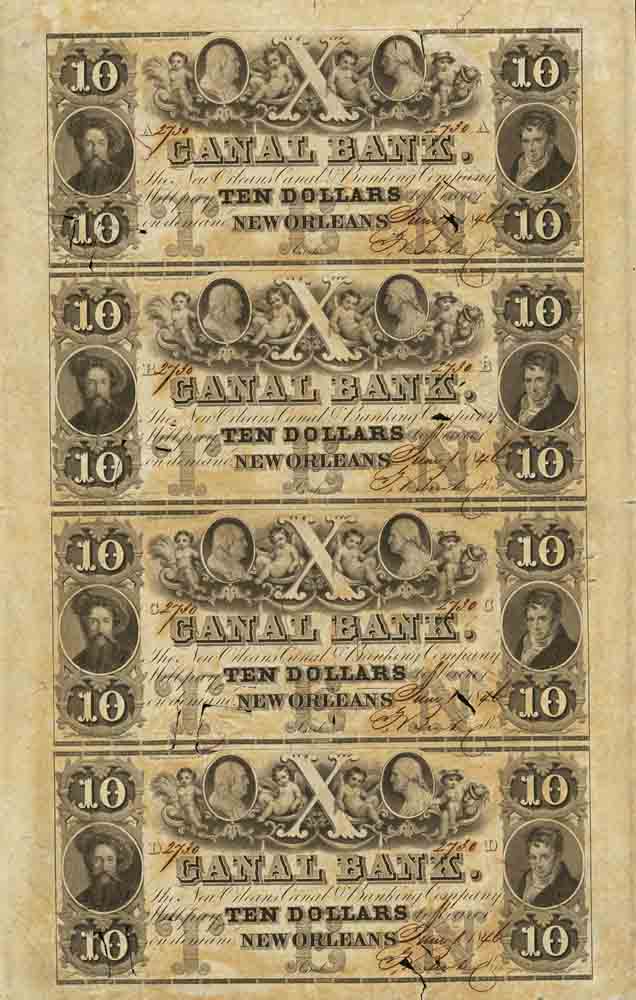 And with this image you may add a sixth bank to the list of those using this vignette pair. In this case the note must be very late in the 1850's since it bears the ABNCo script monogram as well as a Toppan, Carpenter & Company inscription. 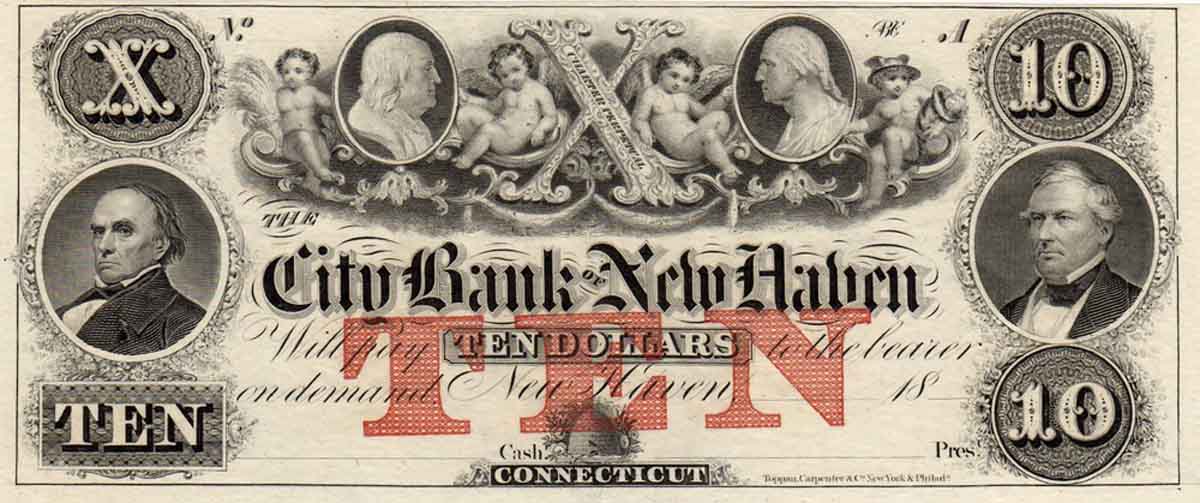 I think with these we have enough syngraphic evidence for this topic. Now we might return to the details of who worked for whom. Thanks for the note on the Casilear inscription. It was a shot in the dark, but I tend to agree that the omission of his name on a TCCo bank note inscription would also date the note design to some time prior to the stamps. I think that horse is now dead. |
|
Send note to Staff
|
| Edited by essayk - 09/06/2013 9:24 pm |
|
|
Valued Member
42 Posts |
|
|
Essayk,
Good images, thanks. May I ask what you did to get them uploaded from Heritage? I seem to be all thumbs when it comes to this transfer business.
I am pursuing some leads of people in the obsolete bank note business who may be able to help with the engravings authorship. I don't know them, but have been referred by some well connected people, so hopefully, something may turn up. No guarantees, though.
Will try to post on the Casilear-engraving firm relationships tomorrow. |
|
Send note to Staff
|
|
|
Pillar Of The Community
United States
1946 Posts |
|
|
These instructions presume a Windows system. The principles are the same for a Mac, but the software probably works differently.
1. go to the lot you want to view at Heritage.
2. select the option to view larger image.
3. on the page that pops up select "Large"
3b or if you prefer, "medium"
4. when the image comes up humungous in a new window,
4b or when the default image is replaced by a larger one
RIGHT click it (ignoring the cursor "hand" that you use to scroll it)
5. from the pop up menu you get, select "Save picture as"
6. A screen will pop up that lets you save the file wherever you wish, and it will have the default name lf.jpg, which you may rename on the spot.
7. The large and medium images default to 300dpi, so the saved file will be much too large to upload to the forum server. But starting with a larger image gives you room to move and keep a sharp pic.
I take it into Photoshop and resize it according to the primary speck required, i.e. that the file size may not exceed 100K. Reset the res to 72 dpi, which is the default screen res for most monitors. This gives you room for more real estate. I tend to set the longest dimension to 1000 pixels, but to each his own. When you save the resized image, change its name so you can go back if you need to. If the final image is less than 100K, you are good to go for upload.
Steps 4 and above can be used for any jpg you find online anywhere. it also works for other raster format images, but not for flash images. I never tried it for vector files. Anyway, that's it. |
|
Send note to Staff
|
|
|
Valued Member
42 Posts |
|
|
The material presented below is copyrighted by the author, aka Sojourner, not to be transferred to or be made available on any other website, or downloaded or otherwise saved. Material is in preliminary draft form and is subject to revision. Any opinions are those of the author. References for specific items can be provided as necessary. Comments are welcome. Relationship of John William Casilear to Bank Note Engraving Firms, 1832-1850 Part One: Charles Toppan & Co. When John William Casilear was made a partner at the Philadelphia engraving firm of Toppan, Carpenter & Co. on January 1st, 1850, a beautifully engraved letter was sent out to the firm's bank note clients and other interested parties. This letter, a unique, surviving example found in the American Bank Note Company archives, was auctioned by H.R. Harmer in October, 2007 (Sale 2978: American Bank Note Company Archives, Part II, October 17-19, lot #1648). The sheet has the notation "Eng' by Charles Toppan" below the new firm name. The letter states the reasons for his ascendancy, among which are: "that as a designer of Vignettes for Bank Notes he is acknowledged to be superior to all others in this Country; and that his Engravings of Vignette Portraits, he is masterly and unsurpassed in character and beauty. These advantages, together with the many years experience in the business of all the members of our Firm. . .". The letter includes the engraved signatures of the five partners: Charles Toppan; Samuel H. Carpenter; John W. Casilear; Henry E. Saulnier; and William C. Smillie. No doubt, for publicity purposes, the letter has a touch of hyperbole; still, Casilear had established a stellar reputation for his engraving skills dating back to the late 1820's, when he was employed as an apprentice by Peter Maverick, and after that with Asher Brown Durand. The Durand connection to Casilear and to Charles Toppan provides the first documentary evidence of the connection between Casilear and Toppan. The latter, who had been engraving since 1814, had opened the Charles Toppan & Co. bank note engraving firm in Philadelphia, which operated in this form between 1831-1834. Skilled primarily in letter engraving, and desiring to increase his new firm's business, he wrote a letter to Asher Brown Durand May 1st, 1832 as "Dear Sir". He informed Durand about "several new banks in the city" as an opportunity for bank note engravers. "Could I enter the field with a few of your engravings. My chance of success would be much increased." He asked for 1-4 vignettes. Durand, who at this time was a partner in another New York engraving firm, Durand, Perkins & Co., was transitioning to a new career as a portrait, historical, and landscape painter, as "his interest in engraving had ceased", according to his son John, as noted in a biography of his father written after the latter's death. In 1832, however, he was considered perhaps the foremost artistic engraver in the country, having already won fame as the engraver of Trumbull's iconic painting, 'The Declaration of Independence', which can be seen even today on the back of the $2 federal bill (much more information on Durand and his engraving companies was presented by Julian Blanchard in the Essay-Proof Journal, Vol.7 and Vol.8). At this time, Casilear was working as an apprentice to Durand, having joined his shop after the death of his old boss Peter Maverick, in July, 1831. Durand, in his return letter of May 3rd, declined Toppan's solicitation, and the latter, undeterred, wrote back May 8th, asking Durand for a single vignette, and requesting that Durand "overcome the reluctance you feel to do anything in the bank note branch of the art". The next steps taken by Durand are hidden to history, but fortunately, the contemporary documentation available indicates that he did ask Casilear to work up something for Toppan. When the vaults of the American Bank Note Company were opened up in order to auction off the thousands of inventory items they had carefully maintained in their archives - including those of predecessor firms existing before the formation ABN in 1858, a compelling piece surfaced. In the H.R. Harmer auction of January 31-February 2, 2007, the following item, shown below, was presented in the catalogue on p. 470: 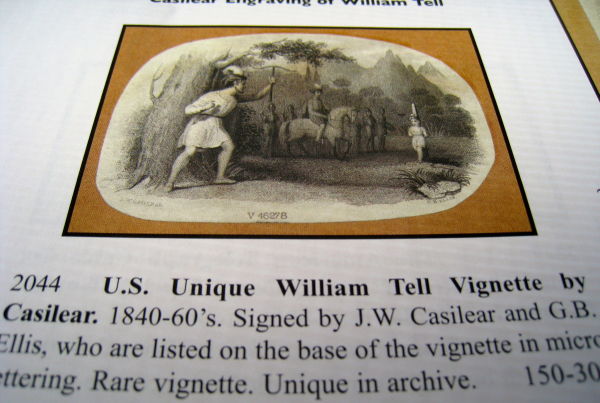 Although the description errs in the date of the vignette paper proof, it clearly shows that Casilear designed the William Tell piece, as his name is placed in the lower left under the scene. This vignette was used subsequently a few times, at most, on bank notes, but the one that ties it to Toppan's firm of 1831-1834 is the use by the Western Bank of Philadelphia. At that time, the city and rural surrounding area had a significant German population. The legend of William Tell shooting the apple off his sons head would have been well known to them, and Toppan saw an opportunity to sell a German text note to banks that dealt with this group. And, to tie this vignette even more to Casilear, in a journal article published about him late in his life, he remarked to his interviewer: "My first attempts of engraving, did you say? O (sic), they were made with a pen knife and a block of wood, when I was fourteen years old, and comprised a picture of William Tell, who was a big hero in my youthful estimation." Available today as a proof and cancelled remainder, and very rare, (Haxby PA-510, G-46, 1830's), it has come to auction only a few times and sold for prices into the several thousand range. Below is a photocopy taken from one of those sales. The vignette also appears as a much reduced size item on a Charles Toppan & Co. vignette sample sheet, last known sale in November, 1996 by Spink America, "Important Early American Paper Money", lot 1076. 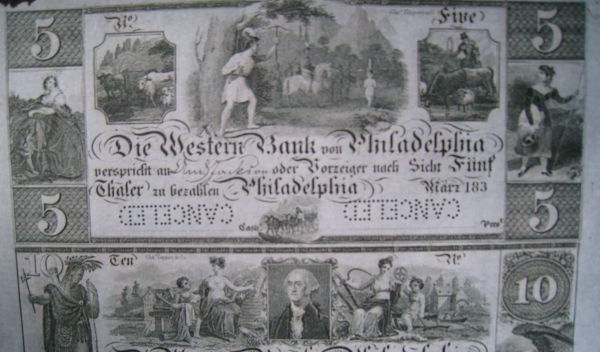 To be continued. |
|
Send note to Staff
|
|
|
Pillar Of The Community
United States
1946 Posts |
|
|
Interesting data. But in view of the restrictive copyright note, and the impression that you are drafting an article, perhaps for publication, I just want to be clear, did you bring this here to get assistance in putting this together? Do you wish assistance in editing it?
Prior to this we have shared in an informal discussion and stimulated each other with our thinking.
This takes the discourse to such a new level I am not quite sure how you want us/me to respond. The tone is no longer that of conversation, but now of dissertation. I can help with that too, but I'm not sure about what is appropriate here.
Please do not misunderstand, I have shared things with the list that I do intend to publish and have likewise asked that it not be posted elsewhere or otherwise circulated. But in every case I have invited the list to participate in the creative process, with the tacit expectation to credit any observations that informed my work. Not sure if you are looking at this the same way.
So what is it you want us/me to do with this?
Do let us know when and where you publish your study so we can see the finished product. |
|
Send note to Staff
|
| Edited by essayk - 09/07/2013 6:06 pm |
|
|
Valued Member
42 Posts |
|
|
Essayk,
First, thanks for sending me the info. on transferring images. Very helpful. I have a Mac, so will have to see how it all works out.
Second, and this is for the forum, I want to make clear that nothing that comes out of this forum, or elsewhere, on the topic under discussion will be used to enhance what I am putting out here. When asked to put out material on the Casilear relationship to the engraving firms, I had to choose between sloppy, half put together, and a more scholarly approach. I am not sure I will ever publish anything related to Casilear, because the information gathered over 10 years is huge and now pretty unmanageable. Also, I did not want others thinking that I have all the information that could be had, but at the same time, it has taken me years to gather what I am presenting, and I don't want to be handing out information freely so that it can be used for whatever purposes others have. Can you see my point of view?
I don't want to discourage open discussion, and, if you prefer, I can post the next parts in a much more general way. OK? Let me know. Thanks. |
|
Send note to Staff
|
|
|
Pillar Of The Community
United States
1946 Posts |
|
|
You should publish it so others can use it. That's the whole point. What is the glory of doing the research just to know something no one else knows?
Suppose I want to use something we discuss here in an article I intend to publish about what we have been calling the "Casilear essay." If your thoughts haven't been published, how do I reference them? Unless we agree to some kind of collaboration, my hands are tied.
Now you should know that I will be writing about that essay as a piece of a much larger story, and it will be submitted to a recognized journal; i.e. the US Philatelic Classics Society Chronicle. The section editor has been on my butt for it for a whole year now, after I did a PowerPoint that mentioned it. A lot of time and money have already gone into that. If you start presenting data here that would help solidify the attribution, and put out a gag order, I need to look the other way, unless you also put it out there for scholarly consumption and review.
So you bet I want you to publish whatever you are sharing here that is original and proprietary. That way I can acknowledge your contribution and be about my own business as well.
Understand? |
|
Send note to Staff
|
|
|
Valued Member
42 Posts |
|
|
Whoa! This is all news to me. Thanks for sharing. . .You know, from the general response this board has given to the topic to date, you and I appear to be the main interested parties. At least it seems that way.
I don't mind collaborating with you on your piece, but maybe this isn't the best forum to be doing it. I have to tell you that when you first posted the Casilear mention, I tried to contact you by email to get the background, but the Admin seemed to prefer that I present online. Maybe you prefer it that way too. If that is the case, then I might have to hold back some until I can see exactly what it is that you are trying to accomplish and how my info. fits into the whole piece.
You aren't the only one who has been on my case about publishing. There are some knowledgeable people in the fine art community that know what I am doing too. The issue for me is the "chinese wall" that the specialties have erected between themselves. Casilear was equally accomplished as an engraver and as a painter, but putting something together that covers both fields adequately and blends together is a huge task, since he was in and out of both for more than 25 years before finally choosing painting. Out of respect for what he accomplished, I need to continue to research until satisfied that I have covered the material adequately. This has been a labor of love to date. The philatelic part has bothered me since I never read anything or saw anyone talk about it until I caught your post. Yet, I always believed he was involved in some way.
Finally, and perhaps, most importantly, I do have other 'life obligations', as you once put it. They need my time too. I have to do trade-offs all the time. It is what it is. |
|
Send note to Staff
|
|
|
Valued Member
United States
101 Posts |
|
|
Have you guys (and lurkers out there) checked out the Travers Papers, just recently made available at the US Philatelic Classics Society? http://www.uspcs.org/travers-papers/Also, from their "Resource Center" you can also find Wilson Hulmes' previously unpublished documents. Of course much of the material relates to Toppan, Carpenter & Co. Oh, and Essayk, in answer to your question, I really have no clue as to exactly how the Washington and Franklin dies were copied, but find it extremely interesting to note that some portions were meticulously duplicated and yet other details (clothing for example) were much more loosely imitated. The skills involved are just mind boggling. One interesting point - in looking at the old banknotes, and the pair of Washington and Franklin images on them, notice how the Franklin image looks lighter and cleaner than the Washington. The Washington portrait reminds me of the unpopular "dirty faced" Washington seen on modern Scott #1283 of 1966, which led to the cleaned up image of #1283B. Looking at your progressive scans as the Washington portrait evolved, it looks like a similar cleanup took place as the 1851 stamp image was created. -Dunc |
|
Send note to Staff
|
|
|
Rest in Peace
United States
7097 Posts |
|
|
What a wonderfully informative post! I wish I could add something to it but I cannot. I am however learning a great deal! |
|
Send note to Staff
|
|
|
Valued Member
42 Posts |
|
|
Thanks, Duncan, for the information on the Travers and Hulme information. I went through the material related to the 1851 issue and Toppan, Carpenter, and found it fascinating. Seems pretty clear that they got the contract because of the price offered to do the work. Also, it is evident that they had to do a lot of fast adaptation - almost 'seat of the pants' like - to get the process underway and deliver, once they had the contract.
The Hulme transcripts of the Travers papers are very helpful - I always have had difficulty reading the longhand of letters of that era. Samuel Carpenter's key role as the business leader really comes out. And, the July 11, 1851 letter from TC to the PMG describing the multiple plates of the 3c being worked on in order to meet demand is a real eyeopener. The firm really was burning the midnight oil! I pity the poor transfer press operator(s) - probably led by Saulnier. No wonder the series has so much variation and is of such interest to philatelists - this opinion coming from a philatelic novice.
I could not find any references to engraving of the issues, however, although have not gone through everything yet. If only the surviving history of TC & Co. went back a little further than 1851. So, we are still in limbo on that matter. Essayk's excellent work on comparison of the various die engravings and styles has got this thread far on stylistic grounds, but, the authorship of the engravings of Franklin-Washington profile busts - both bank note and stamp - in my opinion, is still unresolved, with all due respect to Mr. Morris. The previous paragraph would lead one to believe that there were multiple engravings of the 3c early on. |
|
Send note to Staff
|
|
|
Pillar Of The Community
United States
1946 Posts |
|
|
@I_Love_Stamps
I hope you are able to separate the wheat from the chaff, Jeff, since the hypotheses are flying out pretty fast, and in some cases falling as fast. But in time I think we will get it cleaned up.
@dunc
[chuckle] Catchy user ID, and may I say I have always liked your 99c breakfast menu items.
As for the Travers Papers, Thank you so much for the link and the prod. The two volumes on the 1847s have been out for a while, but I was not aware that the USPCS was putting the next series up on the website. They just did that recently, according to another memo I got.
According to the first notes I looked at, which were from a chronological synopsis done in 1999, adoption of the postal reform act on March 3, 1851 required new stamps, and five days later PMG Hall invited 6 companies to submit bids and samples. That is when the design process began. Hall is the one who prescribed Washington for the three cent. By April 22 the field was narrowed to two finalists for what is specified as a 4 year contract; TCC and Danforth Bald. At this stage the proposed options called for a 3c alone, or a 3c with a 1c and 6c or a 1c and 12c. The next day, Apr 23, TCC got the nod, acknowledging certain "modifications" as agreed to verbally between Hall and [S.H.] Carpenter. Five days later a Philadelphia Sun newspaper announcement of their success mentions only the 1c, 3c, and 12c denoms, so the 6c was apparently out by then already. On May 24 TCC was able to submit plate proofs for the 1c and 12c, and die proofs for the 3c and the Franklin carrier. By May 31 the plates were ready for the 1c, 3c, and 12c stamps, and orders had been given for an initial printing. They were waiting for paper. On June 10 the contract with TCC officially commenced, by June 16 they had printed 1.5 million that still needed to be gummed, and by June 21 TCC delivered 300K-3c, and 100K each of the 1c and 12c to the stamp agent for delivery to postmasters.
The notes continue with fascinating details on production problems etc, but for our purposes this is enough. According to these notes, the sequence of designing the 1851s started with the 3c, with what I assume was the Casilear 3c as the essay which won the day. The use of Frankin was originally planned for the 6c, but that design became the 1c when the 6c denomination was nixed. The design of the 12c was also well along by the time they decided to redo the 3c, presumably so its design style would harmonize with the 12c rather than the 1c.
Good information to have, but I will have to keep looking for any notes that would identify the personnel who worked on a design.
|
|
Send note to Staff
|
|
|
Replies: 91 / Views: 23,238 |
|
|
To participate in the forum you must log in or register. | |
 Help With A 1 Cent Franklin From The Philippines Show Your US 1851-57 Imperforate Stamps Stamps On Stamps Optical Instruments: Microscopes, Binoculars, Sextans, Theodolits, Hand Scopes Cover Calendar For Month And Day -Pics Pushing 330,000 All Different Worldwide Stamps In One Collection . Postmarks.day By Day Experimenting With A Phone As Attached Scanner Turn On The Light! Candles, Lamps, Torches, Candelights, Bedside Lamps. Fan, Éventail, Abanico, Fächer, Leque Linn's To Return To Printed Issues Minkus Supreme Global Albums (The Big Red Thread) Soviet Union Stamp Engravers Czech Stamp Engravers Collecting By Engraver 1851-57 12c Washington Canada 742 Color Shift Error? Stamps Made Of Cloth, Polymer, Metal, Wood Etc Art & Paintings On Stamps Need Help With Swedish Stamp And Postmark Living Persons Portrayed On Stamps If You Have A Design You Like, Might As Well Stick With It! Newfoundland 82 Imperf Cover Please Identify - USSR Stamps US Half Cent Postage Dues On Cover Help With A 1 Cent Franklin From The Philippines Show Your US 1851-57 Imperforate Stamps Stamps On Stamps Optical Instruments: Microscopes, Binoculars, Sextans, Theodolits, Hand Scopes Cover Calendar For Month And Day -Pics Pushing 330,000 All Different Worldwide Stamps In One Collection . Postmarks.day By Day Experimenting With A Phone As Attached Scanner Turn On The Light! Candles, Lamps, Torches, Candelights, Bedside Lamps. Fan, Éventail, Abanico, Fächer, Leque Linn's To Return To Printed Issues Minkus Supreme Global Albums (The Big Red Thread) Soviet Union Stamp Engravers Czech Stamp Engravers Collecting By Engraver 1851-57 12c Washington Canada 742 Color Shift Error? Stamps Made Of Cloth, Polymer, Metal, Wood Etc Art & Paintings On Stamps Need Help With Swedish Stamp And Postmark Living Persons Portrayed On Stamps If You Have A Design You Like, Might As Well Stick With It! Newfoundland 82 Imperf Cover Please Identify - USSR Stamps US Half Cent Postage Dues On Cover
Disclaimer: While a tremendous amount of effort goes into ensuring the accuracy of the information contained in this site, Stamp Community assumes no liability for errors. Copyright 2005 - 2026 Stamp Community Family - All rights reserved worldwide. Use of any images or content on this website without prior written permission of Stamp Community or the original lender is strictly prohibited.
Privacy Policy / Terms of Use Advertise Here |
| Stamp Community Forum |
© 2007 - 2026 Stamp Community Forums |
| It took 0.45 seconds to lick this stamp. |
 |
|
|
|


 Posted 09/06/2013 6:14 pm


