@Kevin450 et al
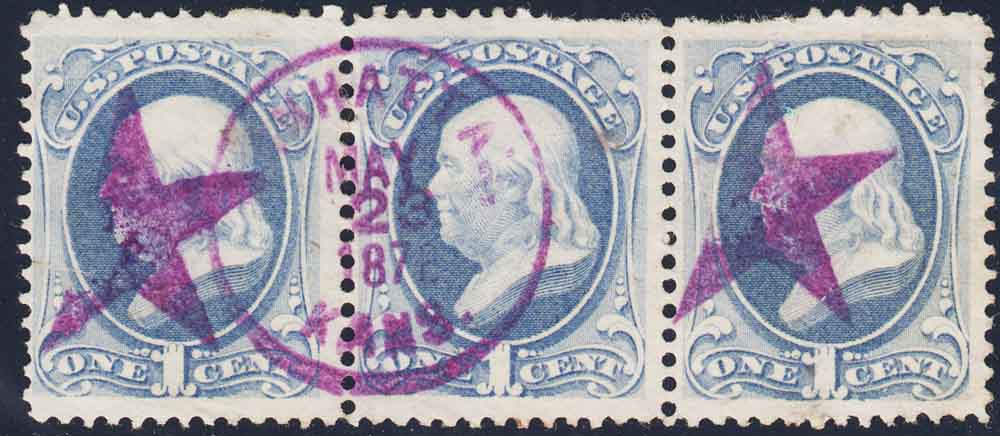
If everything about this item had been as described, it would have moved up by over 6 months the EKU for US #182. So Terry was on the right track. But since that might leave some of you with a question mark, let me explain briefly.
Everyone knows that CBNCo used "hard" rag paper for the stamps they produced. The stamps in this group are known as "imprint captures" and as you can see each has a part of the imprint from the Continental Bank Note Company (CBNCo). However, all of these stamps are printed on "soft" wood pulp paper, which is supposed to be specific to the American Bank Note Company (ABNCo). So the usual explanation for that is that when American took over the printing, they continued to use the Continental plates for a while, even though they "switched" to soft paper.
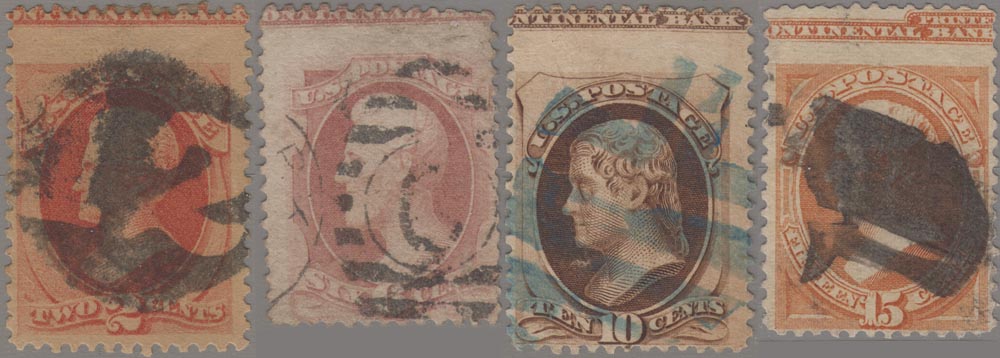
Well that's not quite what happened. Here's the truth.
The CBNCo merged with ABNCo on February 4, 1879. Here is a pair of stamps dated to the evening of the very day of the merger, which I found in a mish-mosh of stuff I picked up in the early 1970s.
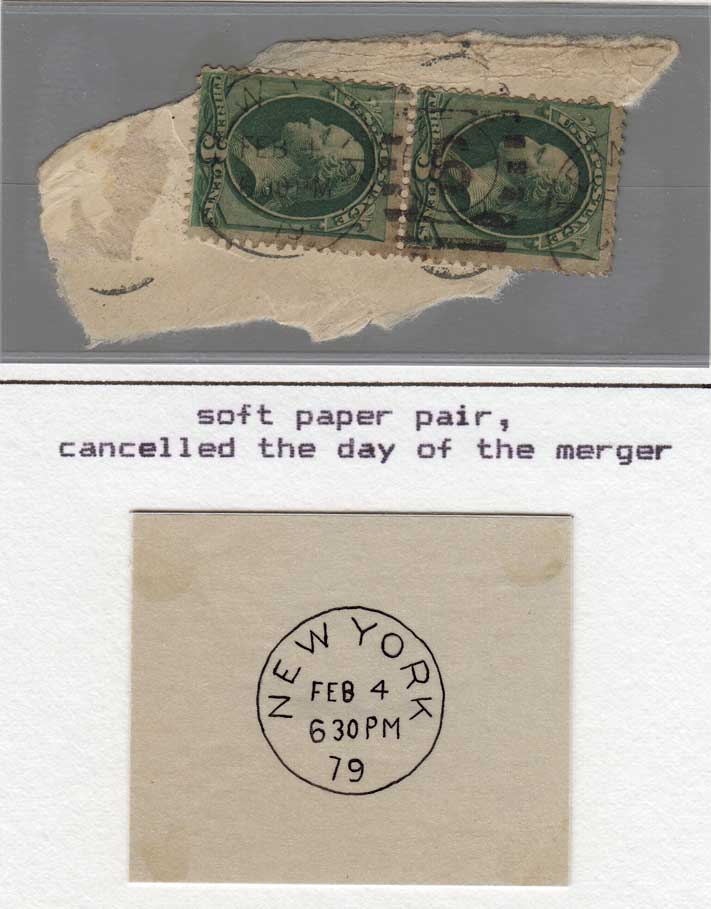
It looks like heck and I was all set to soak it when I noticed that these stamps are on soft paper, American paper. That meant that there was no way that all forms of soft paper began with the ABNCo. Continental must have been using a soft paper late in their tenure of the contract.
Today, Continental soft paper is called "intermediate" paper, and it is being studied for its particular characteristics as part of the paper study project the USPCS is supporting.
Until we know how to determine intermediate paper analytically, the only sure way to spot it is with a dated cancellation, on or off cover.
Here is a cover with a soft paper three cent dated to November of 1878, almost three months before the day of the merger.
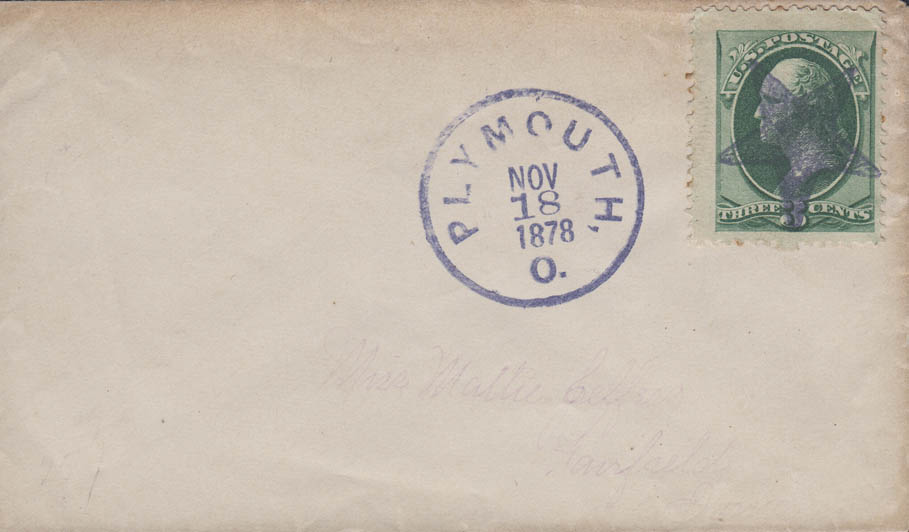
It's a pretty little cover, but there's a problem. The stamp is not tied. Prove it was original to the envelope. Cancellation ink and known fancy cancel types help build a case, but it's not solid.
Here's a better candidate, sort of. It bears two soft paper three cents.
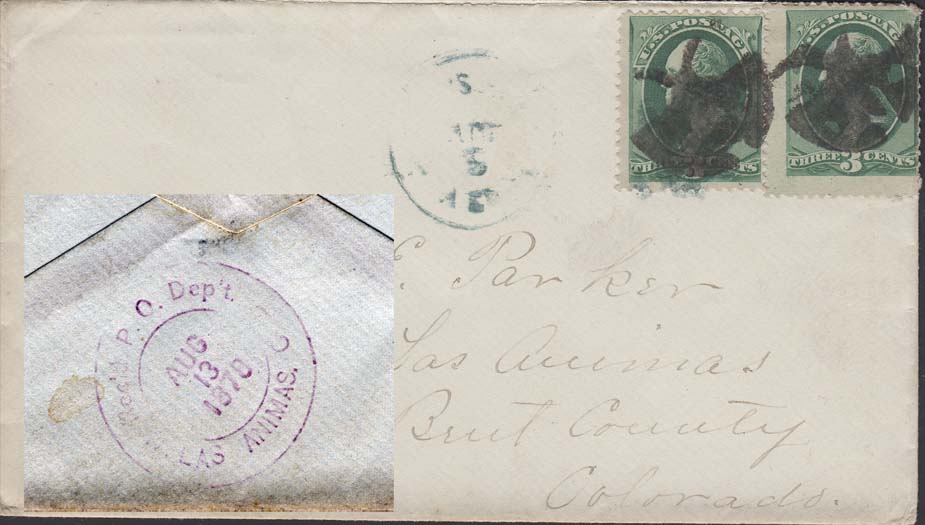
In this case the original cancellation was a poor strike of an August 9 cancellation, but in a rather distinctive ink. The left stamp is just barely tied by that cancel, which shows no year date. Not satisfied with the cancellation job the stamps were hit again in black, which ties the two together. So both stamps are tied to the cover.
As you can see from the inset, the reverse bears a receiving mark which is dated August 13, 1878. So this usage is almost 6 months before merger.
If this strip had been on soft paper as described, it would have been my first example of intermediate paper for the 1c, which presently is only verifiable to one month before the merger. So I was really hoping this would change things.
But this strip is on hard paper.
It has some bum perfs, and the duplex cancel is colorful but incomplete for both stars. I paid about $25 for the strip.
Still think I should keep it?





 Posted 09/11/2013 11:31 pm