|
This page may contain links that result in small commissions to keep this free site up and running.

Welcome Guest! Registering and/or logging in will remove the anchor (bottom) ads. It's Free!
To participate in the forum you must log in or register.
| Author |
 Replies: 6 / Views: 4,188 Replies: 6 / Views: 4,188 |
|
|
Moderator

United States
5106 Posts |
|
|
The various Overrun countries threads caused me to look more closely at my humble collection. When I got to France, I have a single, a block of 6, and then this pair. What is intriguing is the small defect at the bottom of the flag pole on the upper stamp. There appears to be a shift in the black ink. 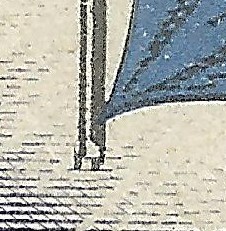 That seemed interesting. But, when I look at both of them together, it appears the top stamp has a darker black section over the red part of the flag, while the bottom is definitely lighter. 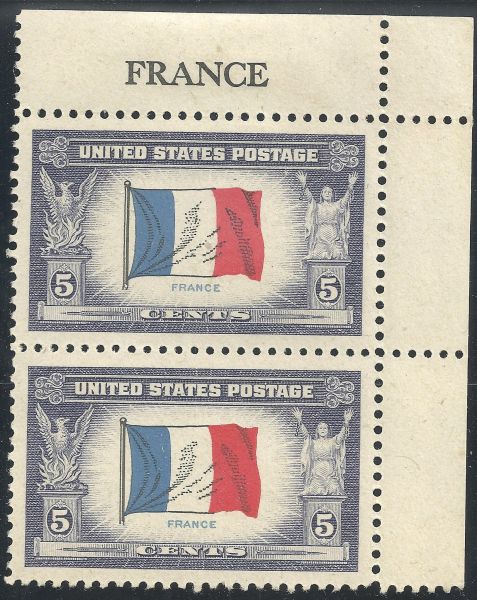 Is it possible that I have a pair of the normal Scott 915 with a Scott 915b (or 915a)? It would be quite the catch! Top Closeup 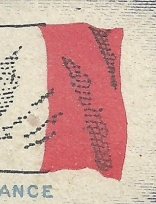 Bottom Closeup 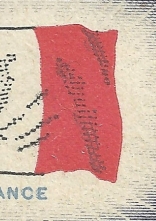 |
|
Send note to Staff
|
|
|
|
|
Pillar Of The Community
1849 Posts |
|
|
The top stamp of the pair cannot be normal and the bottom a reverse
print.
They were not printed that way...sorry. |
Send note to Staff 
|
|
|
Moderator
United States
5106 Posts |
|
|
Kevin ... yes, thought that was near impossible. To me, it almost seems to be a "degree of coverage." For example, my Scott's has an excellent picture of the Yugoslavia reverse printing showing how the red covers up the vast majority of the black underneath. However, here I have two stamps where the right stamp shows the black printing very well, while the left stamp appears to have more "red" on top of the black, especially on the right side of the flag. 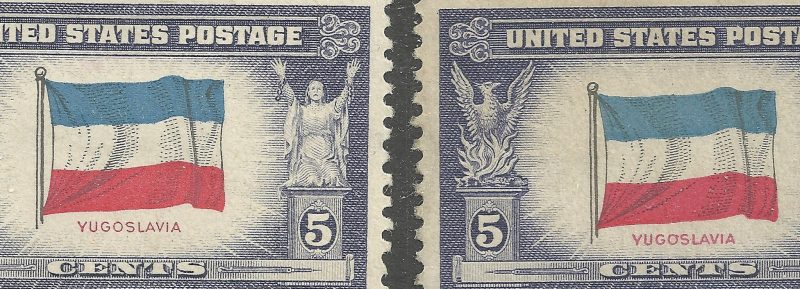 |
|
Send note to Staff
|
|
|
Valued Member
United States
101 Posts |
|
|
Controversial. That's the best way to describe the "normal" and "reverse" printings of the flag colors on this series of stamps.
The idea of "reverse" printings gives the false impression that the stamp colors were done in separate runs, but they were not.
The engraved frame was done separately, but the flag colors were all printed in one run, and all the colors were wet. The central vignettes were printed by offset letterpress - not the same as offset lithography, either - with the colors applied to a transfer blanket and the entire image then applied to the stamps.
I haven't seen a recent Scott Specialized, but earlier editions warned that the printer, American Banknote Company, would not disclose how this process was done.
Consider how the transparency of the inks, the speed of the press, the humidity present in the air that day, the viscosity of the inks (and additives?), and other factors could all contribute to the appearance of these stamps.
Jim Kloetzel wrote a two part series on these for Scott Stamp Monthly about six or seven years ago. He has a block of the GREECE stamps with examples that, if separated, would certify as "normal" and "reverse" printings. Ken Srail is another expert who believes the two types can appear on a single block. Ken Lawrence, on the other hand, says such examples are optical illusions.
It does appear that the majority of GREECE examples look like "reverse" printings, more common than the "normal" examples.
It is also believed that the printers experimented while the series was being created, trying to achieve the best looking results, adding to the variations. It was not a simple process, and so it did not result in simple varieties.
My suggestion would be, collect these if you find them interesting but don't go nuts and pay too much. |
|
Send note to Staff
|
|
|
Moderator
United States
5106 Posts |
|
|
Thanks for the info. I guess if I see something with a good color blanket, I will pick it up (cheap). But otherwise, I will stick to more well known varieties. Always something new in stamps ... Even after all these years. |
|
Send note to Staff
|
|
|
Valued Member
United States
135 Posts |
|
|
See Jim Kloetzel's article in the March, 2009 Scott Stamp Monthly. On page 13, there is an excellent diagram (from Clark Crane's September, 1977 article in United States Specialist) showing the press layout for the printing of the flags. There were four printing plate positions which applied ink to the offset blanket. There were four plates, one each for the up to four colors necessary for printing the flags and country name. For example, on the Czechoslovakia flag (my specialty) the four plates were for: 1) black-flag pole and shading lines, 2) blue-for the flag, 3) red-for the flag, and 4) red-for the country name. The flag red and country name, also red, were printed from two separate plates.
In addition, except for Poland, Denmark, and Korea, two countries were printed at the same time. The stamps were printed in a sheet of four panes of 50 (2x2). For example, Czechoslovakia was printed in the top two panes and Norway was printed in the bottom two panes. For this reason, each of the four plates could have had to apply two different colors to the blanket. Thus, each plate had two ink fountains.
As the printers experimented to achieve the best possible appearance, a specific plate could be moved from one to another of the four plate positions which transferred ink to the blanket. This accounts for some stamps having the shading lines on top of the flag color (normal) and some stamps having the flag colors on top of the shading lines (reverse). It is also possible to have a partial reverse printing--the shading on top of one flag color and under a different flag color. All of these varieties resulted from the printers varying which of the four plate positions a specific plate was placed.
Note that none of these are "errors"; they are printing varieties. |
|
Send note to Staff
|
|
|
Moderator
United States
5106 Posts |
|
|
I thought Coinwatcher would like to see this one. Definitely a red spot in the upper stamp from who-knows-where. 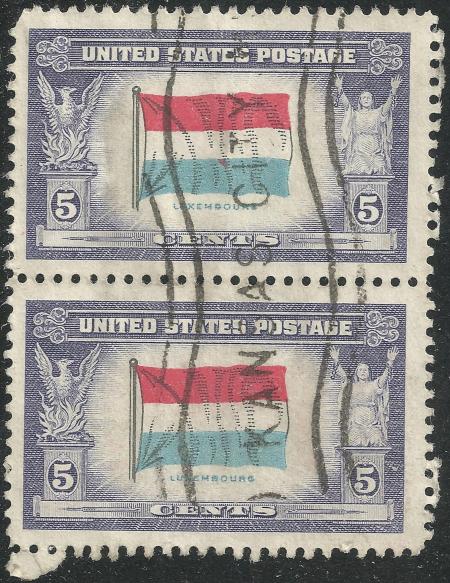 |
|
Send note to Staff
|
|
| |
Replies: 6 / Views: 4,188 |
|
|
To participate in the forum you must log in or register. | |
 Charles Shreve Departs Siegel Suddenly Eire Oddity - Changeling? Indian Head Fancy Cancellation? Some Day I'll Get It -Today -I Got It Heritage Back In The Stamp Auction Business Is This Zululand Stamp A Fake? Bare Feet On Stamps ' , ' , ' , ' Astronomy. Outer Space, Planets, Stars Etc Maxicards / Maximum Cards / Maximaphily Bees - Honey Bee Stamps, Beekeeping, Apiculture Cover Calendar For Month And Day -Pics Jim Jung's Ebay Sales Specializing In Canada, Constant Plate Varieties And Efo's Show Your Film And Music Star Stamps Republic Of China (Taiwan) Stamp Engravers Postmarks.day By Day Egyptian And Near Eastern Mythologies Chinese And Far Eastern Mythologies Norse Mythologies On Stamps Going Ape Israel Revenue Stamp Catalogue Information Request WW2 Redirected Cover To A9958 Raf APO 5095 ? Stamps Made Of Cloth, Polymer, Metal, Wood Etc Textile And Weaving Of Cloth Scotts Catalog New Vs Older Questions Pottery, Ceramics, Porcelain, And Other Clayware Charles Shreve Departs Siegel Suddenly Eire Oddity - Changeling? Indian Head Fancy Cancellation? Some Day I'll Get It -Today -I Got It Heritage Back In The Stamp Auction Business Is This Zululand Stamp A Fake? Bare Feet On Stamps ' , ' , ' , ' Astronomy. Outer Space, Planets, Stars Etc Maxicards / Maximum Cards / Maximaphily Bees - Honey Bee Stamps, Beekeeping, Apiculture Cover Calendar For Month And Day -Pics Jim Jung's Ebay Sales Specializing In Canada, Constant Plate Varieties And Efo's Show Your Film And Music Star Stamps Republic Of China (Taiwan) Stamp Engravers Postmarks.day By Day Egyptian And Near Eastern Mythologies Chinese And Far Eastern Mythologies Norse Mythologies On Stamps Going Ape Israel Revenue Stamp Catalogue Information Request WW2 Redirected Cover To A9958 Raf APO 5095 ? Stamps Made Of Cloth, Polymer, Metal, Wood Etc Textile And Weaving Of Cloth Scotts Catalog New Vs Older Questions Pottery, Ceramics, Porcelain, And Other Clayware
Disclaimer: While a tremendous amount of effort goes into ensuring the accuracy of the information contained in this site, Stamp Community assumes no liability for errors. Copyright 2005 - 2026 Stamp Community Family - All rights reserved worldwide. Use of any images or content on this website without prior written permission of Stamp Community or the original lender is strictly prohibited.
Privacy Policy / Terms of Use Advertise Here |
| Stamp Community Forum |
© 2007 - 2026 Stamp Community Forums |
| It took 0.22 seconds to lick this stamp. |
 |
|
|
|


 Posted 09/15/2013 12:58 am


