| Author |
 Replies: 26 / Views: 7,138 Replies: 26 / Views: 7,138 |
|
|
|
Bedrock Of The Community
United States
10812 Posts |
|
|
"as revenue stamps were never sold or released to the public"
Absolutely untrue! Anyone was able to buy all but a few types of revenue stamps, for whatever reason they wished. Especially documentary stamps. The general public was the users of most revenue stamps, especially in the 19th century. If you wrote a check, you put the stamp on it. The very largest banks in major cities might have them for their customers, but except for large cities with actual IRS offices the sellers of revenue stamps was always some local merchant who was authorized to sell them. There are numerous advertising covers for merchants offering both postage and revenue stamps for sale. Anyone could buy them. Many businesses, lawyers, etc had clerks that would apply stamps and cancel them, but they had no special dispensation to purchase them. Private Die Proprietaries were company specific, so not available to the general public, but regular proprietaries could be purchased by anyone.
Special Tax Stamps were about the only 19th century revenue stamp that the public could not just walk up and purchase; they were taxes on specific occupations which required proof.
The government was interested in the money. They inspected taxable items to see that it was paid, but they wanted to make the purchase of the stamps as easy as possible. |
Send note to Staff 
|
| Edited by revcollector - 10/08/2013 11:31 am |
|
|
Pillar Of The Community
United States
6463 Posts |
|
|
Hmm. I was under the impression that while the revenues were for sale to businesses, they were not available to the general public.
Why then, do we see so few legitimately unused 1st issue revenues, i.e., full gum, not sweated from documents? Fewer than 1 per 1000 seen are actually unused. Unused postage stamps from the era are far more common, probably by several orders of magnitude. |
|
Send note to Staff
|
|
|
|
Bedrock Of The Community
United States
10812 Posts |
|
|
Because revenue stamps were expensive! Most people were making $1 or $2 a day if they were lucky. No one was buying them if they did not need them. Because of this, revenue stamps were printed more on an as needed basis than postage stamps. And they paid specific taxes, they did not provide a future service. Revenue stamps never passed for small change in the 19th century, but mint postage did, for that very reason. Revenue stamps were only valid for the life of the specific taxes that they paid, but mint postage stamps were valid indefinitely, so they were issued in much larger quantities for the most part. At least in the lower values that were most often likely to be used.
If you want to compare the value of a $0.01 Income or Wealth , in 1862 there are three choices. In 2012 the relative:
historic standard of living value of that income or wealth is $0.24
economic status value of that income or wealth is $2.91
economic power value of that income or wealth is $27.80 |
|
Send note to Staff
|
|
|
Bedrock Of The Community
United States
10812 Posts |
|
|
According to Brookman, there were about 658,000,000 Scott 25 and 26 issued (all but about 38,000,000 were 26). That's about 200,000,000 MORE than the 2 cent USIR, which was far and away the largest quantity first issue stamp. |
|
Send note to Staff
|
| Edited by revcollector - 10/08/2013 12:00 pm |
|
|
Pillar Of The Community
United States
1946 Posts |
|
|
Come to think of it, I was able to buy a revenue plate block at the Post Office window back in the day. But, getting back to the thread topic, is anybody going to help me with my cancel? This is not a trick, I really don't know what to make of it. |
|
Send note to Staff
|
|
|
Bedrock Of The Community
United States
10812 Posts |
|
|
I can tell you that it is not a revenue usage, all remaining documentary taxes (the 2 cent tax on checks) ended on March 3, 1883 with the new tax laws which started on that date. Also all the match & medicines, perfumeries, and playing cards (which were again taxed starting in 1894). Easy date to remember, there were a lot of taxpaid provisionals overprinted with that date under the same laws.
It seems likely that it was a partial manuscript postal cancel, or possibly docketing after the fact that happened to be written on the stamp. |
|
Send note to Staff
|
|
|
Pillar Of The Community
United States
1946 Posts |
|
|
Unless the person whose name appears on the stamp can be identified as a Fort Wayne Post Office employee of some kind, I am inclined to think of it as docketing too. There is some indication of handstamp cancellation in black, but it is so faint and incomplete that it would not be surprising that someone in the PO might seek to finish the job with a pen. Plausible as that is, it needs corroboration, since the docketing is about as likely, although that does not usually extend onto the stamp(s) on a cover.
Tracing the name into some roster of postal employees would turn that around for me, but even with that it will always remain open to question, I think. |
|
Send note to Staff
|
|
|
Valued Member
United States
31 Posts |
|
|
Pillar Of The Community
1545 Posts |
|
|
Horrible stamp. Fancy cancel. 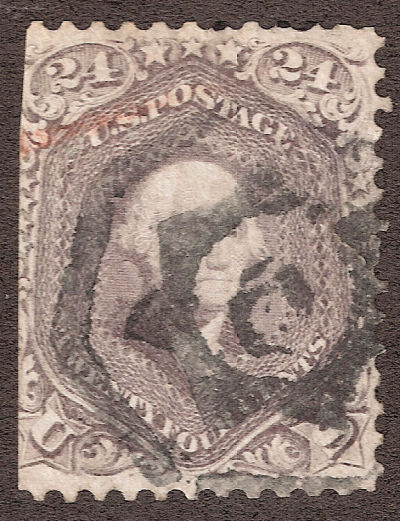 -IBFS |
|
Send note to Staff
|
All science is either Physics or Stamp Collecting. -- Ernest Rutherford |
|
|
Valued Member
213 Posts |
|
|
Interesting Reading about fancy cancels I came across a few years ago . Scroll down to journal section. http://bob.trachimowicz.org/ucanpdf.htmFor the Revenue collectors : It was my understanding they were issued for public consumption . Wine tax stamps , document stamps for wills , contracts and deeds . Potato stamps for farmers and medical and card stamps for doctors and consumers of playing cards. I guess the public "indirectly" consumed these stamps ? |
|
Send note to Staff
|
| Edited by petrucellij - 10/27/2013 7:53 pm |
|
|
Bedrock Of The Community
United States
10812 Posts |
|
|
The public could "consume" them directly. You are talking about a wide range of taxes from different eras, however. Adhesive documentary stamps could be and were purchased by anyone who wanted them. In the 19th century it was always users doing the purchasing, so few mint stamps exist. In the 20th century there were some collectors who also purchased them and saved them, and mints range from very common to extremely scarce depending on the face values.
Wines were not taxed with stamps until 1914, and the tax was paid by the producer and passed on to the consumer; however like the beer stamps before them anyone could legally purchase them if they wished. The relatively large supply of mint stamps around even before the Smithsonian sales indicate that collectors did do so to some extent, although I am sure most were looked at in a funny way.
The potato tax was declared unconstitutional even before it took effect, so the stamps were never used. They were later sold to collectors who desired them, and are fairly common.
Patent medicines used either ordinary proprietary stamps available to everyone or Private Die Proprietaries only available to each specific company that ordered them and paid for the engraving of the plate. They were really not for doctors (unless they produced their own preparations commercially), but for druggists.
Playing cards were taxed from 1862-1883 in the same ways as the patent medicines. They were untaxed from 1883-1894, when the tax was reintroduced in a way similar to the wine tax, paid by the manufacturer and passed on to the consumer. Again they were available to anyone who wanted them, and there are mint stamps around for many of them. Some were precancelled for specific companies and would not have been available to anyone else. |
|
Send note to Staff
|
|
|
Replies: 26 / Views: 7,138 |
|




 Posted 10/08/2013 11:18 am





