| Author |
 Replies: 10 / Views: 2,897 Replies: 10 / Views: 2,897 |
|
|
Pillar Of The Community
United States
6467 Posts |
|
|
Your brain will subconsciously try to make the picture come into focus, but it won't happen.  It's Scott #R234, double impresssion, mint OG block of 4. Not worth a whole heck of a lot, but I like double impressions. 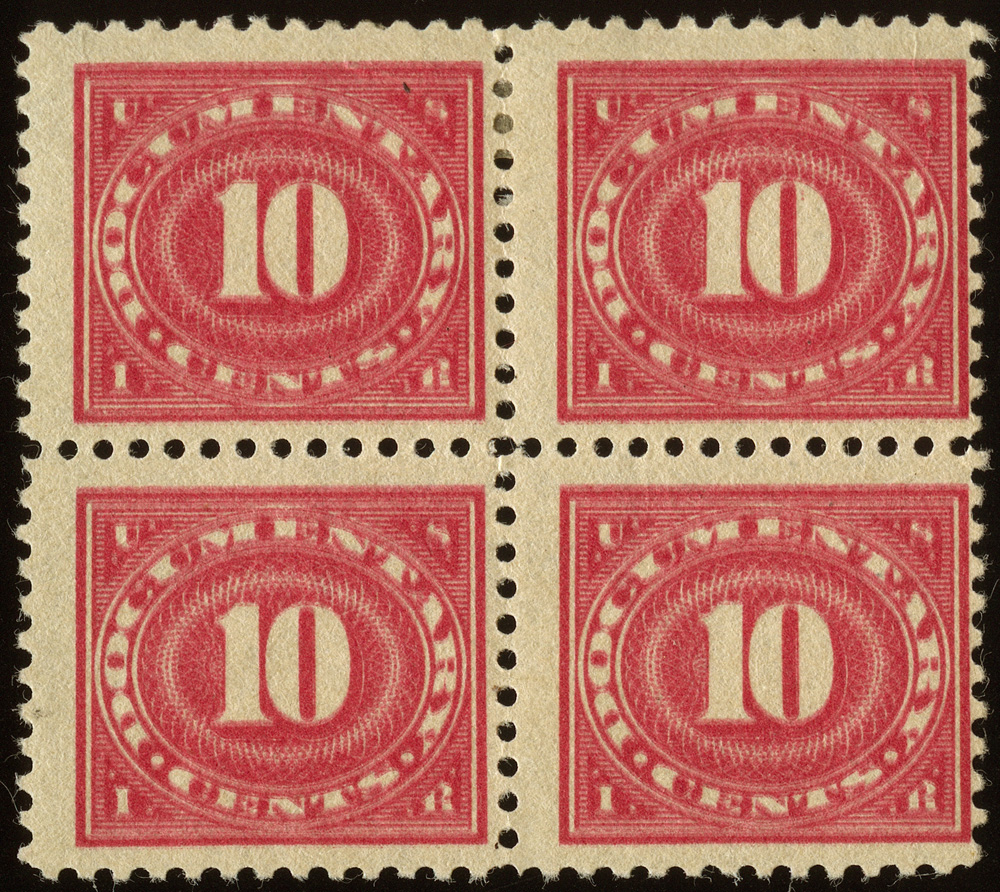 |
|
Send note to Staff
|
|
|
|
|
|
Moderator

United States
5106 Posts |
|
|
I will obey! I will obey! What is your bidding, master? Quite the hypnotic look to it. It's full double impressions like this that make me wonder how to spot a triple impression. |
Send note to Staff 
|
|
|
Bedrock Of The Community
United States
10839 Posts |
|
|
These are offset stamps, and it is always difficult to tell whether it is a true double impression, which is twice through the press, or if the sheet simply came in contact with the blanket a second time resulting in a kiss print. |
|
Send note to Staff
|
|
|
Pillar Of The Community
United States
6467 Posts |
|
|
Yeah, it's closer to being a kiss print IMO, but virtually all of the 20th century documentary "double impressions" look that way to me. They're nowhere near as dramatic as the 1st issue double impressions, which are true double impressions.
There's been quite a bit of discussion, most notably on Philamercury, about what the Scott catalog actually means by "double impression", especially with respect to Washington-Franklins. Most of those so-called double impressions look like kiss impressions to me, and apparently Scott uses the term "double impression" for both.
|
|
Send note to Staff
|
|
|
|
Pillar Of The Community
Australia
554 Posts |
|
|
Here's a real double print from Central Lithuania, 1920. Nothing backdoor about these, they were printed in bulk & sold to dealers, tons of this stuff around. Clive Feigenbaum could have learnt a lesson or two from these guys, they were doing this 20 years before he was even born  |
|
Send note to Staff
|
|
|
Valued Member
United States
240 Posts |
|
|
Hello all, Didn't they have any kind of Quality checks for stamps back in the day? We had done a study SPC (Statistical Process Control) at a plant I worked at for 20 years, and the Quality Assurance guy was questioned about how he had let some of production thru that didn't meet the standards. Come to find out, he needed glasses, but never went to have his eyes checked. Wow revenuecollector that block will make one seasick.lol. Respectfully, Gary |
|
Send note to Staff
|
|
|
Pillar Of The Community
United States
6667 Posts |
|
|
Bedrock Of The Community
United States
10839 Posts |
|
|
Remember these stamps were used to pay a documentary tax from 1917 until 1940. The basic stamps were also overprinted for several other tax uses, such as silver tax, cigarette tubes, stock transfer, etc. They printed uncounted billions of many values, so the idea of serious quality control was a bit iffy at best. Under the circumstances they did a pretty good job. |
|
Send note to Staff
|
|
|
Moderator

United States
12330 Posts |
|
|
Gar,
With manufacturing true quality is never 'inspected in', it is a cultural thing that permeates every aspect of the company. And from what I have learned from guys like Revcollector/revenuecollector is that the US revenue stamp manufacturing was about getting product out the door. In other words, even if there had been a QA guy or shape eyed operators they probably would have been told to let the product ship.
don
|
|
Send note to Staff
|
|
|
Pillar Of The Community
United States
6467 Posts |
|
|
The quality control on these 20th century revenues was absolutely brilliant compared to those of the 1860s, hence all of the perforation and centering issues, the color variance, the dry vs. wet printings, all of the plate cracks, transfers, etc. on the latter.
Quality simply didn't matter. They were under intense pressure to just get the stamps out the door. The stamps were to pay a tax, not works of art or for collectors. A nonperfed, misperfed, or partially perfed stamp would work equally as far as recording the payment of the tax. |
|
Send note to Staff
|
|
| Edited by revenuecollector - 11/16/2013 6:40 pm |
|
|
Bedrock Of The Community
United States
10839 Posts |
|
|
Everything in the technology of the 20th century was better than the 1860's. Engraving was better than offset, but offset was a lot cheaper and necessary with the quantities involved in the payment of 20th century taxes.
I agree that getting the stamps out the door was the priority. |
|
Send note to Staff
|
|
| |
Replies: 10 / Views: 2,897 |
|




 Posted 11/14/2013 3:29 pm





