| Author |
 Replies: 42 / Views: 8,335 Replies: 42 / Views: 8,335 |
|
|
|
Valued Member
United States
82 Posts |
|
|
dkucyk, what you have there is a 65. On this forum two of you guys have shown nice scans of a 64, as for pigeon blood I have seen only one cert. copy and in my opinion the bluish tint is something you have to see for yourself, its not really bluish it's something your mind eye see's it's very suttle. |
Send note to Staff 
|
|
|
Valued Member
52 Posts |
|
|
My personal experience with Scott 64 vs. 65 is that it's hard to tell the difference...right up until the first time you actually see a Scott 64 in person. It truly is PINK - like some young girl brightly shaded it in her favorite color. It stands out, and there is no hint or shades of red. After viewing one up close, you can dismiss 95% of pretenders with a glance...which also included a very significant portion of the stamps advertised on ebay as a non-cert 64, also. |
|
Send note to Staff
|
|
|
Valued Member
United States
82 Posts |
|
|
jaxstamper, you said a mouth full, most stamps sold as #64 on ebay are not, I agree with you that once you see one they are unmistakable but pigeon blood pink is something else all together. The difference there can't be picked up by a scan it must be experienced. |
|
Send note to Staff
|
|
|
Valued Member
52 Posts |
|
|
I would never personally try to identify a pigeon blood; I've seen/read too many arguments about it between people who know far more about stamps than I do. That's definitely one for the experts. |
|
Send note to Staff
|
|
|
Pillar Of The Community
United States
1359 Posts |
|
|
locobot said: "Mr. Weiss you bring up something that the engineer in me has always wondered about. Has anyone at your level (professional expertizer) ever used or experimented with colorimeters? It would be cool if we could assign CMYK values with ranges to every classic color." Can tell you that Jack Daley, owner of the 3cent1861.com site, and one of the preeminent 3c 1861 shade collectors out there uses Photoshop Elements to identify the shades. I think that the real difficulty is understanding not just ranges of RGB, CMYK or HSN (Jack uses HSN), but understanding the different colors of pixels that make up any of the specific shades, including the color of the wash in between the pixels. Look at any of Jack's ebay auctions (he is jdaley3.703) and you'll see his method. When you scan the lower margin of the upper left "3", where the highest concentration of the shade is, and use high resolution (9600 dpi), you can use some of the tricks in Photoshop or PE, to see the individual pixels. What I've come to understand is that to have any of the "lake" shades, you need to have some purple or violet dispersed between the carmine pixels. Also if there is yellow wash, you don't have a pink-- the yellow mixes with the carmine to make brown. So the wash would need to be white in between the carmine, and you'd also need lots of pink, mauve and purples for pink/rose pink/pigeon blood. Then the pink can be further delimited to carmine pink if it is a true pink with more carmine or lavender pink with more blue. Somewhere in there you'd have your pigeon blood. Where I get confused is how to identify the clarets, crimsons, lilacs, and the different roses-- brilliant, rose reds, dull, deep, etc... There is definitely some science that can be used with this. Hope this helps, Ray |
|
Send note to Staff
|
|
|
Valued Member
United States
82 Posts |
|
|
Does anyone remember how grandma got her whites so white, it was a product they called bluing. White paper and pink ink is what the bluish tint in pigeon blood is all about. I'm not saying they used bluing on the paper it's a trick your eye plays on you when looking at white paper through pink ink that's how I can explain it and it's just my opinion and food for thought. |
|
Send note to Staff
|
|
|
Pillar Of The Community
United States
1359 Posts |
|
|
Here is Jack Daley's "lavender pink" scan and explanation as to where the blue is coming from-- and it isn't a trick on your eyes. Has nothing to do with the white paper and pink: 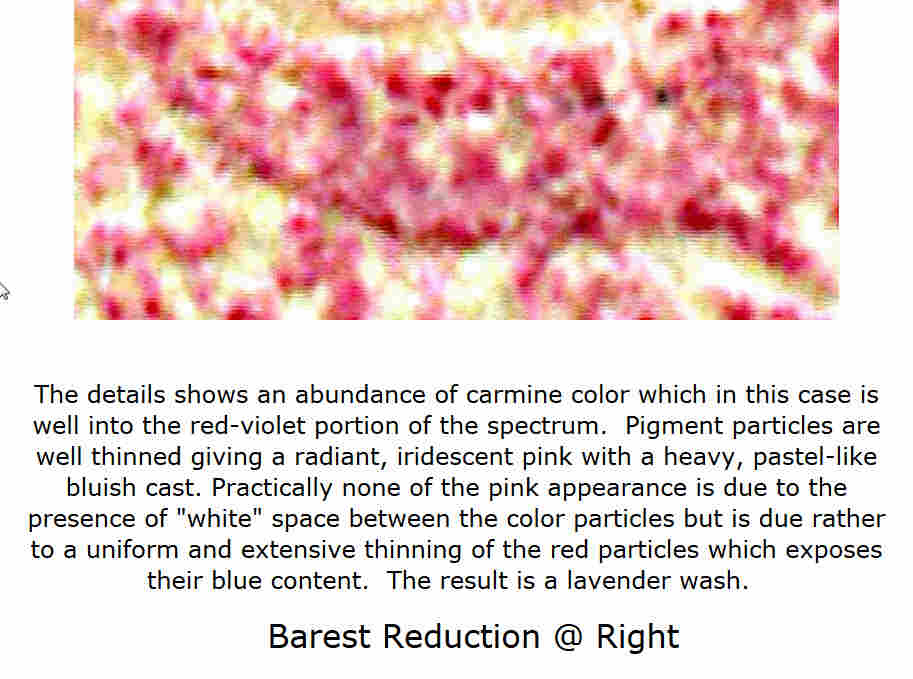 AND here is the ebay auction#: 261370826127Bluer than any pigeon blood you'll ever see. And this stamp is #64 pink, not #64a pigeon blood pink. So how would you then explain how blue this stamp is, but not pigeon blood? Because the true shade collectors would consider pigeon blood pink to be ruby pink, not pink with a blue tint..... Hope this helps, Ray |
|
Send note to Staff
|
|
|
Moderator

United States
12330 Posts |
|
|
ray.mac,
Basing an opinion of an stamp on an image's pixels? How do these fellows capture an image to analyze?
Obviously they would first have to prove that it is not possible that you might get different results using different scanners and scanning software. And I am not sure that this is the case even with higher end scanners.
don
|
|
Send note to Staff
|
|
|
Pillar Of The Community
United States
1359 Posts |
|
|
Don and all,
My last post on this subject.
There are some folks out there that specialize in this stamp-- I've been chasing shades for about 4 years now.
I'm not trying to sound defensive here, but I've been posting on the shades for at least 2 years now, and I don't know how to defend my posts here, other than when I mentioned earlier that when a lot of the pigeon bloods that y'all have seen that were blue, may not have been pigeon bloods at all-- even with certs, and Bill Weiss came out and said that I was exactly right.
So, I guess that if I try to show some of things that I've learned, and show some things that at least one of the leading experts in this stamp is using, it's hard to justify why it is so, when anyone can throw out an opinion on SCF, expert or not-- and that's anyone's prerogative.
I'm not an expert. I'm fairly knowledgeable about this stamp, but by no means an expert. It isn't as easy as pink shades on white paper making you think you're seeing blue. That's what I was trying to show with the pixels.
I've got a decent eye for the shades, but it's really difficult to ID pink or rose pink without a reference. I'll state that I cannot, and I've got at least 6 pinks-- 2 I bought from Jack Daley, 2 I bought from Mike McClung, and 2 others I have expertized by Bill Weiss-- the other 4 don't need a cert. And every pink that I have is completely different. So, if one can pick it out without a reference, that's great.
I think to answer the pixel question, you'd have to go out to Jack's website 3cent1861.com. He has a chapter "How color works", which I think could be very helpful. And yes, not every screen is the same, and I mentioned that on a post in a different thread today (64/65 help). But I think it's a good thing if one can use any technology one has to help them with the chase....because you can't just use reference copies, if they don't exist-- likewise if you know something about the physics of color, one might be able to use the technology.
So, I've tried to be helpful...and I end every post saying "hope this helps" and I think I've been helpful. So, hope this helps.... Ray
|
|
Send note to Staff
|
|
|
Valued Member
United States
82 Posts |
|
|
Ray, I think your jumping to defend your post when it is not necessary, I find our opinions quite close together, even though my explanation is more simplistic. Seems logical that when ink is thick it's a different hue than when it's thin. As for the color of the background it does make a difference, for instance thinly paint a bright white wall with a blue or red paint and tell me it perfectly matches the paint in the can. we are on the same page my friend. |
|
Send note to Staff
|
|
|
Moderator
United States
12330 Posts |
|
|
Ray,
Sorry, I did not mean for my post to come across like I was questioning your opinion.
I was only questioning the use of images to identify the color of something in real life. Most people use a scanner for stamps and in very general terms we can make some assumptions about the color accuracy. But only in general terms.
Any given scanner may or may not be calibrated. Even if calibrated the user may or may not have had various 'automatic color correction' features turned on. Truth is that the same scanner can generate a slightly different color shade or a period of time for the same stamp!
Let's say we had printed a color chip with a 'known' color. The color chip is a dark red color but specifically hex #b10b0b*. Now if we sent this color chip each person here in the forum and they scanned it how many would come up with the exact same color shade? Everyone would report that the color was basically a dark red but chances are very high that different scanners would generate slightly different shades. (And of course determining a simple single color is far easier than an image which contains blends of thousands of shaded pixels.)
I know you mentioned in the other thread the possible deltas between hardware but our hobby appears to replying far too much upon scans and images when we speak of colors. This is particularly true when folks zoom into an image at pixel levels. The issue is not limited to a person's monitor and video card, it extends to how the image itself was generated.
And as you point out several times in your posts, the only absolute method is to send the stamp out for a cert. In many ways throwing up scans and asking for a color identification is a crap shoot at best. At BEST the most any of can do is to scan several examples of the same stamp in the image and talk about the relative deltas between the stamps.
So again sorry if I came across as questioning your expertise. It was not intended that way.
don
*In a RGB color space, hex #b10b0b is composed of 69.4% red, 4.3% green and 4.3% blue. Whereas in a CMYK color space, it is composed of 0% cyan, 93.8% magenta, 93.8% yellow and 30.6% black. It has a hue angle of 0 degrees, a saturation of 88.3% and a lightness of 36.9%.
|
|
Send note to Staff
|
|
|
Valued Member
United States
82 Posts |
|
|
51studebarker, I here you load and clear. I have one more thought on this subject and I'm done. If one of us were buying a piece of art, a painting lets say. would buy a copy before a print, or a print before a lithograph, are they the same as the original? Food for thought. |
|
Send note to Staff
|
|
|
Replies: 42 / Views: 8,335 |
|




 Posted 04/15/2014 4:06 pm


