| Author |
 Replies: 14 / Views: 2,607 Replies: 14 / Views: 2,607 |
|
|
Valued Member
United States
161 Posts |
|
|
I acquired this cover and others from a stamp show. This is the only one I haven't been able to identify. I printed off the WF stamp identifier from 1847usa.com, and it appears to be type II, but it's perf 11 which doesn't exist. It's not an offset printing, because if you look at the laurel leaves and ribbon on the left side, they do not match up as type IV or any of the other offset types. Also, in comparing this stamp to my offset printed stamps, the toga rope and button do not look as crisp and defined as them, but does look like type II. I also looked at the possibility that it's 499 Type I. However, in using the identification guide, all the little details fit the descriptions and pictures of type II, while a few details are not even close to type I, such as the ribbons. Any assistance would be greatly appreciated! 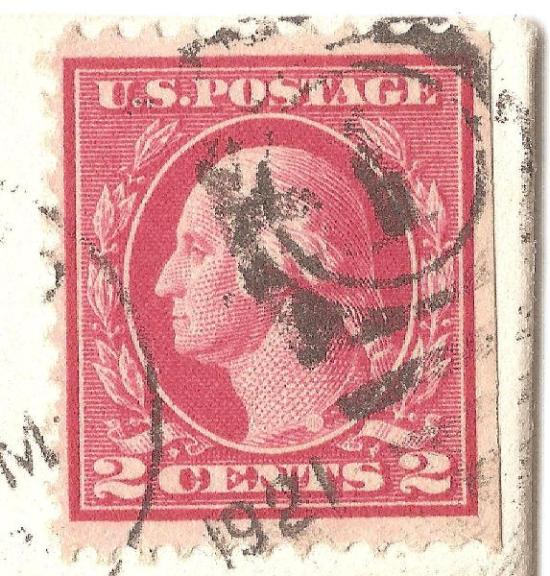 |
|
Send note to Staff
|
|
|
|
|
Rest in Peace
United States
7097 Posts |
|
|
Valued Member
United States
161 Posts |
|
|
Thank you very much for your quick reply! I see what your saying about the toga rope and I do have a few 499s that have similar looking toga ropes; I just thought this one was a little more defined, but I realize that's possible with the Type 1s. After much more studying, with your thought in mind, I've come to the conclusion that it has to be 499.
Thanks for your help! |
Send note to Staff 
|
|
|
Pillar Of The Community

United States
1273 Posts |
|
|
Yep, type one, 1921 cancel date is a pretty good indication that it is a rose or maybe carmine rose #499. Might be a #499e if it measure a bit wider than 19mm in the design east/west measurement.  |
|
Send note to Staff
|
| Edited by Al E. Gator - 03/23/2014 4:09 pm |
|
|
Valued Member
United States
161 Posts |
|
|
Thank you for your input! I just measured it, and it actually measures a bit less than 19mm wide, so I guess its 499. |
|
Send note to Staff
|
|
|
Valued Member
22 Posts |
|
|
I like using the aluminum foil trick to differentiate between foil and offset printing. Believe I got from 1847 USA. As I am a printer by trade, I do specifically know the differences between both styles of printing (and have done both), however, to determine it by eye is almost impossible.
These 2¢-ers have killed me in classification, not to mention the 1¢'s and 3¢'s. But it is a blast nonetheless. I find the most fun looking for the watermark behind a heavy cancel (not).! |
|
Send note to Staff
|
|
|
Pillar Of The Community
United States
1756 Posts |
|
|
themachine99... there's a wonderful book by Martin A. Armstrong which is one of the best identifiers for the W-F's... "Washington-Franklins 1908-1921" by Trenton Publishing originally published in 1979... I have the Second Edition from that same year... I'm not certain if there are any newer editions. It contains very large photos of all of the 2 cent issues which will be very helpful to you, with complete textual descriptions notating all of the graphic details, as well as the corresponding Scott numbers... |
|
Send note to Staff
|
|
|
Valued Member
United States
161 Posts |
|
|
Thanks disi123, the Washington/Franklins are my all-time favorite us stamps. They are so fun to study and identify! I'll keep your book recommendation in mind. Hopefully sometime soon I'll get it. |
|
Send note to Staff
|
|
|
Pillar Of The Community
1545 Posts |
|
|
Quote:
I like using the aluminum foil trick to differentiate between [flat plate] and offset printing  By far the easiest and simplest method. -IBFS |
|
Send note to Staff
|
All science is either Physics or Stamp Collecting. -- Ernest Rutherford |
|
|
Pillar Of The Community
United States
820 Posts |
|
|
So simple, It's pure genius! I put off trying to decipher the different types when I started into this affair. But I now think I may be ready to begin going through the piles of 1 and 2 cent stamps that still need to be identified. I had alll but forgotten about them. Thanks for the reminder. |
|
Send note to Staff
|
Member of the Central Oregon Stamp Club.
Redmond, OR 97756 Mailer's Postmark Permit #1
APS 239403 |
|
|
Valued Member
United States
161 Posts |
|
|
IBFS: I've heard a lot about the aluminum foil trick, but I have no idea what it means, or how to do it. If you (or anyone else) could explain in detail how to do it, I would appreciate it very much!
Thanks in advance!
|
|
Send note to Staff
|
|
|
Rest in Peace
United States
7097 Posts |
|
|
Just lay the suspect stamp on a flat and clean surface and place a small square of aluminum foil on top of it and rub gently. Now look at the foil where it made contact with the stamp and if you see an impression of the design then it is an intaglio/flat plate printed stamp. Offset leaves no design impression. I hope this helps a bit machine. I'm typing on my cell so sorry for any spelling errors. |
|
Send note to Staff
|
|
|
Valued Member
United States
161 Posts |
|
|
Thanks so much ILS! I tried it... very interesting. Flat-plate leaves almost a scratch mark on the foil. |
|
Send note to Staff
|
|
|
Moderator

United States
12330 Posts |
|
|
Bill Weiss web site has a good Washington/Franklin ID tool (its free). He also has just released the Paul Schmid book "The Expert's Book - A Practical Guide to the Authentication of US Stamps Washington/Franklin Issues 1908 - 1923" in PDF format. This long out of print book is a 'must have' for any Washington/franklin lover. You can order it from Bill on his web site http://www.stampexpertizing.comdon |
|
Send note to Staff
|
| Edited by 51studebaker - 06/10/2014 9:27 pm |
|
|
Rest in Peace
United States
763 Posts |
|
|
Thanks Don. Just a quick note - The Expert's Book is currently retailing (I am told) at $150/175. so an eBook at a fraction of that price seems like a good buy! |
|
Send note to Staff
|
|
| |
Replies: 14 / Views: 2,607 |
|




 Posted 03/23/2014 2:43 pm


