Stamp Community Family of Web Sites
Thousands of stamps, consistently graded, competitively priced and hundreds of in-depth blog posts to read


Stamp Community Forum
 
Username:
Password:
Save Password
Forgot your Password?

This page may contain links that result in small commissions to keep this free site up and running.

Welcome Guest! Registering and/or logging in will remove the anchor (bottom) ads. It's Free!

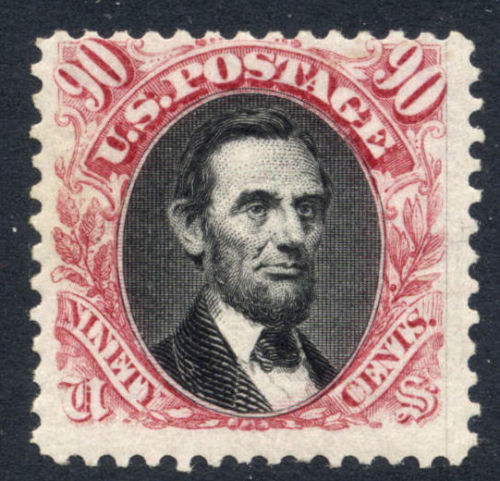
90c Scott 122 Whithout Grill? Forgery?help Me

 
To participate in the forum you must log in or register.
Author Previous TopicReplies: 13 / Views: 2,816Next Topic  
Valued Member

Italy
234 Posts
Posted 04/05/2014   02:23 am  Show Profile Bookmark this topic Add pisti1978 to your friends list Get a Link to this Message
Hello forum
I have this stamp from 90c. grills, the paper is thick and white on the reverse has the rubber wood, I do not like how it sounds like a stamp reprint leave it to you experts for an answer. regards Simone

Send note to Staff

Rest in Peace
United States
7097 Posts
Posted 04/05/2014   04:10 am  Show Profile Bookmark this reply Add I_Love_Stamps to your friends list  Get a Link to this Reply
It looks like a forgery to me. Paper is wrong, no grill and the frame and vignette don't look quite right to me? If it is real, at the very least it has been (very badly) re-perforated! It just looks too crude to me for some reason?
Send note to Staff  Go to Top of Page
Edited by I_Love_Stamps - 04/05/2014 04:18 am
Pillar Of The Community
Learn More...
United States
1493 Posts
Posted 04/05/2014   08:14 am  Show Profile Bookmark this reply Add JLLebbert to your friends list  Get a Link to this Reply
The "paper" appears too thick for a normal 122 and many of the details appear too crude. But maybe it's an essay or proof ...
Send note to Staff  Go to Top of Page
Edited by JLLebbert - 04/05/2014 08:16 am
Bedrock Of The Community
United States
10628 Posts
Posted 04/05/2014   09:02 am  Show Profile Bookmark this reply Add revcollector to your friends list  Get a Link to this Reply
Looks like a perforated card proof.
Send note to Staff  Go to Top of Page
Pillar Of The Community
United States
2953 Posts
Posted 04/05/2014   09:55 am  Show Profile Check Rileysan's eBay Listings Bookmark this reply Add Rileysan to your friends list  Get a Link to this Reply
Nothing but a facsimile or forgery. The stamp doesn't look right at first glance, but when you start comparing details to an original, it becomes obvious this isn't a real stamp. The details are too "muddy", not crisp. It looks like something printed by a copy machine.

Here's a picture of an actual 132 that's on ebay right now.

BRian


Send note to Staff  Go to Top of Page
Pillar Of The Community
United States
6661 Posts
Posted 04/05/2014   12:05 pm  Show Profile Bookmark this reply Add stallzer to your friends list  Get a Link to this Reply
Here is the proof for comparison. Paper will be different since this is on India paper.


Send note to Staff  Go to Top of Page
Valued Member
Italy
234 Posts
Posted 04/05/2014   12:56 pm  Show Profile Bookmark this reply Add pisti1978 to your friends list  Get a Link to this Reply
Hello

thx very much I found an album in 1922 but my suspicion was that it was not good to me and you confirmed.

I put it on ebay for $ 1
Send note to Staff  Go to Top of Page
Pillar Of The Community
United States
6661 Posts
Posted 04/05/2014   6:14 pm  Show Profile Bookmark this reply Add stallzer to your friends list  Get a Link to this Reply
I would confirm what it is first.
Send note to Staff  Go to Top of Page
Rest in Peace
United States
763 Posts
Posted 04/10/2014   12:03 am  Show Profile Bookmark this reply Add Bill Weiss to your friends list  Get a Link to this Reply
Brian is correct. It is a forgery. But let me hasten to add that decent-appearing forgeries of this stamp are not common and collectors of forgeries would probably value this somewhere in the $50/75. range - much more than the usual poor forgeries. Many US Locals, for example, are forged and most will sell for $3/25. range, so a $50/75. fake is collectible. Don't throw it away........
Send note to Staff  Go to Top of Page
Pillar Of The Community
United States
1495 Posts
Posted 04/10/2014   11:12 am  Show Profile Bookmark this reply Add Trainwreck to your friends list  Get a Link to this Reply
On the real stamp and the proof, what's up with that vertical line along the right side of the stamp image?

Thanks, Robert
Send note to Staff  Go to Top of Page
Pillar Of The Community
United States
2953 Posts
Posted 04/10/2014   1:21 pm  Show Profile Check Rileysan's eBay Listings Bookmark this reply Add Rileysan to your friends list  Get a Link to this Reply

Quote:
On the real stamp and the proof, what's up with that vertical line along the right side of the stamp image?

Thanks, Robert


Robert,

I have wondered about this very thing in the past, but you have sparked my interest.

I checked the only reference book I have available to me, the "US Postage Stamps of 1869", by Jon Rose, and can find no mention of the vertical lines on the 90c Lincoln stamps. Not being familiar with the way these were printed, I can only speculate based on what I have observed.

I have observed the following:

1) Looking through all of the pictures in the book, every postage stamp, proof, and essay has these vertical lines that extend above and below the stamp along the right frameline - including the famous unused #132 block of 12. There was one exception - the large and small die proofs.

2) The vertical lines are printed in the same color of the frame of the stamp

3) The vertical lines do NOT consistently align themselves to the right frameline of the stamp. That is, the vertical line can intersect or miss the stamp altogether.

I like to speculate, and this is no exception.

If I were to take a stab at this, I would guess the following -

The plates consisted of 100 dies. Because of the inconsistency of the location of the vertical lines, I would guess that the line did not originate from the dies or plates themselves, but from something on the printing press. The ONLY reason I think this, is that the vertical lines vary in location - either missing, or intersecting the design of the stamp - something that would not be possible if from a die or plate design.

Again, this is just a guess. What it actually is from is gunna keep me awake. Perhaps one of our experts can point me to a better book on 1869s?

Brian
Send note to Staff  Go to Top of Page
Pillar Of The Community
United States
2555 Posts
Posted 04/10/2014   1:38 pm  Show Profile Check sinclair2010's eBay Listings Bookmark this reply Add sinclair2010 to your friends list  Get a Link to this Reply
Those lines are indeed on the plate. They are layout lines.
Send note to Staff  Go to Top of Page
Pillar Of The Community
United States
2953 Posts
Posted 04/10/2014   3:56 pm  Show Profile Check Rileysan's eBay Listings Bookmark this reply Add Rileysan to your friends list  Get a Link to this Reply
I got tired of my ignorance and decided to try to learn a little about the printing of classic stamps. Russ started a great thread on the subject here: https://goscf.com/t/11260

This was all very helpful, but I have some questions.

1) The Layout lines you speak of - were they on the plate for the purposes of aligning the transfer roll to the plate? That is, can I assume that the plates already had layout lines prior to the process of receiving the transfer?

2) I mentioned the mis-alignment of the layout lines along the edges of each stamp. Is this the result of the siderographer - I learned a new word and had to reuse it :) - not properly aligning the transfer roller?

3) Why are the layout lines so prominent on this issue, and not any of the other 1869s - other than those on sheet edges? Same question about other US classic stamps from this era ...

Brian
Send note to Staff  Go to Top of Page
Edited by Rileysan - 04/10/2014 3:59 pm
Pillar Of The Community
United States
2555 Posts
Posted 04/10/2014   10:09 pm  Show Profile Check sinclair2010's eBay Listings Bookmark this reply Add sinclair2010 to your friends list  Get a Link to this Reply
Yes, the layout lines were on the plate before any reliefs were transferred to the plate but they were not used to guide the transfer roll. The guide dots are what was used to place the transfer roll in the correct position. The layout lines were used to place the guide dots in the correct locations. Typically layout lines were burnished from the plate, probably immediately after the guide dots were punched into the plate. Why the layout lines, particularly on the 1869 bi-colored stamps, were not burnished out is an unknown to me.

I think most of the mis-alignment of layout lines that you see is actually the result of mis-registration of the two colors and not the result of sloppy transfer roll placement.
Send note to Staff  Go to Top of Page
  Previous TopicReplies: 13 / Views: 2,816Next Topic  
 
To participate in the forum you must log in or register.

Go to Top of Page

Disclaimer: While a tremendous amount of effort goes into ensuring the accuracy of the information contained in this site, Stamp Community assumes no liability for errors. Copyright 2005 - 2026 Stamp Community Family - All rights reserved worldwide. Use of any images or content on this website without prior written permission of Stamp Community or the original lender is strictly prohibited.
Privacy Policy / Terms of Use    Advertise Here
Stamp Community Forum © 2007 - 2026 Stamp Community Forums
It took 0.35 seconds to lick this stamp. Powered By: Snitz Forums 2000 Version 3.4.05